Navy planning to spend more than $17B on first Trump-class battleship
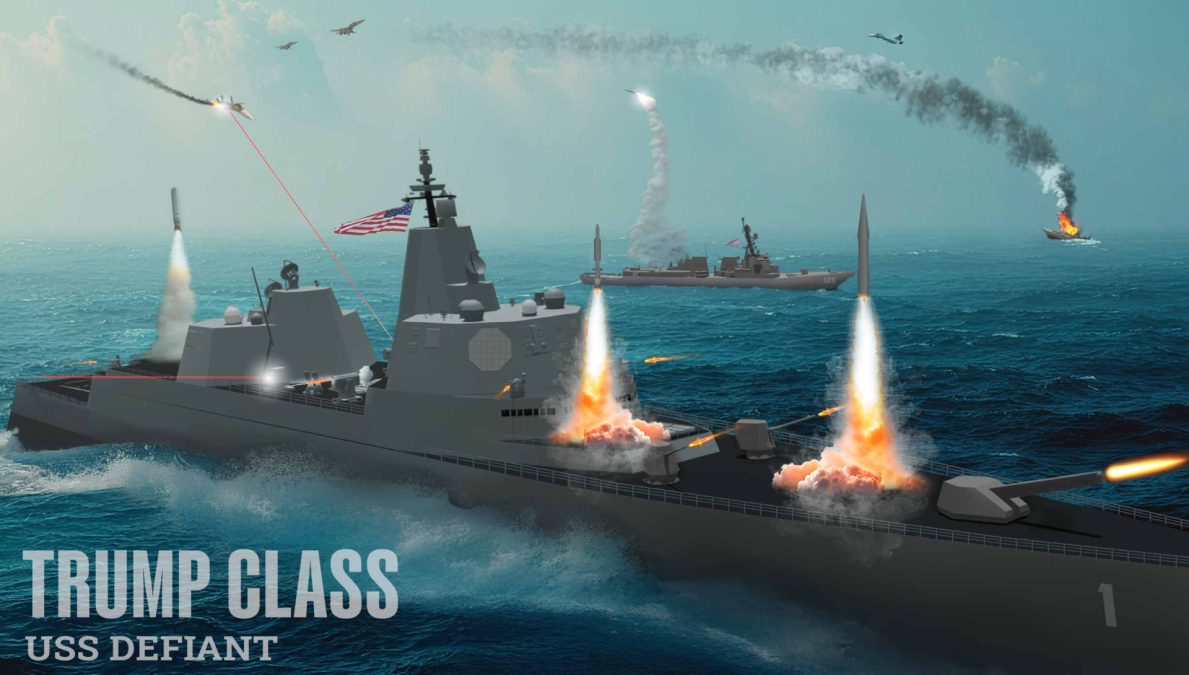
The price tag for the lead vessel in a new Trump-class series of battleships is expected to exceed $17 billion, according to Navy budget documents released Tuesday.
The service’s spending plan includes $1 billion in advanced procurement funding requested for the program in fiscal 2027 and $16.47 billion in net procurement funding for fiscal 2028, when the service plans to buy the first platform. The gross weapon system cost for the lead ship is estimated at $17.47 billion.
The service plans to procure three of the platforms across the Future Years Defense Program, which runs through fiscal 2031. The estimated total net procurement spend for the program during that timeframe is approximately $43.5 billion.
“The Guided Missile Battleship (BBG(X)) program supports the expansion and modernization of the Nation’s large surface combatant fleet, reinforcing maritime dominance,” officials wrote in the budget documents. “The Battleship is based on the validated requirement for high-end surface capability … that cannot be met by current fleet assets.”
The platform is intended to deliver “high-volume, long-range offensive fires” and serve as a command-and-control platform for manned and unmanned platforms.
“Its advanced systems will enable true long-range strike with hypersonic weapons housed in new, larger vertical launch systems. Vastly increased power generation, managed by a sophisticated integrated power system with high-capacity energy storage, will support mission-critical directed energy weapons like high-output lasers and electromagnetic railguns, reducing reliance on costly single-use munitions. Furthermore, its advanced naval gunfire offers cost-effective options for strike and defense, and its capacity to embark a fleet command staff enhances survivability by putting commanders closer to the fight,” per the budget documents.
Officials envision the ship being 840-888 feet in length and having a displacement of 35,000-41,000 tons.
An award for the lead battleship, the USS Defiant, is slated for April 2028, and construction is anticipated to begin in August 2028. The platform is projected to be delivered to the Navy in August 2036.
The second and third vessels in the Trump-class are projected to be delivered in August 2038 and August 2039, respectively. The gross weapon system unit cost for those platforms is projected to be about $13.5 billion and $12 billion, respectively.
“An innovative strategy is guiding the new Battleship’s design and construction, centered on a state-of-the-art digital workflow,” officials wrote in the budget documents. “This utilizes modern digital engineering, AI-enabled design, and advanced production practices to reduce cost and schedule risk. Adopting best practices from Korean and Japanese shipbuilding, the approach emphasizes high design maturity before construction begins, precision modular construction, and tight integration between design and production teams. This digital-first, modular approach allows for distributed construction across the industrial base, with U.S. shipyards focusing on final assembly and integration. The strategy is designed to stabilize the workforce, increase industrial resilience, and deliver the new capability more predictably and affordably.”
President Donald Trump unveiled his vision for next-generation battleships last year. They’re intended to be part of a so-called “Golden Fleet” of new vessels that the Navy aims to field.
During his keynote address Tuesday at the Sea-Air-Space symposium, Secretary of the Navy John Phelan touted the future battleship as a platform that will provide commanders a lot of offensive and defensive options.
“I’ve heard the critiques [that’s] too vulnerable, too expensive, too big. We’ve heard that before about carriers and about submarines, and yet, when it matters most, those are the platforms combatant commanders call for first,” he said.
During a roundtable with reporters on the sidelines of the conference, Phelan said the cost projections in the budget documents are “the early initial estimate.”
“We’ll see where we really settle down as we get through that and start to rationalize some of the costs. So let’s see where we land on that first ship, and then what the economies of scale get us to as we move through it. But I think it is a necessary element to the force … and I think it provides real flexibility to the force. And I think a little bit with those numbers, they’re still moving around because there’s a question, is it nuclear powered, is it not nuclear powered?”
The Navy is still figuring out the propulsion system, he suggested, saying it’s “unlikely” that the battleship will be nuclear powered, but “it could be.”
“I think we’re trying to understand all the proper tradeoffs,” Phelan said.
Earlier this year, Chief of Naval Operations Adm. Daryl Caudle said the battleship won’t be nuclear powered.
DefenseScoop asked Phelan at Tuesday’s roundtable if he had any concerns about the industrial base’s ability to handle the battleship program in terms of their shipyard capacity, workforce and capability to integrate new high-tech weapon systems.
“I think it’s a fair question,” Phelan replied. “We are looking at a couple of different ways to relieve some of the pressure that might put on the industrial base. … I think that we have to still define that a little bit more until we get there.”
With regard to the advanced weaponry that the Navy plans to add to the platform, the SECNAV noted that the service has previously worked on railguns, but “kind of abandoned it,” and it’s been testing directed energy systems “in theater.”
“These are all things we have to get better at and need to do. So I think it’s just making sure that we’ve got the design down in an appropriate fashion, pretty locked down, and then making some tradeoffs as we decide where to build that ship, when and how. And I think, you know, what we’re looking at more is this distributed shipbuilding and modular, and I think that is a way to tackle that issue,” Phelan said.
“We have been talking to two different vendors as we speak right now, and then it’ll be a function of how we get through that design process with them, and then their capacity in their yards, and what we think they can do, because we’re looking to really get moving on this and lay the keel by ‘28 on the first one,” he told reporters.