Army looking to expand its new space operations branch amid increasing demand for capabilities
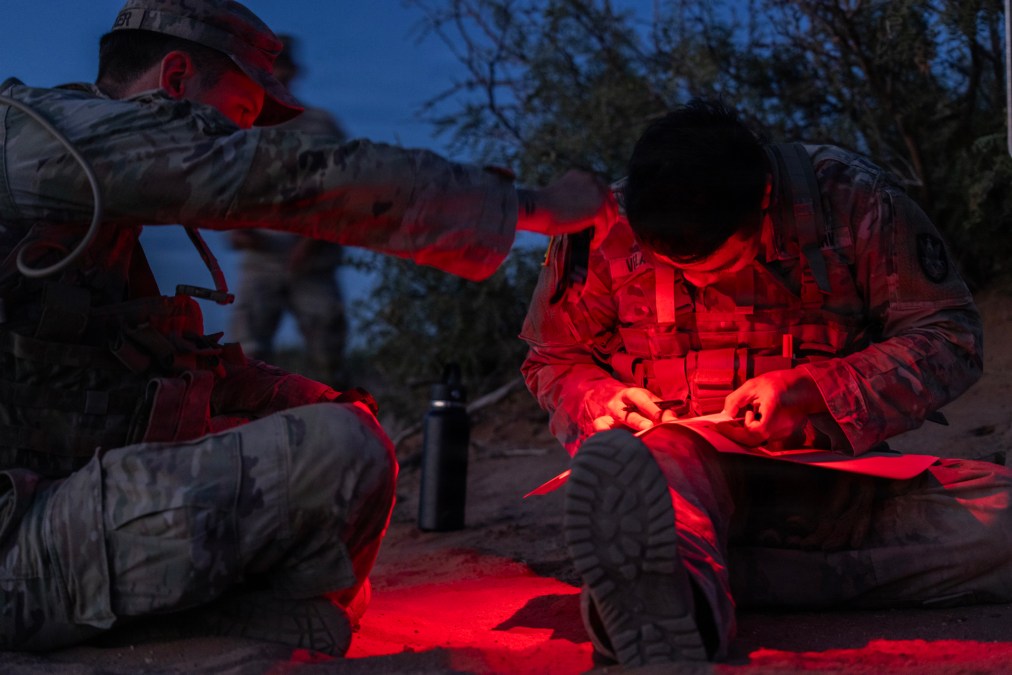
The Army is positioning itself to grow its space-related capabilities over the next year as officials face a growing demand for those types of assets to support military operations.
The service’s June launch of a new Space Operations Branch “was a recognition of the increased not just reliance that the Army has on space as the biggest customer of space for, you know, everything from precision, navigation and timing to communications to intelligence, … but also recognition that space enables multi-domain operations and Army space sets those conditions for the joint force to exploit,” Lt. Gen. John Rafferty, commanding general of Space and Missile Defense Command, told reporters Wednesday during a media roundtable on the sidelines of AUSA’s annual convention.
Command Sgt. Maj. Rickey Jackson noted that SMDC is going through major structural changes.
Earlier this month, more than 600 soldiers were reclassified to the new 40D Tactical Space Operations Specialist billets.
“The Army really helped us with that in providing feeders, which were from the intel community, our communications community, and our air defenders were the primary feeders into the Space Operations Branch. Now, as we continue to evolve, we open this up to the entire Army to have an opportunity to come over and be space operators,” Jackson told reporters at Wednesday’s roundtable.
“We wanted to make sure we brought the right people. So, as we boarded across our Army … we wanted to make sure we had non-commissioned officers that had experience to be able to come in and execute right away,” he added.
SMDC has been moving to fill roles in the new branch while allowing for future expansion, Jackson suggested.
“Even though there was a marker that we wanted to meet, we didn’t select everyone, and we left room for growth so that we do have that pipeline to be able to grow,” he said.
“In the beginning, there was a target number, and because of the interests across the Army, that number grew, right, almost doubled in size, which is a good problem to have. And just to give you a marker, we’ll use sergeants major just for an example, I’m authorized nine and I only filled … five. [That] just gives me an opportunity for master sergeants to grow talent into those billets, and gives us an opportunity to kind of view out what critical positions we want to fill in the future with the right people versus just putting people in. So that’s an example of how we look at talent, and then how we can grow into positions across the command,” Jackson said.
The Army projects that there will be nearly 700 (40A) officers and 1,000 (40B) enlisted soldiers in the branch by the end of fiscal 2027, according to a fact sheet.
“We’re focusing across the Army and messaging and campaigning to bring in more of our junior soldiers. So that’s where I need to provide a little bit more effort,” Jackson said.
Two of the Army’s key contributions for military space operations include capability integration to enable Army and joint ops on the ground and “interdiction” of adversary assets with electronic warfare systems, according to officials.
“In the Pacific, for example, we have space capabilities that we’re going to operate in the first and second island chain that need to be able to provide survivable capabilities to interdict adversary use of space,” Col. Joseph Mroszczyk, director of TID-Space Superiority at SMDC, told reporters at Wednesday’s roundtable.
He likened soldiers’ ability to target adversaries in the space domain to their ability to target ships at sea with land-based assets.
Mroszczyk also touted the Army’s planning contributions to the joint force.
“That’s a big aspect of some of the formation growth that we’re bringing is not just in the actual weapons platform, but on the space control planning teams and our ability to integrate that capability. That’s something unique to 1st Space Brigade, where we have space control planning teams and space control planning sections who perform the planning and the current operations function for space interdiction,” he said.
SMDC serves as the Army service component to U.S. Space Command, which is one of the military’s combatant commands.
“The role that the Army plays in the space domain is distinct from what the Space Force guardians do. You know, primarily they’re focused on ensuring that our nation maintains space superiority, and what we want to do is bring those space capabilities to bear in the tactical environment. So, we work very closely together and often under the authorities that [Spacecom boss] Gen. [Stephen] Whiting and his command has, but we’re focused … on enabling joint operations on the ground,” Rafferty said.
Amid the conflict with Iran, a significant portion of the Army’s space forces are forward deployed to the U.S. Central Command area of responsibility in the Middle East, according to the SMDC chief.
“We have, you know, space control companies and then space support planning teams … that are integrated into multiple echelons of commands forward. So, we have Army space that’s embedded working with Centcom, working with U.S. Army Central. There are, you know, space support element that’s in the 82nd Airborne Division that’s organic to that. So, space is really, you know, embedded in every single echelon there,” Rafferty told reporters.
The Army space community is also growing its formations, Mroszczyk noted.
The service’s 4th Multi-Domain Task Force stood up last week at Fort Carson, Colorado. That unit will be focused on the Pacific region where China is viewed as a strategic competitor.
“That formation includes a space control company within that MDTF. So that’s additional space capacity for the Army that’s grown just this year, and that’s going to continue to get up to full operational capability,” Mroszczyk said.
The Army is also setting up a Theater Strike Effects Group.
“By next year at AUSA, we expect that there will be some formation out there in the Theater Strike Effects Group that is supporting U.S. Army Pacific and again growing capabilities for space interdiction to meet the demand,” Mroszczyk told reporters.
Officials see a role for soldiers in supporting high-altitude operations at 60,000-100,000 feet.
“What I’m pushing for is a family of stratospheric systems that really covers smaller size all the way up to larger size types of platforms in terms of balloons, and what that enables us to provide is space-like capabilities, really exploiting a transition point between what is normally considered the aerial layer and the space domain,” Mroszczyk said.
Such systems could carry payloads for sensing, communications or extending the military’s “launched effects” portfolio, he noted.
Multiple experiments are expected to be conducted over the course of the coming year, he told reporters.
Mroszczyk noted that there will also be command-and-control experiments at the Project Convergence Capstone 7 event next year.
“We’re also working on a virtual space training environment that complements that, that allows us to be able to do live, virtual and constructive [training] … moving forward to help train our warfighters in that environment. And we’re building the virtual space layer to be able to visualize and understand how space effects can play in modern multi-domain operations,” he said.
Rafferty suggested that he expects SMDC to continue to evolve.
“We anticipate when we get together next year that we’ll have maybe some growth to talk about and some new capabilities that have been fielded. We won’t be the same next year as we are today,” he told reporters.