Space Force aims to beef up guardian presence for Centcom and other combatant commands
Space Force leaders are aiming to scale up the number of guardians supporting combatant commands in the coming years as part of a plan to enhance the provision of space capabilities for joint force operations.
In a notice to troops published last week, Chief of Space Operations Gen. Douglas Schiess stated that the service must boost its arsenal and capacity.
“As members of our nation’s Armed Forces, we must continue to arm and grow our service to defend the Joint Force from space-enabled attack while simultaneously providing space capabilities to enable Joint Force combat power. We must do our part to make the Joint Force lethal, while defending our domain, which includes operating on-orbit weapons. This means we acquire and deliver the right technology while ensuring we Guardians train the way we will fight, all to guarantee we deliver mission success for our Nation,” Schiess wrote.
The Space Force is adding new weapons to its inventory. For example, the service anticipates having up to 56 Meadowlands satellite jamming systems “dispersed throughout the world,” according to an RFI that was recently posted on a government contracting website.
Schiess also called for integrating guardians “at scale” at combatant commands to increase capacity and capability.
“We have proven that spacepower produces battlefield success. This means providing effective and well-equipped space forces, in the right quantities, to combatant commands on the front lines, staying ahead of threats through rapid acquisitions, and bringing space expertise directly to the fight no matter where it is. The Space Force needs to continue refining how we generate, embed, and sustain combat-effective Guardians and capabilities across the Joint Force. Likewise, the Joint Force must have enough Guardians in key positions to achieve space superiority and drive combat success,” the CSO wrote in his notice to service members.
Earlier this month, a Space Force component to U.S. Special Operations Command, dubbed SPACEFOR-SOC, was activated.
“While space capabilities are already integrated into USSOCOM missions, this activation institutionalizes how the Space Force organizes, trains, equips and presents forces for the special operations enterprise, placing SPACEFOR-SOC alongside sister service SOF components,” officials wrote in a press release, calling the activation “another milestone in the Department of War’s ongoing effort to establish Space Force service components within combatant commands, ensuring space effects are fully operationalized across every domain of modern warfighting.”
(The Department of War is the Trump administration’s preferred name for the Department of Defense.)
The Space Force also has service components integrated with U.S. Space Command, Indo-Pacific Command, Central Command, European Command, Africa Command, Northern Command and Southern Command, as well as U.S. Forces Korea and U.S. Forces Japan, according to the release.
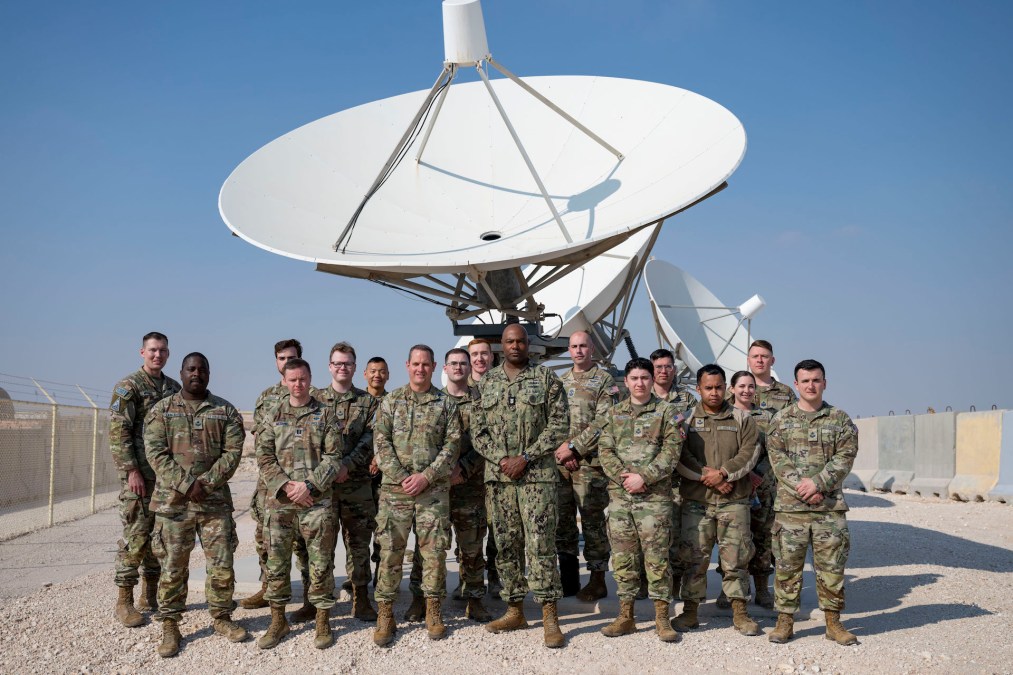
Space Forces Central — a service component for Centcom, which oversees American military operations in the Middle East — is another example of an area where officials are looking to grow.
SPACECENT is headquartered at MacDill Air Force Base in Florida and has elements in Centcom’s area of responsibility.
“The Space Force definitely needs to double in size, and I’m looking forward to that. I think from a component standpoint, I would see increased growth beyond that. Our staff started out with just a few people — literally less than 10 — a few years ago, and we haven’t grown much greater than that over time. But we have to do those staff functions that headquarters needs to do. And right now, it’s … all hands on deck. Everybody’s pitching in, and we’re all jumping in on every problem we can. But I would like to get to some sort of steady state headquarters staff structure, and that’s where I see us going over the next about three years and we’ll have that standard headquarters size and strength that you see,” Brig. Gen. Todd Benson, commander of SPACECENT, said during a Mitchell Institute for Aerospace Studies event Monday.
“It doesn’t matter what service you’re with or what component you do, the expectations are the same. You have to present combat-credible forces, and you have to lead joint forces in combat. That takes size to do that,” Benson said. “So, we have to get to that point, and I think we will in the next few years.”
He added that he’d like to see SPACECENT grow “fivefold.”
“That’s what we need to make sure that we have the requisite staff to do planning cycles, all the intelligence that we need. Never underestimate the value of having the right intelligence professionals on your team in the right quantity. That is something I really want to continue to grow. And then also we have cyber operators and professionals on our team, equally important for our piece. So, I would see us growing about fivefold in our component,” Benson said.
SPACECENT provides planning, coordination and execution of space operations for Central Command and the joint force. Some of the critical capabilities that it brings to the table are communications, precision navigation and timing (PNT), missile warning, and “offensive and defensive operations” when the combatant commander sees fit, Benson noted.
“We want to ensure that the adversary cannot use their space capabilities. We want to deny, disrupt, or destroy what they have,” he said. “Having a component dedicated to getting after an adversary’s space capabilities is a new thing. So that is the major shift, right? We’ve gone from … a traditional supporting role, to one where we not only support the joint force, but they also support our objectives as well.”
Space will be a part of every major military operation going forward, Benson predicted.
Historically, those types of capabilities would be an “add-on” or “side dish,” he said, but now they’re being integrated into military planning from the get-go.
“The inclusion of all domains together and us helping each other out is fundamentally a shift that we are starting to see and execute in Centcom this last year, and it’s really paying off,” Benson said.
“What we’re able to provide to the joint force with an absolutely small amount of personnel — I didn’t expect it to be as powerful as it was. I knew it was good, but what the guardians are doing today, I think, is phenomenal,” he added.
Centcom has played a leading role in American military operations against Iran, including during Operation Midnight Hammer last year and Operation Epic Fury this year.
Benson noted that the SPACECENT team has been busy lately.
“There’s a couple components to that. One is the headquarters itself. We start out very early with a lot of planning. We sync up with [Centcom commander] Adm. [Brad] Cooper and the other components, and we go over our plan for the day or any big things that might have changed overnight. And then we’re rolling right into our execution of operations. We’re doing operations every single day, multiple times a day, so there’s not a lot of idle time, and if you’re downrange … your teams are working 24/7 missions” he said.
“Most of them are working 12-hour shifts plus time on each side for changeover, and then … trying to get some fitness in. Usually during the day when you’re not doing live operations, we’re doing all kinds of drills. You have your body armor ready to go, you’re practicing that you can get to a safe place. That is a pretty standard day. There are no days off, really, downrange. Everybody’s working as hard as they can and just trying to deal with things like the elements of weather, and ops tempo, [and] making sure everything’s maintained. … So, it’s a pretty nonstop, difficult job,” he said.
Some people outside the Space Force have a mistaken belief that guardians aren’t deployed overseas, he noted.
“We’re in harm’s way. We’re fighting forward, displaying tons of courage,” Benson said.
“I still hear it today that people don’t think that we deploy. … Some folks will even say, ‘You don’t deploy-deploy, do you? … Because they’re picturing us in some sort of safe and secure operations center with walls full of TV screens. And we have guardians all over the world. We have those that are here in the United States providing invaluable capability, but we also have some that are downrange,” Benson said. “We are in austere environments, wearing our body armor, taking fire, returning fire. We are sometimes on the very front of the front lines.”
He highlighted the rescue of an American airman who was downed in Iran earlier this year as an example of SPACECENT’s contributions to joint operations.
“We have access to just about every type of information you can think of, so I got to watch that live and unfold. And you get goosebumps on the back of your neck as Dude 44 [the rescued airman] came out and started getting towards the helicopter and getting loaded on. What was interesting are the effects that we provided, provided extra time for that rescue team to do what they needed to do. And I know without a shadow of doubt, without that the outcome could have been completely different,” he said. “Those are the moments where you get a lot of pride and those opportunities to see our guardians in action.”
In addition to adding personnel, the Space Force aims to acquire new tools to help guardians do their jobs more effectively.
Benson noted that artificial intelligence capabilities could come in handy.
“AI is important. And to be specific, you know, machine learning, being able to have things sift through so much data,” Benson said. “We’ll find as we go forward and you get more and more sensors and collectors, that being able to make sense of all the information is something that … no amount of humans could ever do. So, AI will be most pivotal in being able to distill information to the things that are actionable. And that’s where I would be looking to leverage AI going forward.”