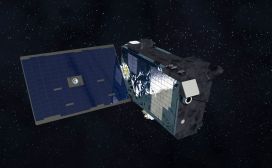
Pentagon launching mission operations center for Space Data Network to support Golden Dome and other modernization efforts

The U.S. military is launching a mission operations center for the Space Data Network Backbone program that’s expected to advance top modernization priorities, such as the Golden Dome missile defense architecture and other systems that depend on digital connectivity.
The Space Force’s Space Systems Command announced the move Thursday, noting that Viasat has been awarded a “competitive” IDIQ contract worth up to $450 million to support network and mission system integration. The company received an initial task order valued at $115 million to design, field and scale the mission operations center.
“The MOC will bring together mission integration, network operations, and data transport management across a growing multi-vendor architecture, helping SSC’s Space-Based Sensing and Targeting (SBST) portfolio field an operationally integrated capability,” according to a Space Force press release.
“As the central integration hub for orchestrating mission systems across multiple constellations and providers, the MOC strengthens the foundation for secure, resilient, high-capacity connectivity support for warfighters across air, land, sea and space domains,” per the release.
The Space Data Network is expected to include a multi-orbit satellite constellation and a hybrid architecture that includes both military-owned and commercial payloads built by different companies to provide high-speed data transport and tactical communications to the joint force.
Earlier this year, the Pentagon awarded SpaceX a $2.3 billion contract to deliver a fully operational prototype of the SDN’s “backbone” by the end of 2027. That technology is intended to enable backhaul communications across the Defense Department.
In August, the Space Force tapped Amazon LEO for Government, Lockheed Martin, Northrop Grumman, Rocket Lab and York Space Systems to demonstrate ground-to-space and space-to-space data transport across vendors’ systems, and develop and field space exchange point (SEP) payloads.
The ground component of the SDN Backbone program is expected to enable dynamic data management via real-time priority routing and boost connectivity for military users across the joint force.
Space Force Lt. Col. Alexa Eggert, materiel leader for the SBST SDN Backbone program, said in a statement that standing up the mission operations center is “a crucial step in maturing our Space Data Network into a fully operational, multi-vendor capability.”
The press release did not disclose where the MOC will be built.