HDUSA wants to replicate South Korea’s ‘war footing’ industrial capacity in America

Hanwha Defense USA executives hosted a “supplier day” during the Army’s annual AUSA summit last week, where they met with dozens of companies to review in-demand technology and weapons components that can be sourced domestically and the most promising places to expand local production capacity.
“We had 70-something suppliers at our event,” HDUSA’s CEO and President Michael Coulter told DefenseScoop. “And they were all American.”
In an exclusive interview on the sidelines of the conference, Coulter shared new details about the company’s plans to fuse overseas manufacturing approaches to help revitalize the U.S. defense industrial base.
Headquartered in Arlington, Virginia, HDUSA is a subsidiary of South Korea’s largest defense corporation, Hanwha Aerospace.
HDUSA makes and delivers land, maritime, missile, and munitions platforms for the individual military services and joint force — with a sharp focus on localizing U.S. production capacity and onshoring advanced South Korean defense technologies. The company operates in America as a foreign-owned defense entity that holds a Special Security Agreement with the Department of Defense.
Under that SSA framework, HDUSA can bid for sensitive DOD and military contracts through an independent U.S.-cleared team, bypassing foreign ownership concerns.
The Pentagon has been hustling to overhaul its weapons purchasing and adoption processes since the start of the second Trump administration. Late last year, Defense Secretary Pete Hegseth initiated multiple regulatory and procurement reforms to transition the U.S. defense industrial base to what he called a “wartime footing.”
“Korea has been on a war footing for many, many years,” Coulter said. “So, if you visit our shipyards, our artillery campus, or our munitions campus, what you see is a defense industry that is built for war, and we believe that’s what the U.S. has been asking for.”
The CEO added that Hanwha’s overarching intent is to become “a global, multi-domestic defense company — not just by selling out of Korea — but by creating that same capacity in the United States.”
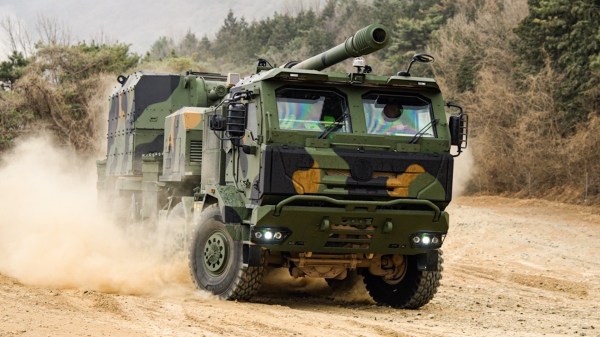
In September, HDUSA unveiled plans to stand up a new advanced manufacturing campus at the U.S. Army Pine Bluff Arsenal in Arkansas as part of a capital investment worth more than $2 billion. News emerged at AUSA that the Army was officially ordering nine prototype wheeled “XM1776 Mobile Tactical Cannon systems.” The platform’s name was revealed during last week’s Army summit.
The XM1776 is a U.S. variant of Hanwha’s K9 mobile howitzer.
“We have the most proliferated tracked howitzer in the world. Every country on the Eastern Flank of Russia has it,” Coulter told DefenseScoop. “They like it because they know it’s going to be delivered on time. The cost is right. They know it’s reliable. And the force that we have in Korea is largely a conscript force, so it needs to be really easy to use.”
While the Army was initially interested in buying the tracked howitzers, its preference over time shifted to a wheeled version. According to Coulter, the project moved from those talks to the launch of a complete prototype in 12 months.
He indicated that, in some ways, the pivot reflects lessons captured amid the ongoing war in Ukraine.
“If you fire, you’re going to be targeted very quickly. The battlefield is becoming visible — particularly with drones and sensors — and so you need to fire and move, and fire and move, and you need to fire fast,” he said. “What this brings that our competition doesn’t bring is an extended range so you can fire from further away, hugely expanded, like, quadruple the capability to deliver munitions, and then the ability to fire and move very quickly.”
The nine XM1776 prototypes ordered by the Army are now on Hanwha’s hot production lines in South Korea and the Czech Republic. But to move into a full program of record and scale across the service, the mobile tactical cannon systems must be entirely made in the United States.
“Already about 40 to 50% of the vehicle is American,” Coulter said.
He confirmed that the company would be working directly with the Army and U.S. manufacturers in the near term to build out the domestic supply chain for the XM1776. The “supplier day” that unfolded during AUSA was part of those onshoring efforts.
When asked about Hanwha’s exchanges with more than 70 American businesses at that event, Coulter said officials involved discussed the components of the system that still need to be produced in the U.S. — and where around the nation those products could be sourced or built.
Beyond its Army contracts, HDUSA is also significantly expanding its footprint across the U.S. Navy. The firm purchased Philadelphia’s historic Philly Shipyard in late 2024 and has been developing uncrewed maritime platforms with commercial AI partners.
In Coulter’s view, Hanwha’s path ahead for DOD reflects the second Trump administration’s “bridge strategy.”
That plan aims to meet the military’s urgent needs with existing and trusted international supply lines, while simultaneously building out comparable manufacturing capacity across America as fast as possible.
The approach is also expected to give the government more flexibility to ramp up production in either country if a regional crisis disrupted the other one.
“So, if it’s ships, or if it’s artillery, or if it’s missiles and munitions, we have the ability to refill stocks now out of Korea,” Coulter told DefenseScoop. “But the intent of the company is to replicate the capacity that we have in Korea in the United States.”