Hanwha captures Army contract for mobile tactical cannons and expects to deliver first prototype this fall
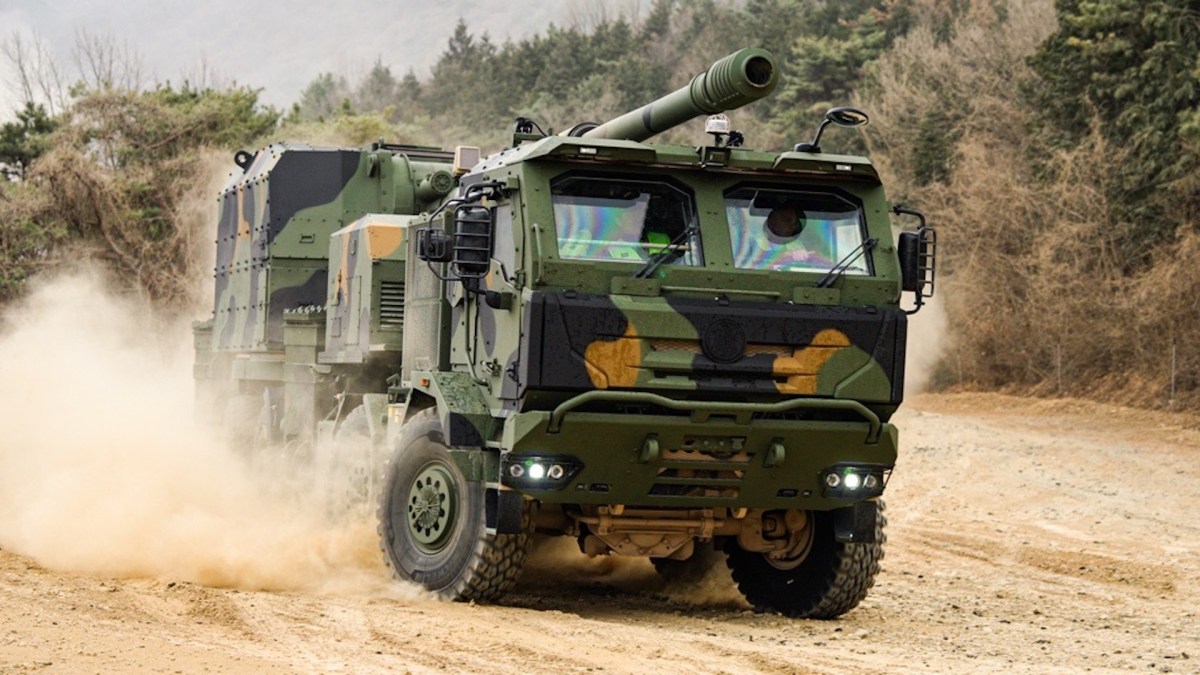
The Army has awarded Hanwha Defense USA, a subsidiary of South Korea-headquartered Hanwha Aerospace, $100 million for mobile tactical cannon prototypes as part of a deal that could be worth up to nearly $263 million.
The service announced the other transaction agreement, which has an estimated four-year period of performance, Tuesday evening.
The move represents a confluence of two Army goals: boosting its long-range firepower for modern battlefields and expanding the defense industrial base.
Hanwha Defense USA noted that the deal for its K9 Mobile Howitzer to support the service’s new Mobile Tactical Cannon program is the firm’s first major contract award from the U.S. Army.
Under the agreement, the company is expected to deliver six prototype systems to the Army, which has an option for 12 additional platforms.
“Soldiers will use these platforms in a series of operational experiments to assess performance, reliability, and supportability in realistic combat conditions. This Soldier-centric, experiment-driven approach reflects the Army’s continuous transformation initiative to rapidly deliver lethal capabilities, incorporate immediate Soldier feedback, and adapt the force to pace emerging threats in multi-domain operations,” officials wrote in an Army press release.
In the early stages, Hanwha intends to use its production capacity in South Korea and a new integration facility in Opelika, Alabama, to support the effort.
“Battles are won through platforms and combat capability, but wars are won by industrial capacity,” Mike Smith, Hanwha Defense USA’s chief operating officer and president of land systems, told DefenseScoop during a media roundtable Wednesday to discuss the way ahead.
“What is the product that Hanwha is providing? It’s not just that mission capability or the operational capability that a K9 brings you. It’s also the munitions, the charges, the full-up rounds, the integration, and then the industrial capability to produce those systems on our own here in the U.S. So you’ll see over time, you can almost think of two waves: one wave that it’s starting to rise, and that’s the production in the U.S., and a wave that starts to kind of subside a little bit, and that’d be the production in Korea. There are certain things that we want to keep in Korea, however, and we’re working through that. But you know this is going to be a U.S. product. So when we think about jobs, jobs will be measured in the hundreds. And yes, we’re looking at multiple locations potentially for full-rate production,” Smith said.
The full-rate production run, if the Army decides to go in that direction, could end up at nearly 500 MTC systems, he suggested.
If approved for fielding, the Mobile Tactical Cannon will replace M777 towed artillery in “select formations,” according to the Army. The service noted in a press release that it wants a system that significantly increases units’ “lethality, mobility, reliability, and survivability on the modern, highly transparent battlefield.”
Hanwha’s new integration facility in Opelika is expected to be “fully operational” in early fall, Todd Mueller, the company’s executive director for fires capture programs, told reporters during Wednesday’s roundtable, adding that an engineering and program management center will be set up in Huntsville, Alabama.
The first prototype vehicle is slated for delivery in “early fall,” according to Mueller.
The other five initial prototypes that are included in the deal will be provided within a year of contract award. Those systems will be built in South Korea and sent to Opelika for final integration work, he said.
“That’s to help the Army meet its objectives near-term, while in parallel we establish our domestic presence and position for production in the U.S. following” that effort, Mueller told reporters.
Hanwha anticipates working in partnership with the organic industry base and other industry partners, Smith said, including traditional contractors, non-traditionals and “some folks who probably are coming in from a very commercial side of the of the spectrum.”
“It’s not going to be just Hanwha investing. There are a number of companies that want to be a part of this important effort, and you’ll see those announcements just coming out over the next few months,” he told reporters.
Hanwha produces a family of K9 vehicles.
“We have the baseline K9 evolved into the A1. We have the K9A2 coming online, and that’s where the similarities really reside between the K9 Alpha 2 and the K9 Mobile Howitzer. So it’s essentially … a minimally modified K9A2 turret. It pulls forward all the technology and the ammo handling system from the K9A2, and it pulls it into a … truck-agnostic design package,” Mueller explained.
“We really worked hard to leverage [and] protect the maturity of the technology we’re pulling off of the track chassis by isolating our integration risk and focus to the interface between the chassis, but not marrying ourselves to a chassis,” he said. “It’s been a really delicate balance on the engineering front. I think we’ve done a really good job of it, but it’s protecting the maturity of the systems that we’re pulling from as we roll them into a new but also flexible package going forward in terms of the wheeled chassis.”
Jason Pak, the company’s senior director for business development in the land systems sector, emphasized that the K9MH architecture is “vehicle agnostic.”
“What we have demonstrated to date has really shown the maturity and flexibility of pairing the K9 turret and that gun system on an 8-by-8 chassis,” he told reporters during Wednesday’s roundtable. “When you talk about … the longer term, you know, configuration, we’re absolutely going to be working side-by-side with the customer in the Army to decide what that looks like. But it is currently offered as that baseline configuration with this initial prototype award.”