Army turning to AI in its fight against biological threats
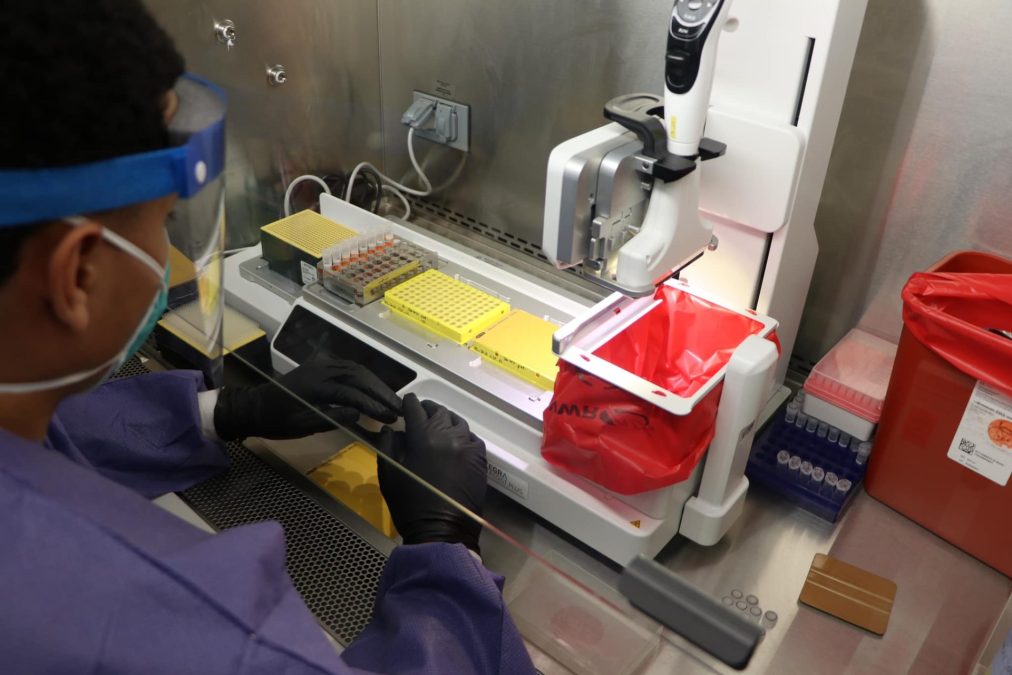
The Army is moving to combine environmental, clinical, logistics, chemical, biological and intelligence data with artificial intelligence to identify unseen and emerging disease outbreaks before they can spread widely or harm the force.
Senior officials who developed the 2026 Army Biodefense Strategy discussed their new approach to operationalizing security measures against biological threats during a media roundtable Monday at the annual AUSA conference.
“There’s a lot of data involved in doing bio-surveillance and sort of figuring out when that threat rears its head early enough to do something about it. And so, we are looking very heavily toward how we leverage AI to help us integrate and sort through that data,” Dr. Alison Tamasi told DefenseScoop.
Tamasi serves as chief of the Survivability and Effects Analysis Division at the U.S. Army Nuclear and Countering Weapons of Mass Destruction Agency.
She noted that, compared to the prior biodefense strategy released in 2021, this new plan marks “a big pivot” for the service in that it transforms biodefense from a more localized medical or chemical specialty into an integrated, “whole-of-Army” operational priority.
“We are confronting a volatile technological convergence where advanced biotechnology and artificial intelligence are dramatically lowering the barrier to engineering biological weapons. Our adversaries view these agents as tools to degrade our logistics, paralyze our mobilization and deployment, and erode our combat power. This is a strategic threat to our nation’s ability to respond to a crisis,” former Army Secretary Dan Driscoll wrote in the document’s foreword.
At the roundtable, the senior officials emphasized that the Army is taking steps to ensure that its own strategy can be quickly and fully integrated with the overarching approach that the Defense Department is taking towards biological surveillance and defense.
They suggested that the Office of the Secretary of Defense has an “imminent biodeterrent posture that will come out” in the future.
“The Army is sort of the first service that came out ahead and led the way on having a Biodefense Strategy, but that doesn’t mean that we’re doing anything in a vacuum,” Tamasi said.
Lt. Col. David Kingery, who led the strategy’s development as the Army’s senior biodefense advisor, added that coordination with the rest of the services and the department is “extremely important” to ensure that authorities are met and data systems are interoperable.
“There is an effort to pull the multiple different data streams and use AI [and machine learning for] predictive analysis to help us speed the early analysis, always using [a human] in the loop,” Kingery told DefenseScoop.
Heaps of data sources — from environmental monitoring, compliant medical and clinical information, intelligence resources and more — will be integrated to support biodefense work.
“We recognize that all of the wonderful things that are happening in AI to accelerate biomedicine are dual-use problems, and so we are very much doing it from that lens of the fact that the threat could change very rapidly in the biomedicine space,” Tamasi said.
She told DefenseScoop that there is not an offensive angle to the Army’s strategy.