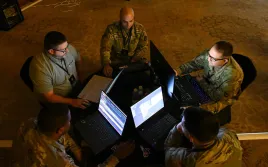
Pentagon elevates AI as a ‘fundamental requirement’ for cybersecurity staff training

The Pentagon is adding artificial intelligence as a mandatory training requirement for its cybersecurity workforce, according to Mark Gorak, who serves as the director of its cyber academic engagement office and principal director for resources and analysis in the Office of the CIO.
Gorak shared new details about the Defense Department’s ongoing efforts to confront modern shortages in cybersecurity personnel and plans to make AI a foundational skillset for those officials, during an onstage presentation at the FedTalks summit, presented by FedScoop, on Tuesday.
“All of our cybersecurity [roles] are now going to have AI as a fundamental requirement in training,” he told the audience.
The DOD’s integration of AI training into its cyber workforce standards comes as U.S. adversaries are increasingly applying powerful algorithms and models to automate reconnaissance, discover zero-day vulnerabilities and scale social engineering, and presenting other digital threats.
It also comes as the Pentagon is pivoting to test potential incoming cybersecurity candidates in relevant environments and on tasks that are necessary for the roles — rather than hiring individuals primarily based on their resumes and credentials.
“I don’t want your pedigree. I don’t care about your education or your 30 years of experience. I want to know if you can do the job today, so I’m going to put you in a cyber range. I’m going to test everything that’s required of that specific job role,” Gorak said. “And, by the way, you put a strict timeline on it. Use AI to help you. You’re not going to finish in 30 minutes, right? So, skills-based hiring is where we’re going.”
The Pentagon is moving in this direction at a time when the department is hustling to fill major gaps across its cyber workforce. He said there are now 79 defined cybersecurity positions at the department, which marks an increase from 76 last year.
“We’re short 24,000 people. Think about that number — I know a lot of companies in here aren’t even that big — that’s how I’m short, out of about 240,000 total in my cyber workforce,” Gorak noted. “[But] I think this is a national challenge. How do we get the workforce we need for the future?”
He listed some of the steps DOD is taking to do exactly that, including the shift in focus to skills-based hiring, a prioritization of AI in training and rotational programs with industry.
“Also, I want to announce we have our cyber workforce summit [on] April 7 to 9, right here at [National Defense University], downtown,” Gorak told the audience. “So, please join us for that.”