Army cyber chief reveals AI task force building agents to ‘hunt’ in the DOD network
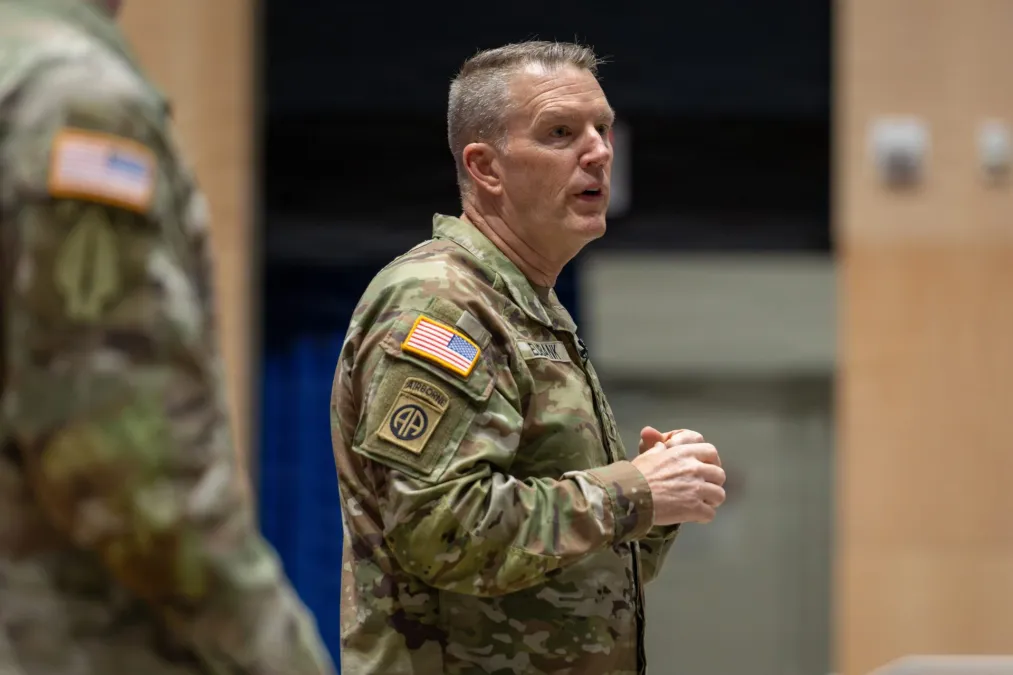
AUGUSTA, Ga. — The Army’s top cyber officer revealed Wednesday the existence of a new task force dedicated to exploring the use of artificial intelligence in the service’s cyber command, from simple staff processes to agents “hunting” in the Department of Defense Information Network (DODIN).
Task Force Lexington was established in April and charged with creating AI agents for different cyber work roles, including developers, data engineers, host analysts and exploitation analysts, according to Lt. Gen. Christopher Eubank, head of U.S. Army Cyber Command.
“You name the work role, we’re creating,” he said. So far, ARCYBER agents have taken on red team roles and the command now employs 17 agentic mission elements and cyber protection mission elements that scour the DODIN every day.
The revelation comes after a string of high-profile disclosures from top AI companies that agents escaped their sandboxes to hack other organizations, sending shockwaves across the cybersecurity world and raising fresh alarms about guardrails around the disruptive technology.
“Each and every day, we sit down as a group, we figure out the guardrails we’re going to apply to these agents, [and] we ask ourselves: Is it risk that a human should be answering, or is it risk that an agent can answer?” Eubank said. “And right now, today, humans are all responsible for risk. We have not turned any agents loose to assume risk on their own behalf.”
The balance, he said, constituted a “delicate dance” because the agents move so much faster than humans.
“But,” Eubank added, “this is a monumental point as we operate, secure, defend, and attack the network.”
Eubank told DefenseScoop on the sidelines of the annual TechNet Augusta conference that the task force is composed of about 8-10 civilians and service members, and is led by a lieutenant colonel that is soon set to promote.
He said members of his command traveled to the West Coast and “visited with a bunch of really smart folks,” though didn’t detail who those people were during the interview, but referenced a trip to the Pentagon’s innovation hub in California in an earlier speech. They came away from the trip having learned that the best way to integrate AI into the command was to form a small group and make the effort its sole job.
Since then, the task force is “way ahead” of where Eubank thought it was going to be, having created and trained agents that mimicked human work flows in about 45 days.
“Whether it’s simple things like helping write sit reps, or it’s getting after agentic red teaming or agentic mission elements, if somebody wants to do something, they go to them, and they’re the ones that work it,” he said. Members of his command can request help from the task force for AI-related projects, and the new formation will also keep tabs on its development.
To the audience at the conference, Eubank said the task force trained agents “to the same standard that humans get trained,” adding that they get tasked with a mission that is overseen by humans.
“When they make a mistake,” he said, “they get taught the way to do it and it goes back in and re-trains itself.”
Eubank said the command has “purposely” avoided using commercial frontier models, to show the work they’ve been doing — which is still supported industry — can be done without having to go to larger companies.
He said the move away from those models was informed by the cost of tokens and a broader conversation about the lack of AI governance, adding that without it, “we’re going to price ourselves out of business.”
Eubank also offered a sober assessment about AI and compute, acknowledging “we’re never going to have” enough of it. Other DOD leaders have said in recent months that compute was a top concern.
Outside of those concerns, the top Army cyber officer said he was focused on building expertise among the new task force, having recently sent the team to the Silicon Valley-based Defense Innovation Unit to learn from industry AI engineers.
“We’re now at a place in the cyberspace domain where we have to augment our workforce, and right now the fastest, easiest, smartest, best way to augment the workforce is to create agents and train those agents,” Eubank told DefenseScoop. “It’s important today. Everybody in the world is learning AI — good people and bad people — and so this is important because we should stay ahead of everybody else.”