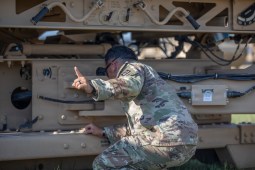
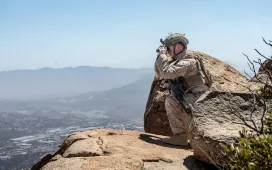
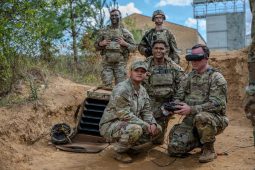
A U.S. Army soldier assigned to 6th Battalion, 35th Air Defense Artillery Brigade, performs set-up tasks on an air defense system as part of Exercise Dragon Flag on Kunsan Air base, August 18, 2026. (U.S. Army Reserve photo by Spc. Samantha Mussatti)
The 8th Army has been learning from what’s happening in Ukraine and the Middle East, and working through changes in its own tactics, techniques and procedures, Lt.…
An aerial view of the National Mall, including the Washington Monument, the U.S. Capitol, the Jefferson Memorial, the Tidal Basin and the Pentagon from Air Force One as it departs on September 26, 2026 in Joint Base Andrews, Maryland. (Photo by Tom Brenner/Getty Images)
Secretary of Defense Pete Hegseth tests a Dronebuster while touring static displays led by the 3rd Battalion, 10th Mountain Division (3/10 MTN) Warriors and Foreign Legion Force Poland Battle Group in Powidz, Poland, Feb. 15, 2025. (DoD photo by U.S. Navy Petty Officer 1st Class Alexander C. Kubitza)
Director of Joint Interagency Task Force 401 Brigadier General Matthew Ross tours Yuma Test Center at Yuma Proving Ground in Yuma, Ariz., Sept. 22, 2026, ahead of the Falcon Peak demonstration. (DOD Photo by Ana Henderson)
U.S. Secretary of Defense Pete Hegseth gives a State of the Force address at Marine Corps Base Quantico on September 30, 2026 in Quantico, Virginia. Secretary Hegseth delivered his State of the Force address to junior officers, enlisted leaders, and special guests including Anduril Industries co-founder Palmer Luckey. (Photo by Alex Wong/Getty Images)
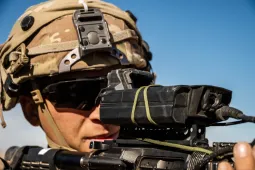
Spc. Brandon Mack, a small unmanned aircraft system operator assigned to 1st Battalion, 8th Cavalry Regiment, 2nd Armored Combat Brigade, 1st Cavalry Division, looks through his SMASH 2000L optic, a counter-sUAS tracking scope developed by SMARTSHOOTER, during rotation 26-02 at the National Training Center, Fort Irwin, California, Nov. 2, 2025. (U.S. Army photo by Spc. Julian A. Winston)
So far, however, less than one percent — $50 million — of the ten new awards have been obligated, officials said, with the rest contingent on congressional…
U.S. Marine Corps Lance Cpl. James Brooks, an infantry rifleman, with the 1st Battalion, 6th Marine Regiment, 2nd Marine Division, assigned to Joint Task Force-Southern Border (JTF-SB) in support of Operation Ardent Vanguard, patrols the southern border in Tecate, California, Aug. 25, 2026. Patrols help deter illegal crossing of the southern border. U.S. Northern Command is working side-by-side with the Department of Homeland Security and the U.S. Customs and Border Protection within narrowly defined authorities to provide unique military capabilities to protect the territorial integrity of the U.S. southern border. (Dept. of Defense photo by Sgt. Nathan Hislop)
Gen. Dagvin Anderson, commander of U.S. Africa Command, participates in a small unmanned aircraft system demonstration with U.S. soldiers from the 1st Squadron, 2nd Cavalry Regiment, at Rose Barracks, Vilseck, Germany, Sept. 1, 2026. As the pace of innovation accelerates and tactics continue to evolve, sAUS integration is becoming increasingly critical to adaptation on the modern battlefield by improving how units coordinate detection, tracking and response capabilities against emerging aerial threats. (U.S. Army photo by Sgt. 1st Class Kenneth Tucceri, AFRICOM public affairs)
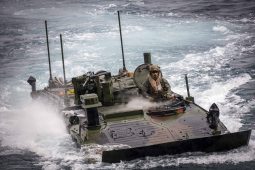
U.S. Marines assigned to Battalion Landing Team 2/4, 13th Marine Expeditionary Unit, conduct amphibious combat vehicle qualifications, during routine operations and integrated training off the coast of California, June 24, 2026. (U.S. Marine Corps photo by Sgt. Mary R. Jenni)
The Marine Corps plans to integrate an unspecified number of Pulsar-L systems into its Amphibious Combat Vehicle fleet at a time when armored vehicles have proven vulnerable…