Pentagon counter-drone task force announces pilot program to get directed energy systems to 5 installations
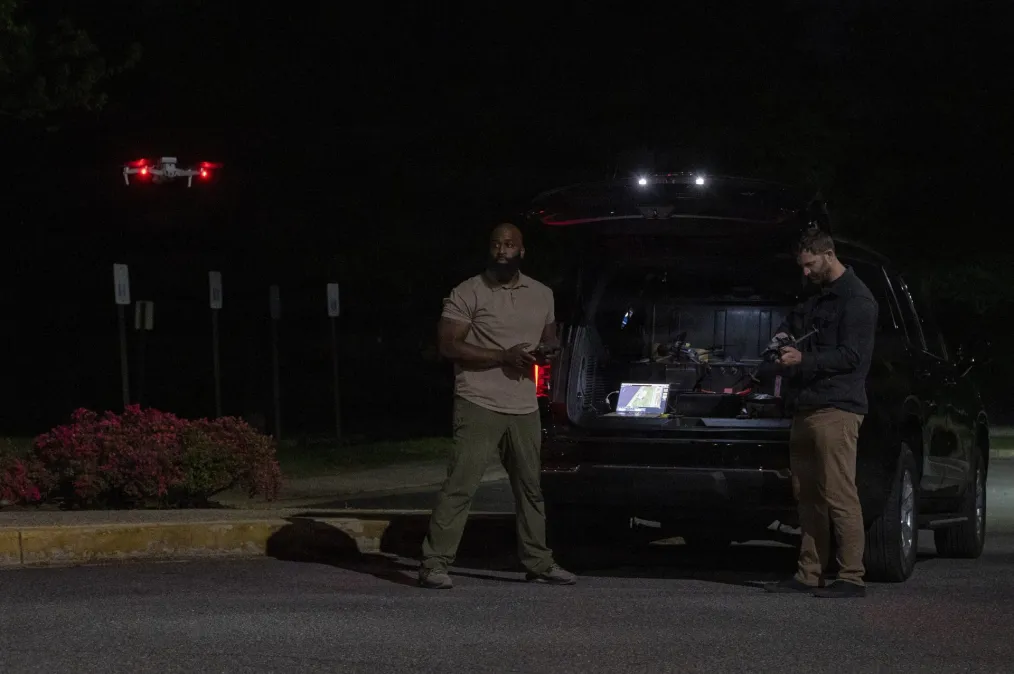
The Pentagon’s counter-drone task force announced a new pilot program this week aimed at fielding directed energy systems for UAS defense to five military installations across the country over the next six months.
Joint Interagency Task Force 401, an Army-led entity charged with boosting the military’s counter-drone efforts, said the initiative is intended to protect infrastructure, military installations and domestic missions against unmanned aerial systems.
Concerns over the domestic drone threat have been galvanized in recent years by technological advancements, increased UAS sightings over military bases and key infrastructure as well as their use overseas, which have wrought new tactics that make homeland defense worrisome.
Since its inception, JIATF-401 has rushed to field counter-UAS systems to troops at home and abroad, an effort punctuated by changing installation protection policy and some interagency missteps. Now, it is moving to build counter-drone infrastructure at a handful of key bases.
“Countering unlawful and adversarial drone activity is a homeland defense imperative,” Brig. Gen. Matt Ross, the task force director, said in a press release. “There is no ‘silver bullet’ to address this challenge, and this pilot program integrates cutting-edge technology into the department’s broader counter-drone toolkit.”
Fort Huachuca, Arizona, and Fort Bliss, Texas (two Army bases); Naval Base Kitsap, Washington; Grand Forks Air Force Base, North Dakota; and Whiteman Air Force Base, Missouri, were all selected for the pilot program. Officials said these sites were selected to support testing “across diverse environments and mission sets.”
The announcement did not specify which directed energy systems the pilot would focus on fielding, though it did mention high-energy lasers and microwave systems, preferred choices for homeland defense because they minimize “risk to surrounding personnel and infrastructure,” according to officials.
Spokespeople for JIATF-401 did not respond to DefenseScoop inquiries by publication.
The announcement comes two months after the Pentagon and Federal Aviation Administration conducted a first-of-its kind laser test in the New Mexico desert, one intended to quell concerns about the effects of counter-UAS systems on commercial airplanes.
DefenseScoop first reported details of the test in March, an evaluation that officials fast-tracked after back-to-back airspace incidents in Texas where federal personnel employed the high-energy laser without adequate coordination between the military, FAA and Department of Homeland Security.
Following the test, the FAA was notably silent for more than a month until it jointly announced with the Pentagon a safety agreement over the use of domestic counter-drone technology.
“The FAA is working closely with the Department of War (DOW) to ensure airspace safety is maintained as it deploys its counter-UAS pilot program,” a spokesperson for the aviation agency told DefenseScoop on Thursday.
The Pentagon said that it will finalize “deployment plans with installation commanders” over the next six months, according to the release, and start operations later this year. In January, the Defense Department said it expanded installation commanders’ defensive areas around facilities to protect against drones.
“Our collaboration with the FAA and the successful demonstration at White Sands were pivotal steps forward in our counter-UAS efforts,” said Col. Scott McLellan, deputy director of JIATF-401. “We showed that directed-energy systems can counter drone threats while preserving the safety of air travelers. This pilot program now allows us to translate that progress into evolving operational capability for the homeland.”