Air Force picks Anduril, General Atomics to build first operational CCA drones
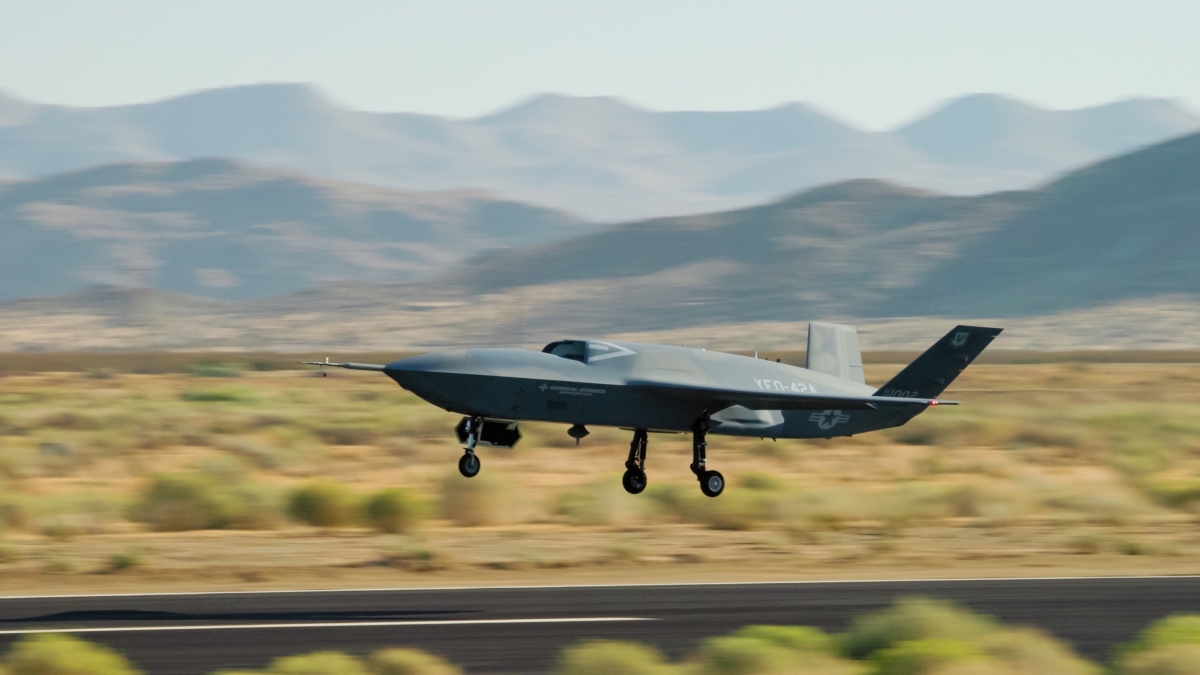
General Atomics and Anduril have received production contracts from the Air Force for Increment 1 of the Collaborative Combat Aircraft (CCA) program, the service announced Wednesday.
The firms were each awarded engineering-and-manufacturing development and production contracts for the CCA air frames, beating out at least three other vendors that competed for deals. The contracts — which come four months ahead of schedule — cover the first three lots of unmanned aerial vehicles and will allow the service to field at least 150 systems by the end of the decade, according to Col. Timothy Helfrich, program acquisition executive for fighters and advanced aircraft.
The Air Force also announced Wednesday that Anduril, Shield AI and RTX subsidiary Collins Aerospace were selected to move into the next phase of the CCA Increment 1’s mission autonomy software program. Over the next year, the service will evaluate the three vendors’ software packages and then select a primary provider in 2027.
“We see CCA as representing the next evolution of air power,” Helfrich said during a call with reporters Wednesday. “It is our first instance of taking human-machine teaming into the aviation world to this extent, and being able to drive it operationally.”
Considered a linchpin of the Air Force’s modernization efforts for operations in the Indo-Pacific, the CCA program is one of the service’s most high-profile development efforts. The unmanned fighter jets are designed to fly alongside the service’s future F-47 and current fifth-generation platforms to provide additional reach and capabilities for manned aircraft.
Once fielded, the modular drones are expected to be retrofitted with different equipment to conduct a range of missions, including offensive strike and intelligence, surveillance and reconnaissance.
The Air Force initially selected Anduril, General Atomics, Boeing, Lockheed Martin and Northrop Grumman for the first phase of the CCA effort. In 2024, the service selected Anduril and General Atomics to move into the subsequent development-for-production phase.
The funding supported first flights, autonomous software integration and weapons captive carry tests featuring inert AIM-120 Advanced Medium Range Air-to-Air Missiles (AMRAAM).
Although only two CCA drones were funded for further development, the Air Force opened up the production contract competition to all five of the original vendors, Helfrich said.
“It is important to know that what we looked for at selecting the air vehicle vendor was based on their ability to meet the Air Force’s schedule, the demanding cost criteria and performance required to still deliver operational capability of 150-plus aircraft by the end of the decade,” he said.
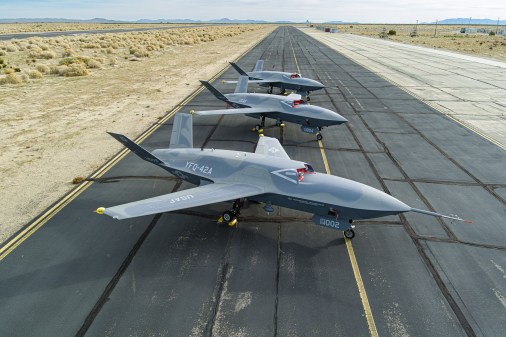
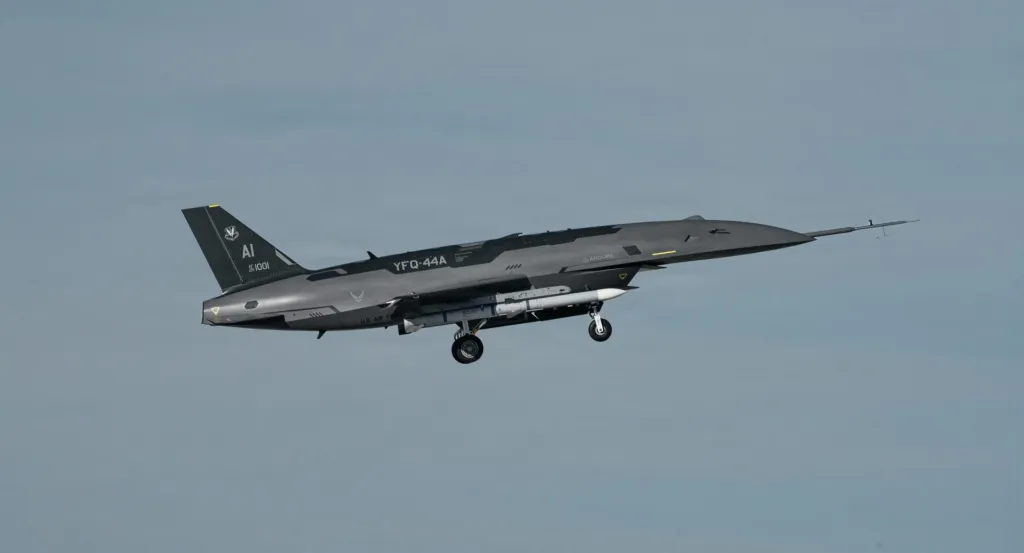
The CCA drones that will be delivered by General Atomics and Anduril will have roughly the same designs as their prototype versions, Helfrich noted. General Atomics’ platform has been designated as the FQ-42A and Anduril’s is referred to as the FQ-44A, but “at their core, they are built fundamentally as the same aircraft,” he said.
General Atomics’ CCA is known as Dark Merlin and based on the company’s XQ-67A drone, which had its first successful flight in February as part of the Air Force Research Lab’s Low-Cost Attritable Aircraft Platform Sharing (LCAAPS) program.
The company first flew a prototype of the FQ-42A last August and later began working with Collins Aerospace to retrofit the drone with a government-owned Autonomy Government Reference Architecture (A-GRA) to test software for unmanned flight.
“This is an exciting day for our company and the nation,” General Atomics President David R. Alexander said in a statement. “Moving to production on FQ-42A is the result of an extraordinary partnership and many years of investments between General Atomics and the U.S. Air Force. We’ve been preparing for this order, and manufacturing is already well underway.”
However, General Atomics experienced a setback earlier this year after one of its prototypes crashed during an April test at a company-owned airport in California. The drone resumed flying roughly one month following the accident, which was caused by “an autopilot miscalculation for the weight and center of gravity of the aircraft, prompting a software remediation,” General Atomics said in a press release.
Helfrich asserted that the crash did not influence the Air Force’s decision to award the company a production contract.
Anduril’s CCA — which is dubbed Fury — began flying in October, also in California, using the company’s own autonomous flight software. Later, Anduril paired with Shield AI to conduct semi-autonomous flights using the A-GRA.
“In its current configuration, FQ-44 has the ferry range necessary to deploy anywhere in the world,” Mark Shushnar, vice president for autonomous airpower at Anduril, said in a statement. “It can take off and land on a short field. It has a combat radius that significantly exceeds the combat radius for current crewed fighters, and the speed to keep up. It has the payload capacity required to make a real impact on the battlefield.”
The Air Force did not disclose how much Anduril and General Atomics received for the production contracts, nor did Helfrich say how many platforms the service plans to buy across each lot.
“The bottom line is, we have to deliver 150-plus by the end of the decade, so that does kind of set a lower limit for how many we have to get across the lots,” he said.
The award for the first lot will be given as soon as the Air Force’s budget for fiscal 2027 is approved, and both companies will have “equal opportunity” to receive orders, Helfrich noted.
The Air Force is requesting $996.5 million in 2027 to initiate CCA Increment 1 procurement. Previously, the service has claimed it wants to purchase one drone at roughly one-third the cost of an F-35 Lightning II fighter jet — or about $30 million per unit — but Helfrich asserted that the program is beating those projections.
The service does plan to purchase additional CCA Increment 1 drones in future aircraft lots, but will not open the competition back up to vendors other than Anduril and General Atomics, he added.
Other companies will have the chance to compete for the follow-on Increment 2 CCA platform, which will likely have different capabilities and features than the Air Force’s first batch of drones. The service is still nailing down specific requirements of the next iteration.
With production deals set for CCA Increment 1, the Air Force is now focusing on completing development of the primary software that will enable the drone’s autonomous flight capabilities.
Per the service’s acquisition strategy, the service is holding separate competitions for the CCA airframe and mission autonomy packages to allow for continuous and rapid software upgrades without needing to re-engineer the physical platform.
The Air Force has already established a vendor pool of six companies, each of which received a baseline six-year contract vehicle that provides the ability for all to compete for individual awards. Those companies are Anduril, Shield AI, Collins Aerospace, General Atomics, Lockheed Martin and Northrop Grumman.
For Increment 1, the service has chosen three of those companies — Anduril, Shield AI and Collins — to participate in two, six-month competitive phases that will culminate in a final contract to provide the CCA’s primary mission autonomy.
“They have been awarded a six-month contract … to advance their mission autonomy to meet our [initial operational capacity] criteria as best they can,” Helfrich said. “At the end of that six months, we will do an assessment of how much capability they have towards what is necessary for IOC, and then do another down-select to either one or two vendors for another six-month option.”
By summer 2027, the Air Force will choose one vendor as its Increment 1 CCA mission autonomy provider. However, Helfrich added that the service’s contract structure with all six vendors allows them to order additional software licenses from another company in the event the Air Force determines it needs to alter course.
“There’s always the ability for us to order software licenses from any of the six vendors if it’s in the best interest of the U.S. government,” he said. “We also have plans at the three-year point to do a large-scale fly-off and look at all of the mission autonomy that is in the marketplace from those vendors and evaluate whether or not we wish to make a decision to pivot or to stay with the initial winner.”