Pentagon awards $500M contract for counter-drone tech to AeroVironment
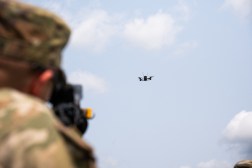
The Pentagon awarded a $500 million contract to AeroVironment, a defense company that makes Switchblade loitering drones and other tech such as the LOCUST directed energy laser, to procure commercial counter-drone technology for the military over the next three years.
The award language contained few details, but was listed under the Army section of the Defense Department’s online contract update posted Wednesday. While locations and specific funding will be determined with each order, the contract aims to build on defenses against drones, including small unmanned aerial systems which were specifically referenced.
The announcement comes after AV reported record fourth-quarter revenue earlier this week, bucking estimates, CNBC reported. The company’s shares surged nearly 19% after Monday’s earnings call, according to the publication, and then bumped again after the Army contract announcement.
“We remain focused on executing with excellence and strengthening our supply chain to accelerate the commercialization of our platforms,” AV CEO Wahid Nawabi said in the earnings release. “AV is well-positioned to capture the rising global demand across lethal and non-lethal drones, counter-UAS, space and advanced technologies and deliver long-term shareholder value.”
Spokespeople for AV and Joint Interagency Task Force 401, the Pentagon’s counter-drone team which frequently flows money to UAS defense technology, did not answer DefenseScoop’s request for additional details Thursday.
The Pentagon announcement about the award listed Army Contracting Command Detroit Arsenal in Michigan as the contracting activity.
Top defense officials have continuously beat the drum about proliferating counter-drone systems across the force, especially after the Iran war revealed gaps in the U.S. military’s ability to defeat UAS.
Those gaps are exacerbated by what service officials call a “cost curve,” in that the U.S. military was using expensive, “exquisite” air defense systems to target drones such as Tehran’s one-way-attack platform known as the Shahed. The Pentagon has been looking to bridge that disparity.
One example: AV has billed its LOCUST system as a cost-effective counter-drone tool. Nawabi recently said the cost-per-shot of the laser can be as low as $3 as opposed to the millions it might take to fire off a single round for other systems.
JIATF 401 tested the LOCUST at White Sands Missile Range in New Mexico earlier this year after the directed energy weapon was involved in an air space closure incident over Texas in February, DefenseScoop exclusively reported.
U.S. Customs and Border Protection used a laser on-loan from the Pentagon to shoot down an object near El Paso, the publication first reported. The object was later revealed to be Mylar balloons, according to new reports. Within the same month, troops downed a U.S. Customs and Border Protection drone in another part of Texas, which was launched without notifying the military task force assigned to the U.S.-Mexico border.
Lawmakers from both parties had been critical of the agencies, including the Federal Aviation Administration, over the dual airspace incidents. The Pentagon and FAA signed an agreement a month after the White Sands test, both determining that the lasers were safe to use in American airspace.