Gen. Caine urges defense logistics leaders to be ‘creative and entrepreneurial’ ahead of future fights
GRAPEVINE, Texas — Chairman of the Joint Chiefs of Staff Gen. Dan Caine encouraged hundreds of military personnel and commercial logistics insiders gathered in Texas on Monday to embrace more entrepreneurialism as they prepare for future wars.
On the opening day of the annual Fall Meeting co-hosted by the National Defense Transportation Association and U.S. Transportation Command, Caine described expanding the nation’s industrial capacity and the military’s strategic mobility as essentials to ensuring combat power in the years ahead.
“As you consider your business models of the future, whether you’re one of the component commanders or you’re in industry, I ask you to be very creative and entrepreneurial in starting to think about how we’re going to move forces and sustain forces in contact — [in] both the physical domain and then the information domain, as well,” Caine said in a fireside chat with Transcom Commander Gen. Randall Reed.
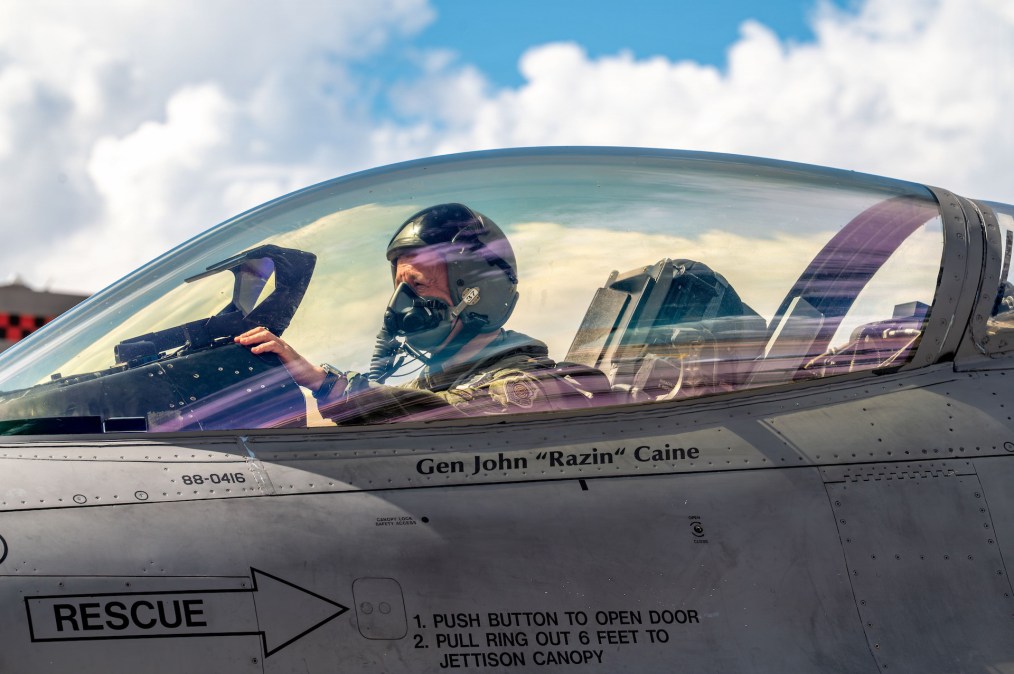
Before he was nominated to serve as President Donald Trump’s principal military advisor last year, Caine served in various operational, staff and joint assignments, including as an F-16 fighter pilot, weapons officer, and associate director for military affairs at the CIA, among other roles.
He was also a part-time member of the National Guard and a serial entrepreneur and investor.
“For those private sector teammates here, I have strategic empathy for what you go through every day,” Caine said.
As military leaders hustle to ensure the joint force is properly armed in the modern era, he noted, they need to adopt the right mix of high-end capabilities and autonomous, attritable assets at scale — ahead of U.S. adversaries.
Caine said the national industrial base, “like the one up here in Denton, Texas” that he “ran for a few years” while in the private sector, will be key to realizing and sustaining that capacity.
America’s highest-ranking military official also urged the international audience, which included attendees from South Korea, the Philippines, the United Kingdom and other countries, to “be very entrepreneurial” in their approaches to modernization.
“In our lifetimes, we will do space-based logistics. We’ll do space resupply,” Caine said. “I mean, that is not that far away.”
During the onstage conversation, he and Reed also spotlighted artificial intelligence — or what the second Trump administration is rebranding as “super intelligence” — as a top U.S. military priority across logistics, command and control, fires, and other joint functions.
Notably, both leaders stressed that humans must remain appropriately in and on the decision loop.
“It’s going to be a game-changer as we move forward. And the number of things that are going to go back and forth between an adversary and the United States — both kinetic things, missiles and rockets and bombs, and non-kinetic things in the cyber domain — are going to be significant,” Caine said. “We have to train leaders, and train systems, and train models to allow the four stars of the future in Transcom who are sitting in this room, or a future chairman who’s sitting in this room, to be able to make those decisions utilizing SI, AI.”