U.S. Navy, Quad partners move to ‘fingerprint’ dark fleets in the Pacific with Vantor’s AI
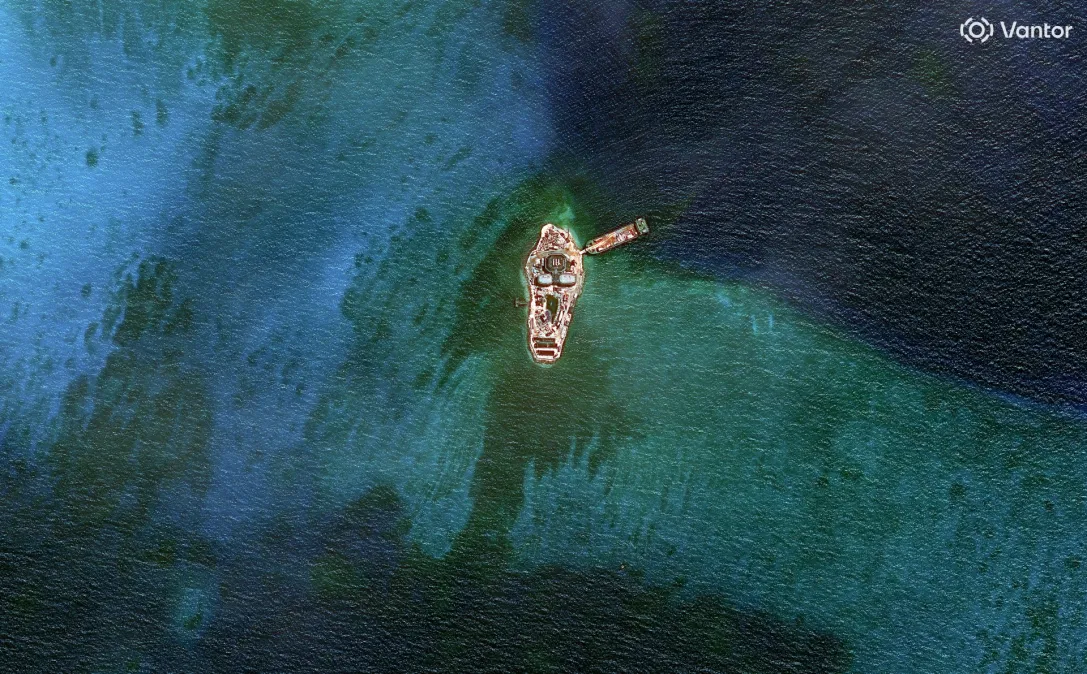
Spatial intelligence firm Vantor is set to supply the Navy with persistent, AI-enabled maritime monitoring assets that steadily spot and surveil “dark” fleets and other non-compliant vessels in and around the Pacific Ocean.
“Dark vessels can be associated with illegal fishing, trafficking, sanctions evasion, unauthorized activity in sovereign waters or military activity,” Will Cocos, executive vice president and general manager of Vantor’s U.S. government business, told DefenseScoop on Thursday.
Under a new contract award unveiled this week, Naval Information Warfare Center Pacific and several of its regional partners will tap into Vantor’s Maritime Sentry capability, which fuses AI with sensors and satellite imagery to track objects across large swaths of ocean and trace potentially adversarial watercraft that turn off, manipulate, or never transmit Automatic Identification System signals.
The deal comes as the scale and complexity of dark fleets are reaching an inflection point.
Beyond harmful fishing and moving crude oil, so-called shadow tankers have increasingly been linked to grey-zone operations, like loitering over undersea fiber-optic pipelines, mapping energy cables, and acting as motherships for illicit drones in international waters.
Cocos shared new details with DefenseScoop about the scope of this effort and what it means for Vantor, almost one year after its rebrand from Maxar.
The full picture
Over the last decade, threats posed by shadow fleets have shifted from being considered a global economic enforcement issue to a central operational challenge for the U.S. military.
Tactics historically used by smugglers and illegal fishers are now also widely applied for attempts at state-backed sanction evasion, maritime blockade running, covert or physical sabotage of underwater infrastructure, and illegal trade.
And this year, the Navy and Coast Guard are actively monitoring, boarding, and seizing stateless or dark oil tankers in international waters around the Caribbean, North Atlantic, Indian Ocean and elsewhere — against the backdrop of Operation Epic Fury and the second Trump administration’s willingness to enforce regional blockades.
Defense Secretary Pete Hegseth and Chairman of the Joint Chiefs of Staff Gen. Dan Caine have emphasized that shadow vessels are subject to searches by American special operations teams or forcible seizure.
Dark vessel operators typically intentionally deactivate their ships’ Automatic Identification System transponders or use sophisticated GPS-spoofing software that disseminates false coordinates — making a ship in one area of an ocean appear on networks to be anchored off a distant coast.
“AIS is an important source of maritime information, but it depends on vessels accurately broadcasting their identity and location. A vessel can turn it off, manipulate the signal or never transmit at all,” Cocos told DefenseScoop. “That creates blind spots for countries trying to understand what is happening in their waters.”
Satellite imagery can help “close an important gap,” he noted, by offering officials another way to observe what is physically there instead of relying only on what a vessel is broadcasting.
Still, a single analyst cannot manually watch every ship across thousands of square kilometers of ocean.
“The scale of the problem makes AI important,” Cocos explained. “No single sensor gives you the full picture. We combine synthetic aperture radar, electro-optical satellite imagery, AIS and AI-powered vessel fingerprinting to build a broader and more persistent picture of activity.”
That, in turn, helps surface the movements or watercraft that likely deserve an operator’s attention, including when AIS is unavailable or unreliable. Maritime Sentry also identifies potential dark vessels’ distinguishing characteristics, connecting data-backed observations over time.
“AI does not replace the operator,” Cocos said. “It helps the operator find what matters much faster.”
According to the combat veteran-turned technology executive — who began his career as a Navy SEAL officer — part of the “value” Maritime Sentry offers to the sea services is that it’s designed to fit directly into existing operations.
“The resulting intelligence goes into the systems partners already use,” Cocos said. “It is not another standalone tool they have to monitor.”
The broader Vantor story
Vantor grew out of the company formerly known as Maxar Technologies, which was rebranded in October 2025.
At the time, the firm’s leadership billed it as a transformation that reflected a broader evolution from primarily providing satellite imagery to building end-to-end spatial intelligence assets that help customers better understand and operate with the observations it generates.
Like Maxar, Vantor still operates some of the world’s most capable imaging satellites. But now, the company also combines that imagery with AI, software, 3D data, and other sources to build solutions around specific real-world problems.
“Maritime Sentry is a good example of what Vantor does today,” Cocos told DefenseScoop.
He noted that it runs on Vantor’s Tensorglobe platform, which fuses imagery with commercial and customer data, applies AI and analytics — and turns it all into intelligence that can move directly into operational workflows.
“That end-to-end model, from collection to operational use, is the broader Vantor story,” Cocos said. “Maritime Sentry applies it to the maritime environment.”
He confirmed that Maritime Sentry already had U.S., foreign government and private-sector users ahead of gaining this new contract.
Though Cocos declined to share the total award value, he indicated that it will support NIWC Pacific’s work with the Indian navy and regional partners through the Indo-Pacific Partnership for Maritime Domain Awareness.
“Commercial technology is core to IPMDA,” Cocos said. “The initiative is focused on using commercially available satellite data and other technologies to give partners across the region a better, more timely picture of activity in their waters.”
Leaders of the Quadrilateral Security Dialogue nations — Australia, India, Japan and the U.S. — agreed to form the IPMDA during the Quad Leaders’ Summit in Tokyo in 2022.
“The Indo-Pacific is an enormous maritime operating environment,” Cocos said. “There are critical shipping routes, military activity and illicit activity across vast areas, and the challenge is maintaining a clear, current picture of what is happening.”
Notably, under NIWC Pacific’s new contract with Vantor, Maritime Sentry will directly feed intelligence into operational systems that are used by both the U.S. and its foreign partners in the QUAD.
“That interoperability is a big part of why this matters,” Cocos noted.
According to the senior Vantor official, the firm will deliver insights through an application programming interface, or API, enabling the Indian navy and participating partner nations to directly access Vantor data in the maritime systems they already deploy. Those systems include SeaVision, a U.S. government application used to view, share and correlate maritime information from multiple sources, as well as a separate Indian navy system.
“The technology only matters if the information gets to the operators who need it, in the systems they already use,” Cocos told DefenseScoop.
“And when countries are working together across a region as large as the Indo-Pacific, being able to share intelligence and a common picture becomes even more important,” he said. “That is core to how we think about this at Vantor. Getting intelligence into the operational workflow is just as important as collecting it.”
NIWC Pacific and Navy spokespersons did not respond to DefenseScoop’s requests for comments.