Gen. Caine urges industry to lean more into ‘shared risk’ when delivering tech for U.S. military
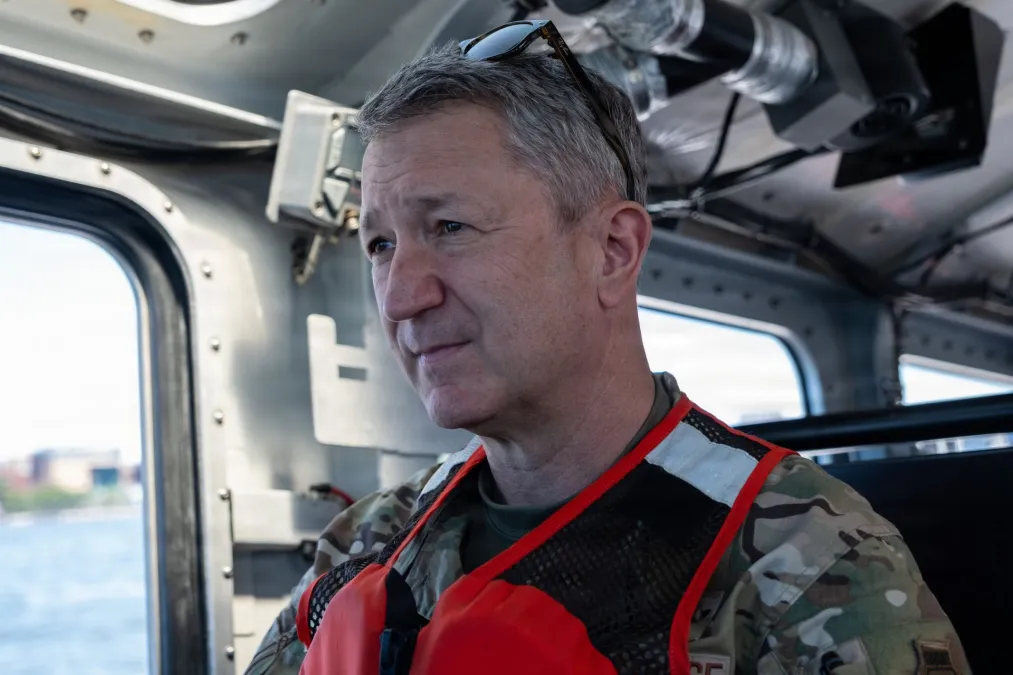
America’s highest-ranking military official urged industry stakeholders in Washington on Wednesday to join the Defense Department in embracing a more shared sense of risk when delivering in-demand technologies.
During NDIA’s Emerging Technologies Conference and Exhibition, Chairman of the Joint Chiefs of Staff Gen. Dan Caine called on government buyers and commercial sellers to deliberately meet in the middle on cost, speed, and experimentation as they deliver and adopt new assets in the modern global security environment.
“The character of war is absolutely changing, and technology is [essential] to that. When you look at the price of lethality right now, it’s on an exponential decrease. Technology is [proliferating] everywhere,” Caine said. “Learn the right lessons from fights in Europe and elsewhere — the battlefields of the future are becoming much more digital.”
The chairman noted that he can increasingly feel a “shared sense of urgency” between the White House, government, military and industry, particularly at this time when the U.S. is confronting diverse adversaries in multiple regions around the world.
“That said, teammates, we all have to go fast on our side. On your side — newcomers, and startups, and entrepreneurs that are out there — ultimately, what I’m seeking to solve for is shared risk. Where can we find a place to compromise between buyers and sellers at scale, so that our primes, [neoprimes] and startups all [have] an open door?” Caine said.
He spotlighted ongoing work in the services as well as on Pentagon teams like the Defense Innovation Unit (DIU) and Office of Strategic Capital (OSC), which insiders are doing to align more closely with industry partners.
That sort of cooperation, in Caine’s view, “is going to be key and essential” for DOD moving forward.
“I acknowledge the tensions that companies have [with] a mandate to create profit for their shareholders, and what we have, which is to create capability for our warfighters — and sometimes those things are in tension. But what I hope we can continue to do is to cooperate with a real sense of shared risk,” he told the audience.
Caine also said advanced tech like AI, drones and hypersonics are increasingly changing the battlespace in real-world combat domains.
The U.S. military must therefore continue to build an arsenal encompassing a “high–low mix” of weapons that can deliver both exquisite effects and mass, at scale.
“As companies, entrepreneurs, [or] founders, funders, and fighters come together — and that’s a triad that I think about — we have to be mindful that the technology that we bring into the joint force has to manifest itself in outcomes through those warfighting functions. And, along the way, we need resilient technology,” Caine said. “Our tech stacks are going to be under attack in high-end conflict. We need to prepare for a resilient command-and-control structure that allows us to arm that young member of the all-volunteer joint force with the capabilities that they need at the time that they need them, not after conflict starts.”