Pentagon to publish open-source software stack for 5G, 6G network innovation
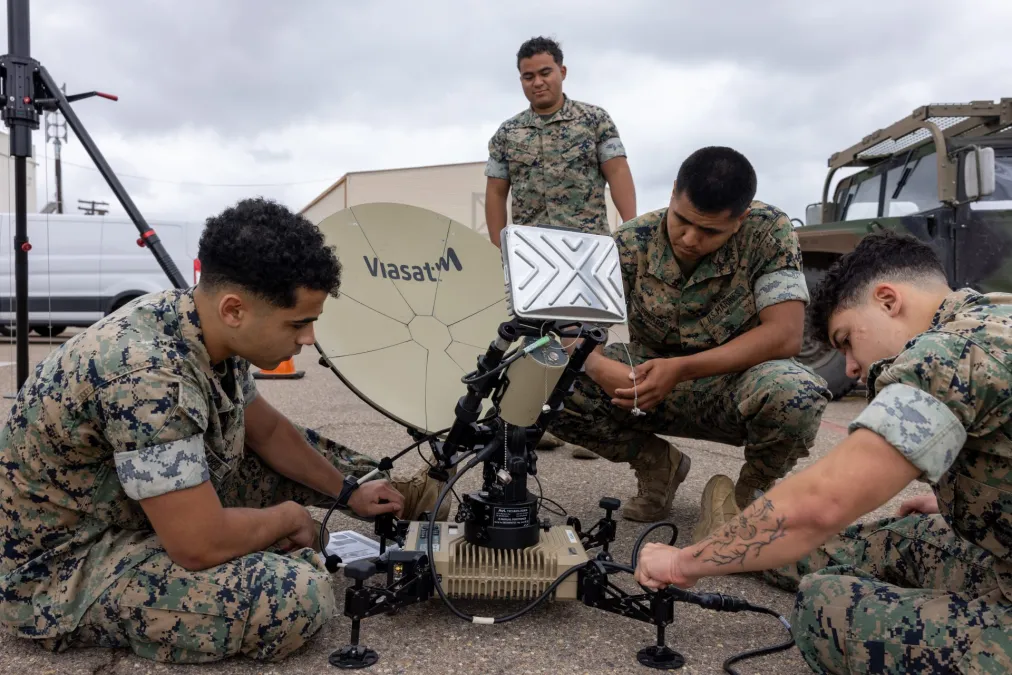
In a bid to diversify wireless communications innovation, the Defense Department is poised to release an open-source software stack that users from the military and commercial industry can use to develop their own custom network solutions.
The Pentagon’s FutureG office will publish the first version of the Open Centralized Unit Distributed Unit (OCUDU) radio access network project to GitHub in April, the department announced Sunday. Once published, the OCUDU codebase will be open to developers, enabling them to build new capabilities that could ultimately reshape development of current 5G and emerging 6G networks.
The effort is a collaboration between the FutureG office, which is overseen by the Office of the Under Secretary of Defense for Research and Engineering, and the non-profit National Spectrum Consortium. It seeks to build upon a broader push to break down barriers within the telecommunications industry that has stifled innovation, Tom Rondeau, principal director for the FutureG office, told DefenseScoop.
“The way I always phrase it is what Linux did for the Internet and what Kubernetes did for cloud,” Rondeau said in an interview ahead of the official announcement. “We need that same transformation to share the burden of the infrastructure, to allow companies to compete where competition is going to make a difference.”
Today, the world’s 5G networks are operated by a select few major companies — including China’s Huawei, Sweden’s Ericsson and the United States’ Qualcomm — that sell their systems as proprietary products. Even with the push to open radio access networks (Open RAN) solutions, vendor lock limits meaningful customization of hardware and software applications, while also keeping new entrants from breaking into the industry.
“Basically, you have the developer community that’s going to be important to making these types of use cases happen and building all the applications and infrastructure around it,” Rondeau said. “They’re kept out of innovating in this industry space because even with an Open RAN-type solution, you still don’t necessarily have access to everything inside of it.”
After announcing the project last year, the National Spectrum Consortium awarded DeepSig and its partner Software Radio Systems (SRS) a contract in September 2025 to build the first iteration of the OCUDU software. In the last six months, the companies have developed a codebase that is essentially a functioning, downloadable RAN stack.
The goal is to give developers a virtual playground where they can create, test and deploy custom wireless technologies, according to Mari Silbey, chief program officer at the National Spectrum Consortium.
“It provides a software stack so that developers don’t have to start from scratch, but they can instead focus on building new things on top of those basic radio functions,” Silbey told DefenseScoop in an interview.
The Pentagon and National Spectrum Consortium are working closely with the Linux Foundation, which will provide oversight and control of the software once it’s published. To help foster development and accelerate the project, the company has established a coalition of industry and academia members called the OCUDU Ecosystem Foundation.
The Linux Foundation announced Sunday that 47 organizations have signed up as founding members of the OCUDU Ecosystem Foundation. It includes major telecom companies from around the world — including Ericsson, Nokia, Verizon and AT&T — as well as vendors that specialize in other sectors, like NVIDIA.
“Now it’s about being able to say, ‘Hey, we have this baseline software and we also have this community of big companies, small companies, universities, research institutions and multiple government agencies who are committed to developing this further,’” Silbey said.
While OCUDU aims to benefit the broader industry, the project could also greatly improve the Defense Department’s network operations.
In the past, the Pentagon could procure bespoke telecommunications systems from providers, but industry has since shifted their focus to the larger and more profitable consumer market centered on 5G — leaving little incentive to build customized solutions for the DOD, Silbey explained.
“To get new features [and] to be able to get things that aren’t necessarily in that consumer product development line, DOD wants to open up the technology more so that people can innovate and create these new features and functions,” she said. “And again, that sort of started with Open RAN, and then goes a step further with OCUDU.”
One of the things the Pentagon is interested in is understanding all of the different applications that can sit on top of a radio access network, Rondeau said. In previous work, the FutureG office has seen different apps that can improve energy efficiency and spectrum efficiency — which is crucial to the Pentagon’s ongoing work to advance spectrum sharing with commercial industry.
To help identify and test military-specific use cases for innovations that come from OCUDU, the FutureG office is working with both the Naval Information Warfare Center Pacific and the Georgia Tech Research Institute, Rondeau said.
A key focus will be exploring capabilities that can optimize the Defense Department’s operations within the electromagnetic spectrum, such as artificial intelligence-enabled network management.
Arpit Joshipura, general manager of networking, edge and internet-of-things at the Linux Foundation, told Defensecoop that putting customized AI models near the end user — whether that be a person, defense system or base station — can automate functions such as beamforming and network traffic management.
“The AI part of it does a lot of what I call magic,” Joshipura said in an interview. “It will allow for the most efficient use of the limited resources that are available in the network, in a war front [or] an area where there is a disaster and there’s no connectivity.”
Once the initial OCUDU software is published, the FutureG office plans to continue putting out revisions of the software over the next six months, Rondeau said. At the end of the three-year project, the Pentagon believes it will have a minimum viable profile of a carrier-grade network solution, he added.
“What I’m really looking for is a marketplace of competitive ideas,” he said. “I want to see people being able to come at this not just with hyper-specializations … but really break that open to this friendly, open development ecosystem where we can be generating ideas, testing against them and, importantly because it’s open, be able to pull data from different parts of the processing stack that happens in a RAN and use that to drive different ideas.”