Air Force wants to develop follow-on to ARRW hypersonic missile
The Air Force is planning to kickstart two programs in fiscal 2027 aimed at developing more hypersonic missiles, including a follow-on to the AGM-183A Air-Launched Rapid Response Weapon (ARRW) and the new Air-Launched Ballistic Missile (ALBM) effort.
The service is requesting $346 million in base funding for continued hypersonic weapons prototyping in FY27 — split between $296 million for ARRW Increment 2 and nearly $50 million to begin ALBM design activities, according to budget documents. If approved by lawmakers, both programs would seek to bolster the Air Force’s current hypersonics arsenal with long-range strike and other enhanced capabilities.
The request comes as the Air Force continues to build up its nascent inventory of hypersonic missiles, which can travel at speeds of Mach 5 or greater and maneuver through the atmosphere during flight.
Along with funds for additional research and development, budget documents show that the service wants to continue procurement of the ARRW baseline missile and purchase the first batch of the Hypersonic Attack Cruise Missile (HACM).
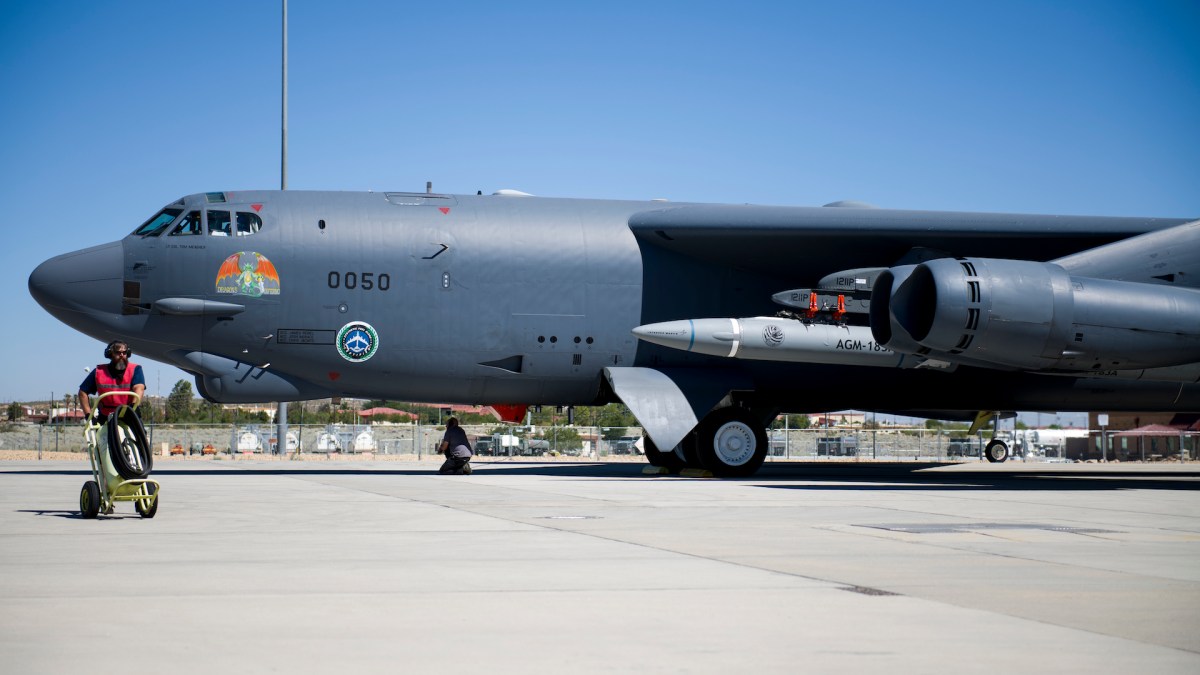
ARRW was the Air Force’s first major effort to field a hypersonic weapon. Developed by prime contractor Lockheed Martin, the AGM-183A is a boost-glide missile that is launched from bombers such as the B-52 Stratofortress and the B-1B Lancer.
The program had its share of complications during development — including at least one failed all-up-round flight test — that prompted the Air Force to pause ARRW in 2024 to analyze test data before making a production decision.
But in 2025, the Air Force decided to formally move the program forward when it requested funds to procure ARRW from Lockheed Martin. Congress allocated the service $362 million in fiscal 2026 to buy an unspecified number of AGM-183A missiles.
Specific details on what exactly a follow-on to ARRW would look like are scant in the service’s budget request, which notes only that Increment 2 would add “enhanced capability” to the baseline weapon.
“The [Department of the Air Force] continues to refine capability requirements for ARRW Increment 2 based on operational requirements and evolving threats,” an Air Force spokesperson told DefenseScoop. “While specific enhanced capabilities remain under evaluation, the DAF is focused on improvements that ensure the weapon system remains effective in contested Anti-Access/Area Denial (A2/AD) environments.”
They added that the Air Force plans to hold a traditional acquisition process for future ARRW increments, opening up the competition to other vendors besides Lockheed Martin. The service has yet to publish any solicitations for the program, according to the spokesperson.
Meanwhile, the ALBM program will focus on developing a new air-launched, long-range capability that complement the Air Force’s rapid-strike portfolio — which includes the baseline AGM-183A and upcoming HACM.
Details on what additional capabilities ALBM will have were also not detailed in the service’s budget request, but the Air Force spokesperson said the weapon will feature “unique trajectory profiles to address distinct target sets.”
“ALBM will provide combatant commanders with an additional capability to address distinct target sets, ensuring a highly diversified and resilient strike capability,” they added.
The new program is currently in early development stages, and its schedule will be set as the service finalizes its requirements and acquisition strategy, the spokesperson said.
As for the service’s current hypersonics, the Air Force’s FY27 budget includes $452 million to purchase the ARRW baseline missile and $404 million to begin procurement of HACM. Both requests for discretionary funds do not include how many missiles the Air Force wants to buy.
Developed by RTX-subsidiary Raytheon, HACM is the second hypersonic missile the service wants to move into formal procurement and production. The weapon is an air-launched scramjet platform that is smaller than ARRW, meaning it can be launched from either fighter jets or bombers.
Although issues with the hypersonic weapon’s design briefly delayed the program, the Air Force is in the midst of HACM’s live testing phase and plans to begin rapid fielding efforts in FY27. A service spokesperson told DefenseScoop that procurement funds would go towards HACM missiles, containers and other supporting equipment.
Despite approaching fielding timelines, budget documents show that the Air Force plans to continue funding research and development of HACM through at least fiscal 2031 — spending a total of $3 billion in the next five years. In FY27, the service is seeking $806 million to continue testing efforts, enhance the weapon’s capabilities and support investments in the industrial base’s capacity to achieve full-rate production.
“HACM procurement funding supports the entire weapon system to include resolution of obsolescence, end-of-life buys, supplier/parts replacement, to include electronic components used commercially and in short supply, and qualification activities to preserve and increase future production capabilities and capacity,” the Air Force spokesperson said. “Funding may be used to address Diminishing Manufacturing Sources (DMS) and obsolescence issues.”