Pentagon OIG partners with Justice Department’s new government fraud-hunting team
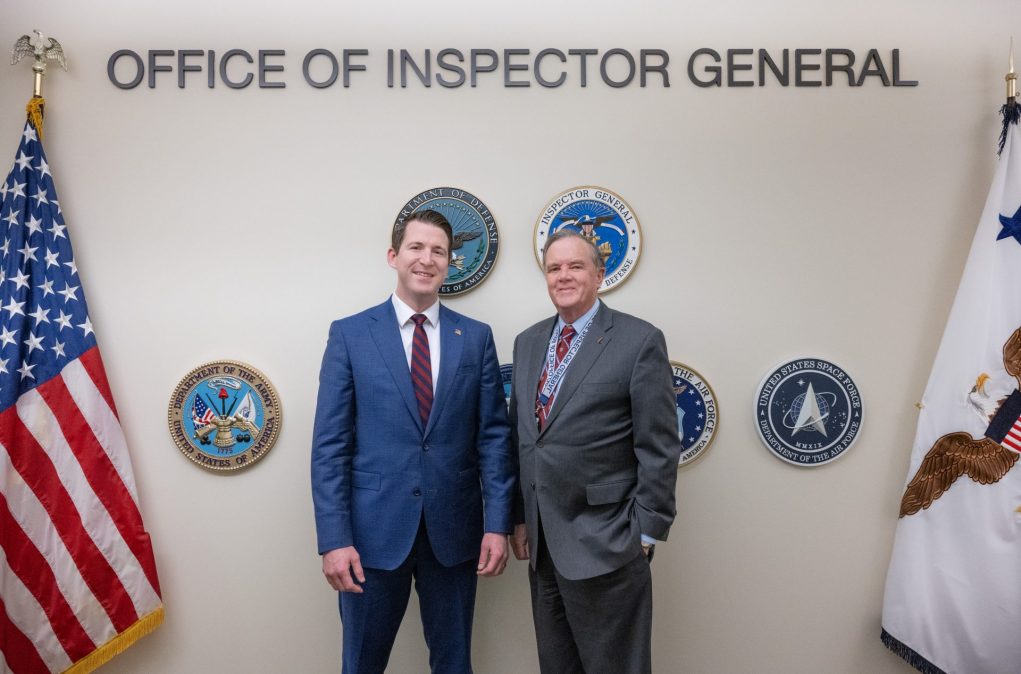
The Pentagon’s inspector general recently met with the Justice Department’s first-ever assistant attorney general for the national fraud enforcement division to explore opportunities for their teams to cooperate more closely on efforts to confront increasingly complex scams impacting the Defense Department and military.
According to a press release, “the discussion centered on potential joint initiatives that could further align investigative and prosecutorial priorities.”
This expanding partnership between the DOJ and the DOD watchdog’s Defense Criminal Investigative Service (DCIS) comes as the second Trump administration is launching a major, multi-agency “war on fraud,” as part of a large-scale campaign to target what U.S. leaders allege amounts to billions in wasteful spending across federal programs.
“DCIS and DOJ discussions regarding potential joint initiatives remain under consideration so describing or characterizing our efforts to eliminate fraud would be premature,” Mollie Halpern, a spokesperson for the DOD’s Office of Inspector General, told DefenseScoop. “However, we are committed to close coordination with DOJ and once both agencies are positioned to provide additional detail we will do so through appropriate channels.”
Broadly, DCIS investigates criminal and civil matters to advance and support DOD and its OIG’s strategic goals.
“With limited resources, DCIS must focus on the most impactful investigations. We are guided by our motto, ‘Protecting the Warfighter,’” Halpern said. “Investigations that impact the life, safety, and health and patient harm of U.S. warfighters are the highest priority.”
Cyber crime and computer network intrusions, illegal transfers of sensitive DOD technologies and acquisition-related fraud are among the organization’s top focus areas that she listed.
“As reported in our most recent Semiannual Report to Congress, we enabled the recovery of more than $1.22 billion through our criminal investigations. A large majority of the recoveries stem from procurement and healthcare fraud investigations,” Halpern said.
The DOJ officially established its National Fraud Enforcement Division (NFED) in April, following a directive from the White House in January.
This new, centralized unit is expected to integrate data analytics and multi-agency resources to combat sophisticated fraud schemes against taxpayer-funded programs.
“On paper, this partnership between the Department of Justice and Department of Defense and the goals that have been stated are laudable. I want to believe that they are operating in good faith and will genuinely push to save taxpayers money and ensure our National Security efforts are not impacted by fraud,” said Virginia Burger, a senior defense policy analyst for the Center for Defense Information at POGO.
But she’s concerned the work could “turn into just another vehicle” for government corruption.
“The Department of Defense needs to be critically examined for fraud, waste, and abuse of all kinds by agencies and institutions — fully divorced from this administration’s influence,” Burger told DefenseScoop. “Under [Defense Secretary Pete Hegseth], we’ve seen an increase in the positions and influence private industry wields in the Pentagon.”
Burger, who previously served for almost a decade as an active-duty Marine Corps officer, said she’ll be watching to see whether or not the reach and influence of this new partnership will be politicized.
“Hopefully, the Department of Defense Inspector General remains staunchly separate and independent from Hegseth,” she said. “However, the Department of Justice’s lack of independence from the rest of the executive branch in its operations does not provide hope.”