CBO estimates Golden Dome-like missile shield could cost $1.2T over 2 decades
The price tag for the Golden Dome for America could reach $1.2 trillion to develop, deploy and operate over 20 years, according to a new report published Tuesday by the Congressional Budget Office.
The updated cost estimate is based on a “notional” missile defense architecture that broadly includes capabilities outlined in President Donald Trump’s 2025 executive order calling for Golden Dome’s development. CBO’s projections are significantly larger than the $185 billion already budgeted for the project — with space-based interceptors (SBIs) accounting for over half of the office’s estimate.
“Of the $1.2 trillion amount, acquisition costs for the notional [national missile defense] system would total just over $1 trillion,” the report stated. “The most expensive component is the space-based interceptor layer, which accounts for about 70 percent of acquisition costs and 60 percent of total costs.”
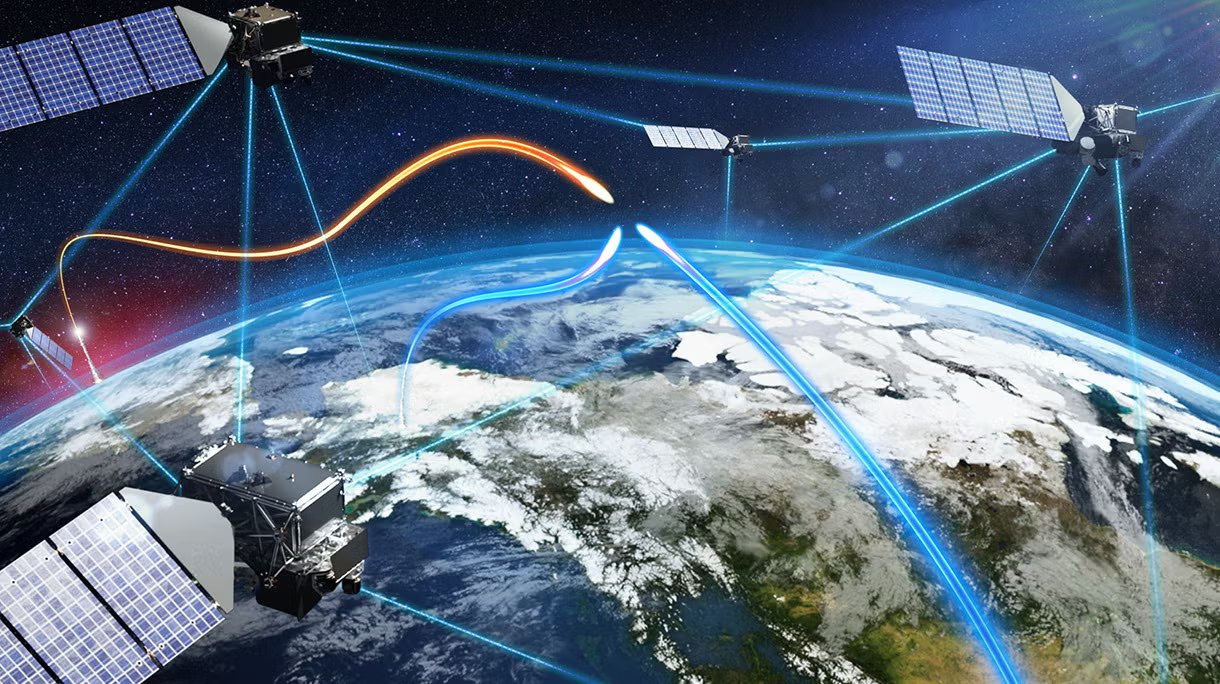
Golden Dome is envisioned as a multi-domain network of advanced sensors and interceptors that would serve as a missile defense shield for the U.S. homeland against threats such as ballistic, cruise and hypersonic weapons.
Overall, CBO said the notional architecture it assessed based on the Golden Dome EO would be capable of engaging an attack from regional adversaries with limited capabilities, such as North Korea, or smaller barrage of threats from China or Russia.
“However, the system could be overwhelmed by a full-scale attack mounted by a peer or near-peer adversary,” the report added. “Furthermore, ‘fully engage’ is not the same as ‘fully defeat’ because no defense works perfectly every time.”
Since the effort began in the early days of Trump’s second presidential term, the Defense Department has shared few details about its plans for the architecture and what systems — both existing and new — will be part of it.
As such, CBO acknowledged in its new report that determining the long-term costs of Golden Dome isn’t currently possible.
“In the absence of specific plans for [Golden Dome for America’s] objective architecture, CBO has estimated the cost of a notional [national missile defense] architecture based on the defensive systems and capabilities that are called for in the executive order,” the report said.
Trump initially said in May 2025 that the project would cost $175 billion to deploy before the end of his second term. Golden Dome director Gen. Michael Guetlein noted in March that the Pentagon was approved for an extra $10 billion to cover additional space capabilities.
Furthermore, the department is required to demonstrate an operational capability by the summer of 2028 and field an objective Golden Dome architecture in the 2030s, Guetlein said.
CBO noted in its report that the Defense Department’s estimates are consistent with projections outlined in its budget request for fiscal 2027, although those costs reflect “a shorter time frame than CBO’s analysis and may reflect a different scope of activities and budget categories.”
Funding for Golden Dome has so far relied heavily on money allocated through reconciliation bills, which are not guaranteed to pass. As part of the 2026 One Big Beautiful Bill, the Pentagon received $24 billion for the project.
In FY27, the department is requesting over $17 billion in reconciliation funds for the project once again, and just $400 million from the Pentagon’s base budget.
The most expensive component of the notional architecture assessed by CBO is an SBI constellation, considered one of the linchpin capabilities of Golden Dome. The office estimated that the Pentagon would need 7,800 satellites stationed in low-Earth orbit to be able to destroy 10 intercontinental ballistic missiles (ICBMs) during their boost-phase.
In total, that SBI constellation would cost $720 billion to develop, deploy and maintain over two decades and another $1 billion annually to operate, according to the report.
Guetlein told lawmakers in April that he is aware of how costly SBIs for Golden Dome could be, noting during a House Armed Services Strategic Forces subcommittee hearing that he is willing to sacrifice fielding SBIs in order to stay within the project’s budget.
“If boost-phase intercept from space is not affordable and scalable, we will not produce it because we have other options to get after it,” he said.