Navy creates warfighting development center in Virginia to determine how the sea service will employ unmanned systems in future battles
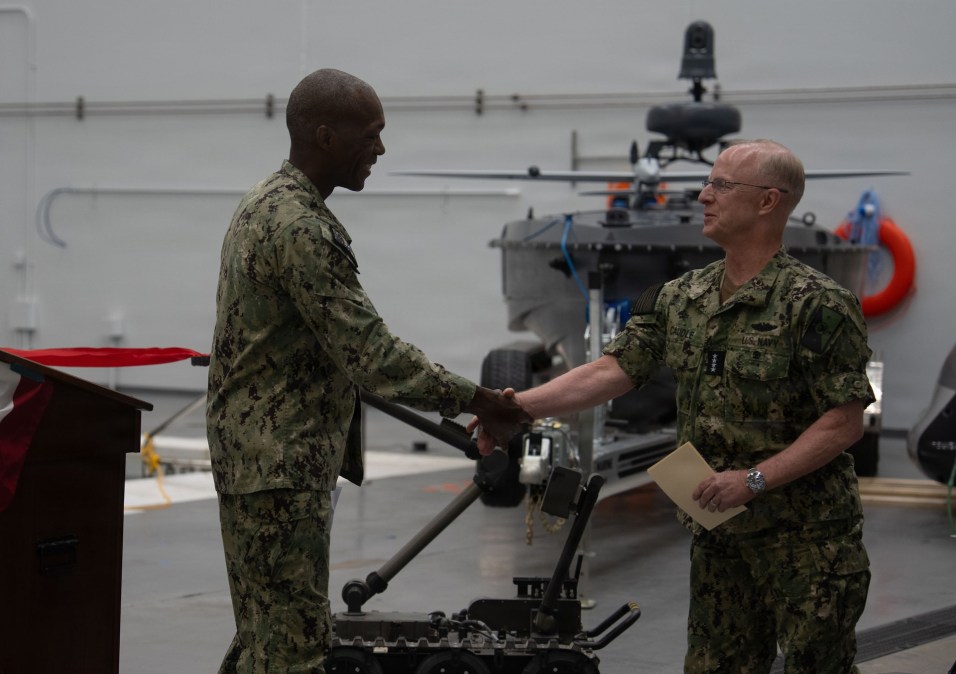
The Navy formally established a new center Thursday at Joint Expeditionary Base Little Creek in Virginia that’s expected to play a major role in shaping how the sea service fights with uncrewed systems.
The Robotic and Autonomous Systems Warfighting Development Center (RASWDC) will bring “operational coherence” that’s needed for the integration of unmanned platforms across the fleet with the Navy’s general-purpose forces, according to an unclassified administrative message from Chief of Naval Operations Adm. Daryl Caudle that was posted Thursday on a Navy HR website.
Caudle is a major proponent of using AI and robotic tech to give the Navy a warfighting edge. Earlier this year, he unveiled a new “Hedge Strategy” that includes a major role for uncrewed systems and enabling technologies, and the CNO also noted that he was looking to launch a new warfighting development center focused on those types of capabilities.
“To maintain our decisive maritime advantage, we must rapidly integrate robotic and autonomous systems into how we operate, train, and deploy,” Caudle said in a statement issued Thursday. “The establishment of RASWDC ensures our Sailors are equipped with the tactical edge, advanced training, and specialized doctrine required to win the high-end fight.”
Rear Adm. Melvin Smith has been tapped to command the new warfighting development center. According to a press release issued Thursday, he’s spearheading a “phased” near-, mid-, and long-term implementation plan. That work includes developing the command structure, mission relationships, and resource requirements as the organization “progresses toward full operational capability.”
“Our purpose here is to consolidate the Navy’s autonomous efforts across air, surface, and undersea domains, and give them a single home here at Little Creek,” Smith said in a statement. “Our mandate is straightforward: educate our warfighters, equip the Fleet with tools that actually survive the environment, and develop the combined tactics to employ them decisively. We are here to make sure our forces don’t just field unmanned systems, but dominate with them.”
The Navy has been pursuing and employing a variety of drones, including unmanned aerial systems, uncrewed surface vessels and unmanned underwater vehicles.
Now, Caudle wants the sea service to up its game.
“Our Navy has spent years experimenting with robotic and autonomous systems across multiple warfare communities, commands, laboratories, and acquisition organizations,” he wrote in his administrative note. “That work has produced important capability and invaluable experience. But much of it has advanced independently within individual domains. The next step is integration.”
The RASWDC has three “core missions,” according to Caudle: to develop warfighting concepts, train sailors, and field and test new tech.
The Navy needs personnel that are “technically proficient, tactically fluent, and confident employing these systems in combat,” the CNO noted.
The new center “will turn operational experience into training, tactics, techniques, procedures, and standards that can be rapidly distributed across the Fleet,” he wrote. “We will enhance our Robotics Warfare specialists, but robotic and autonomous warfare cannot remain the expertise of a small community. It must become part of how our Navy fights as part of a tailored force.”
The organization will be tasked with testing uncrewed platforms in “realistic” operational conditions against “realistic” threats, including environments where communications are degraded or denied.
“Systems that work will move forward. Systems that do not will be improved, redirected, or stopped,” Caudle wrote. “The measure of success is not how many prototypes we demonstrate. It’s how much combat power we can repeatedly generate, deploy, sustain, and adapt.”