Pentagon, FAA to test counter-drone laser weapon in New Mexico
The military and Federal Aviation Administration will conduct a high-energy laser test over the weekend, the Pentagon announced Friday, confirming DefenseScoop’s reporting earlier this week.
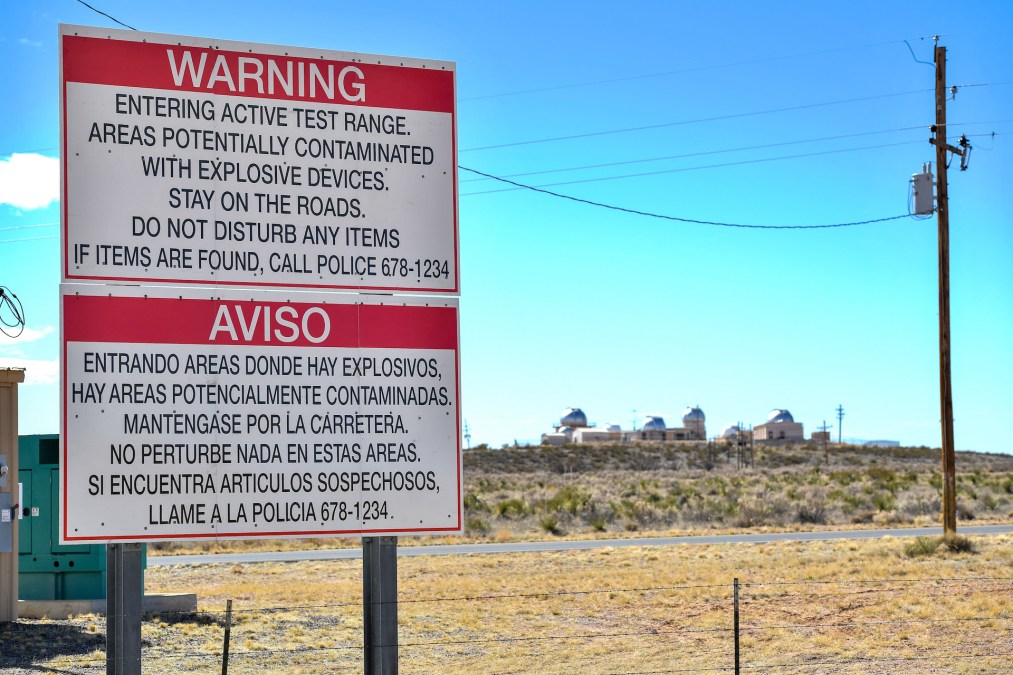
The FAA and Joint Interagency Task Force 401, the Defense Department’s counter-drone hub, will conduct the test at White Sands Missile Range in New Mexico between March 7-8. The test is intended to advance “the safe use of counter-unmanned aerial systems in the United States” and boost interagency coordination, according to the Pentagon.
The release did not disclose which high-energy laser system will be used in the White Sands test. A defense official, commenting on condition of anonymity, identified the platform as the Army Multi-Purpose High Energy Laser, or AMP-HEL.
“The most important aspect of this test is to show the safety features of using the AMP-HEL in the national airspace. During the test we will use both static and flying targets. The flying unmanned aircraft demonstrate the system’s accuracy and persistence by engaging only with targets that are clearly known and have been positively identified,” the defense official told DefenseScoop.
The announcement comes after lawmakers from both parties criticized interagency coordination over the use of domestic counter-drone technology in the wake of back-to-back incidents in Texas last month that caused airspace closures.
In mid-February, CBP used a military laser transferred from the Pentagon to down an object near El Paso, which news outlets reported to be Mylar balloons. Only weeks later near Fort Hancock, service members shot down a CBP drone that was launched without notifying the military task force assigned to the U.S.-Mexico border.
“This is a critical step in making sure our warfighters have the most advanced tools to defend the homeland,” Army Brig. Gen. Matt Ross, director of JIATF-401, said in a statement.
“By working hand-in-hand with the FAA and our interagency partners, we are ensuring that these cutting-edge capabilities are safe, effective, and ready to protect Americans from emerging drone threats,” he added. “Our measure of success is to quickly deliver state-of-the-art C-UAS capability to the warfighter, and this test furthers that mission.”
DefenseScoop reported Thursday that Ross and members of his team were in Kyiv last week — right before the U.S. and Israel launched strikes against Iran — to see how Ukrainians were defending against Russian drones, a version of which are being used against American troops in the Middle East.
The Pentagon described the upcoming test in New Mexico as part of a “long-term, multi-year partnership” between the Defense Department and FAA to “ensure counter-drone technologies are safely integrated into the national airspace.”
A defense official told DefenseScoop that the agencies tested a high-energy laser last year.
“For this [upcoming] test, we are only testing one system which is part of the Army directed energy program of record,” the official said.
The event is intended to “specifically address FAA safety concerns” and gather data on the laser’s effect on aircraft stand-ins and aircrew eye safety, and validate the platform’s automated safety shut-off systems, according to the release.
CBP and the FAA did not respond to a request for comment earlier in the week from DefenseScoop regarding the White Sands test.
Following a close-door hearing from agency officials on Wednesday, senators said the departments hadn’t been adequately working together, apparent given the two airspace incidents last month, and urged the federal government to quickly fix it, DefenseScoop reported.
Those incidents broadly related to competing efforts between the military and FAA: defending the skies against drone threats while keeping the airspace safe, senators said.
“Everyone wants to see hostile drones that are a threat incapacitated, but obviously we want to do so in a way that doesn’t pose a threat to civilian aircraft, and it ought to be possible to do both at the same time,” Sen. Ted Cruz, R-Texas, who chairs the Senate Committee on Commerce, Science and Transportation, told reporters. “It’s clear that in the early implementation of this technology, coordination fell far below what should have happened.”
Reuters reported that the LOCUST c-UAS system was used in the first accidental shootdown near El Paso last month. The company that develops it, AeroVironment, did not immediately respond to questions from DefenseScoop about whether its system will be used in the White Sands test.
The Pentagon said that the White House Task Force to Restore American Airspace Sovereignty, the Army’s program acquisition executive for fires, U.S. Northern Command and Joint Task Force Southern Border (the entity that CBP didn’t notify about its drone flight near Fort Hancock) will also be involved in the test.
Members of the Department of Energy, National Nuclear Security Administration, Department of Homeland Security, Customs and Border Protection, and the New Mexico National Guard “will be in attendance,” the Pentagon said.
“The test underscores an ongoing unified federal effort to counter threats posed by unmanned aerial systems while maintaining the sovereignty and safety of U.S. airspace,” according to the military.
Advocates of using laser weapons to take down drones have touted their low cost per shot and deep magazines.
Updated on March 6, 2026, at 11:20 PM: This story has been updated to include additional information about the planned laser test at White Sands Missile Range, including the system that will be used.