Transcom turns to AI-enabled logistics, data-driven planning as Middle East disruptions intensify
It’s no secret that Operation Epic Fury and the associated war in the Middle East have sparked major disruptions in the complex, global logistics network that U.S. Transportation Command relies on to move, equip and support the joint force.
But according to its commander Air Force Gen. Randall Reed, those disturbances are also enabling Transcom and its military partners to integrate and refine their joint logistics operations, and expand deployments of real-time data and AI-enabled visualization assets.
“Using information technology and some ‘smart’ systems of various kinds, that’s helped — one, for us to maintain visibility, to connect to the other contributing combatant commands, to get a common understanding of what’s occurring, and then also use that to help speed up the development of options and decisions,” Reed told DefenseScoop.
He shared new details about Transcom’s contributions to Epic Fury and what he’s learning about the challenges that inevitably accompany modern wartime missions, during a meeting with a small group of reporters at the annual Sea-Air-Space symposium on Wednesday.
A command pilot with more than 3,500 hours flying multiple military aircraft, Reed has extensive expertise in strategic airlift, special operations air refueling, and contested logistics.
“Make no mistake, what’s going on now is not a ‘normal Tuesday’ — but we really don’t change how we operate on Tuesday to handle this, and we specifically structure things that way, such that we don’t break anything,” he noted.
Broadly, Transcom is responsible for transporting forces and cargo worldwide for all U.S. combatant commands and defense agencies, as well as transferring sick and injured troops to medical facilities for specialized treatments and recovery — during peace and wartime.
“We’re operating at pace all the time. Then a crisis pops up. We spike to address the crisis. But we always plan, organize, train and equip ourselves so that we do one thing and one thing only — we respond, we don’t react. If we react, then we’re going to overextend ourselves,” Reed said. “By maintaining awareness and close collaboration with the rest of the combatant commands and services, then we’re able to respond to something and make micro-decisions along the way to keep the force steady.”
Operation Epic Fury was initiated on Feb. 28 by President Donald Trump, who billed it as a U.S.-led, Israel-coordinated military campaign to destroy Iran’s leadership, weapons arsenals and nuclear infrastructure.
Iran responded by holding up maritime traffic near the Strait of Hormuz on a major global shipping chokepoint for oil, and striking U.S. military installations and other targets around the Middle East with explosive drones and missile barrages.
As of Wednesday, the Navy is enforcing its own blockade on Iranian ports, while the U.S. and Iran remain locked in a fragile ceasefire that was set to allow peace talks in Pakistan.
“With all that’s happening in and around the Strait of Hormuz, it’s obviously a disruption,” Reed told reporters. “But we face [maritime disruptions] across the globe on any given day.”
He said that’s one reason why the command never plans around “a single point of success.”
As Epic Fury evolves, Transcom adapts and pivots its paths and plans, including by re-routing aircraft and other assets through alternative ports and airfields and pre‑positioning and diversifying fuel storage locations.
“We look at a number of places in conjunction with the [U.S. Central Command] commander where we can source things in the region, and particularly for us, transportation to help out,” Reed said. “While we’re primarily responsible for strategic transport, we do help out in theater. And so we’ve added additional assets in theater and people to help move things around.”
A key priority for Transcom under Reed’s leadership has been, as the commander put it, to set “the globe and then set the theater.”
“When we look at Centcom and supporting them, they are getting assistance from [Indo-Pacific Command], primarily from fuel, and they are getting assistance from European Command and the states,” he told DefenseScoop. “I think it’s pretty easy to see that, and setting conditions to connect all of those contributions to then flow in a way that’s helpful [to Centcom and other commands] — that’s what we’ve concentrated on for the last year and a half — how to really look at the globe for the things we’re doing each day, rewire the networks and set conditions for success, and then rush in.”
Regarding unique or historic elements of Epic Fury, Reed said that “what you’re seeing is the entire joint logistics enterprise, from just about every combatant command and every service, lending a hand — and this is very important to understand.”
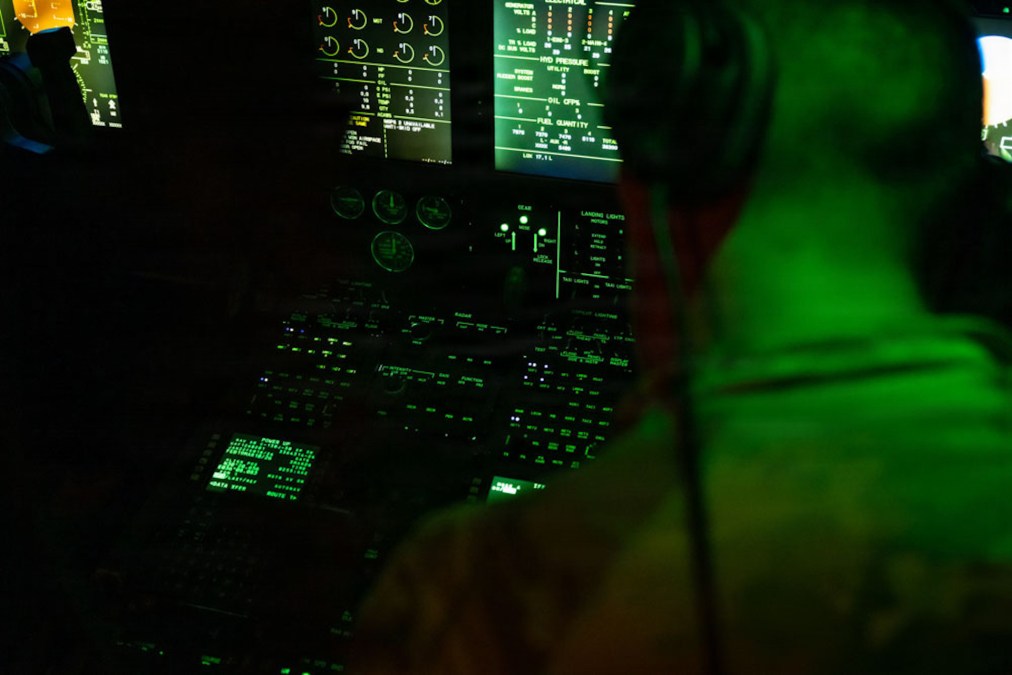
He further suggested that Transcom and its partners are applying AI and other technologies to enable worldwide visibility and situational awareness, networked planning and tracking systems, better connectivity across the CoComs, and a more comprehensive gauge of the military’s sprawling assets and operations.
“We are decisive, using real-time data to make informed, real-time decisions,” Reed said.
The commander also briefly discussed Transcom’s work involving drones and counter-drone operations.
“There’s an offensive piece, which we’re seeing and a lot of people are focusing on. And there’s a defensive piece for surveillance and force protection. And so drones are an issue and a factor no matter where we go,” he explained. “As Transcom gets called in to support someone or operate with someone, usually there’s somebody else that’s providing that protection for us.”
Reed said he typically sets the command’s requirements for protection, but the joint force determines how to execute on them and facilitates the counter-drone efforts.
“For the defense of critical infrastructure in the U.S., if I need support from that standpoint, I would typically turn to [Northern Command] to provide that for me, as well as civil authorities,” he told DefenseScoop. “And then if they have that lever to use, then they use that. But, really, that’s transparent to me.”