‘America’s seed fund’ is being revamped for modern warfare
The U.S. government is modernizing its Small Business Innovation Research and Small Business Technology Transfer (SBIR/STTR) programs to get after contemporary warfare and national security gaps, senior officials involved in the work said on Wednesday.
Referred to collectively as “America’s seed fund,” that decades-old pair of federal programs provides technology-focused small businesses and startups with early-stage investments and support to commercialize their products, and ultimately field them for use by federal agencies and the military.
“I think what you’re going to see is more urgency,” the Pentagon’s Chief Technology Officer Emil Michael told DefenseScoop. “There’s sort of specific modifications we’re going to make to make it easier … for small businesses by removing some of the barriers — regulatory and otherwise — that they currently face.”
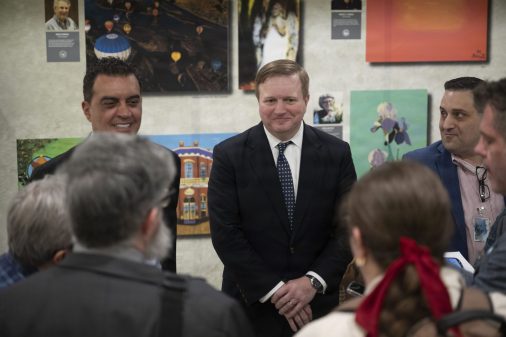
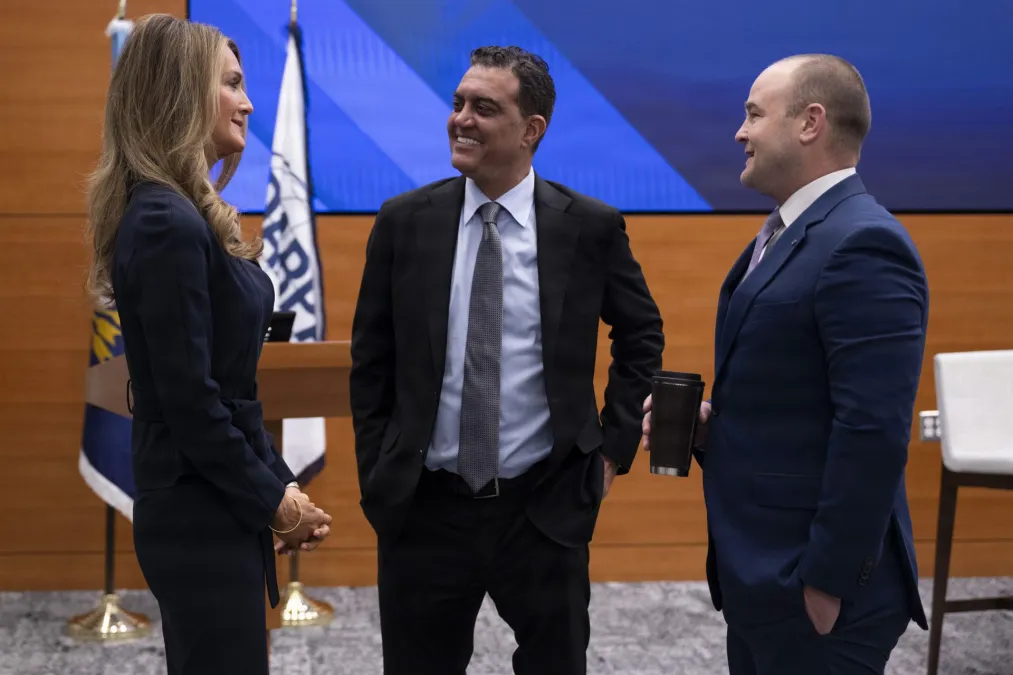
Michael, who wears dual hats as CTO and the undersecretary of defense for research and engineering, hosted a joint press event with Small Business Administrator Kelly Loeffler at the Defense Advanced Research Projects Agency’s headquarters in Virginia. At DARPA, they and other senior federal officials engaged with small business owners and industry representatives to discuss efforts to revamp these cross-agency programs and help build up the U.S. defense industrial base by aligning entrepreneurial innovation with urgent warfighting needs.
The event was held on the heels of the passage of the Small Business Innovation and Economic Security Act.
President Donald Trump signed that legislation into law earlier this month, which officially reauthorized the government’s SBIR/STTR programs through Sept. 30, 2031 — notably concluding a 6-month lapse.
The bill introduces several substantive changes to the programs’ administration and oversight, as well as other reforms to speed up the operationalization of federally-funded tech produced by small businesses.
“We stand here today modernizing a 44-year-old program in statute,” Loeffler told the audience on Wednesday.
As SBA’s administrator, Loeffler serves more than 36 million small businesses across the nation that provide assets to ensure national and economic security. She confirmed that the agency would be writing new regulations associated with the recent reauthorization over the next three to six months.
“I’m re-dedicating this agency to ensure that the SBIR/STTR programs achieve the aim of the statute to meet the demands of modern warfare, and I will just echo Undersecretary Michael’s comments — no longer is it acceptable to be aware of the challenges these programs face and to do nothing and to pass the challenges to the next leaders,” Loeffler said. “This administration brings an ownership mentality and a sense of collaboration across all agencies.”
It’s no secret that the SBIR/STTR programs have been plagued by challenges in the modern era, including funding freezes, concerns about selections and repetitive winners, scaling issues and stricter security vetting that have sparked uncertainty for small businesses that opt to participate.
“What you see in the reauthorization language is to actually streamline capability and processes across all the enterprises, right? So the bipartisan decision really was that this pipeline and these processes need to be more stabilized and more consistent for small businesses to manage across whatever customer that they have,” said Gina Sims, who leads the office for small business innovation at the Defense Department.
Michael added: “We want genuine small businesses to get their genuine shot. And no games — [we’ll] limit the gaming of the system by actors that might do that. If we do that effectively, we will increase the number of participants and give the people who haven’t had a shot more of a shot — and that’s the goal.”
The Pentagon CTO noted that, since the origin of SBIR/STTR, DOD’s all-time investment in the programs stands at more than $41 billion, with 80,000 awards made so far to 14,000 small businesses.
“This is how we turn American ingenuity into an overwhelming battlefield advantage for the warfighter. We’re looking at the leaders in this room right now to carry the legacy forward,” Michael said. “Many of the companies here today are innovating in space, AI, hypersonics and quantum to ensure that our warfighters can confidently face the emerging threats of our adversaries.”
Echoing that sentiment, DARPA’s Director Stephen Winchell said that that agency currently spends “about a third” of its core budget on small businesses.
“In addition, DARPA runs a very aggressive SBIR/STTR program that executes — on the order of last year, it was internally $120 million and then in total $190 million … that are going to small businesses,” he said.
The agency approves programs on a weekly basis, and according to Winchell, “not a week goes by that [officials] don’t see a program whose seeds and roots are in a small business.”
“So, whether it’s advanced manufacturing in space, whether it’s bio-engineering, advanced hardware, advanced software — every single one of these companies, every single one of these ideas starts with innovators in small businesses all around the country,” Winchell said. “And so pushing resources to them, sucking out their best ideas, and then scaling them up, is what we’re all about, and it’s what this event is all about as well.”
The senior defense officials also indicated that small businesses are crucial to diversifying the defense industrial base and supply chain to avoid reliance on single or foreign sources — particularly in high-demand periods like the present one where the military is engaging in combat in multiple regions of the world.
“Our small business partners bring the grit, the speed and the agility that the joint force needs to win, as we’ve seen in Operation Epic Fury, Absolute Resolve, Midnight Hammer and Southern Spear. We as a department have no time to waste. That’s a lot of operations in one year,” Michael said. “We’ve already made fundamental strides in changing the defense innovation ecosystem. We’ve opened the aperture for tech startups, and we’ve met hundreds of companies — many of whom are in this room.”
He noted that the U.S. military is applying new weapons and methodologies in the Middle East that were first deployed in the Russia-Ukraine war.
“We’re learning a lot from that, and we’re giving some of the startups a shot, too. It’s sort of a ‘live battle test,’ if you will, where you get real data and you see how things perform, like the LUCAS drone that’s been written about,” Michael told DefenseScoop. “And that’s giving us a lot of confidence in what these companies can do, and frankly it’s speeding up their T&E or test and evaluation timelines. That’s what we’re seeing.”
SBA’s Loeffler further emphasized that small businesses and startups can offer a long-term innovation engine that enables U.S. military advantages.
“As we continue to modernize our programs and accelerate technological advances to surge that technology to the battlefield, now is the time to look forward to the next 250 years,” she said. “And it’s not just about contemporary conflicts — it’s the future of might and deterrence.”