U.S. prioritizes mine-clearing ops after Trump makes ‘shoot and kill’ warning to Iran
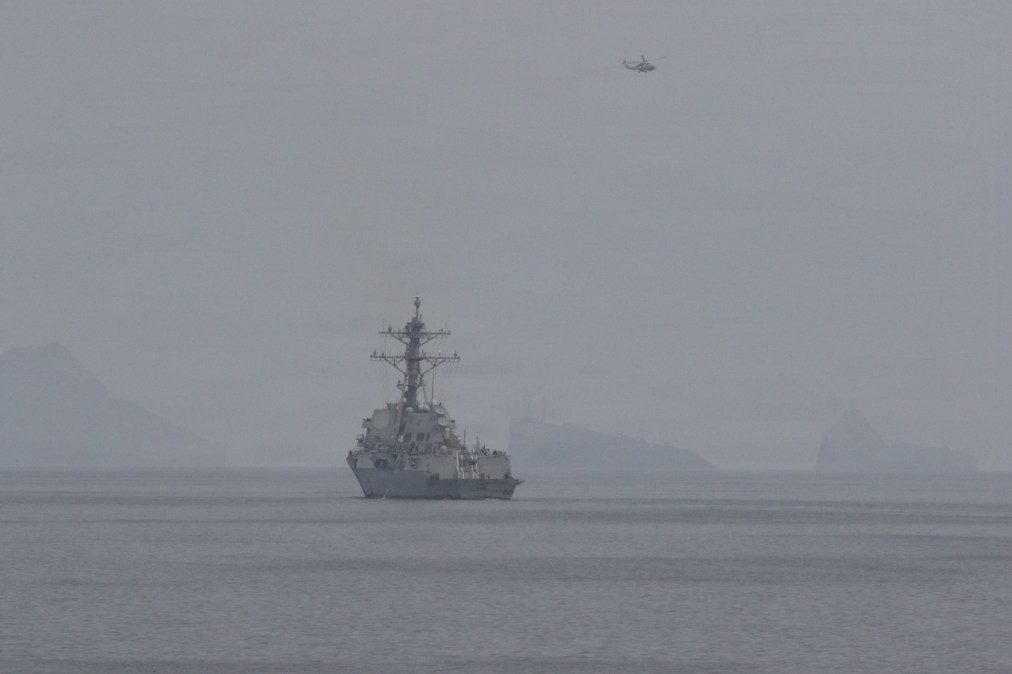
The U.S. military is expanding intelligence-gathering and minesweeping operations to clear out underwater explosive devices that are restricting maritime navigation in the Middle East as the war between Iran and the American-Israeli coalition hangs in limbo amid an uncertain ceasefire.
Defense and military officials supplied updates on those and other activities associated with Operation Epic Fury this week, after President Donald Trump ordered the Navy to use lethal force against any Iranian boats caught laying mines in the Strait of Hormuz.
“Our commanders have clear rules of engagement. If Iran is putting mines in the water or otherwise threatening American commercial shipping or American forces, we will shoot to destroy, no hesitation — just like the drug boats in the Caribbean,” Defense Secretary Pete Hegseth said at a press briefing Friday.
As he suggested, the joint force is aggressively pursuing a regional agenda to counter alleged cartels, narcotics distribution and adversarial influence in Latin America under the second Trump administration, including a large number of strikes against vessels carried out by U.S. Southern Command.
Simultaneously, since the launch of Epic Fury in late February, the U.S. has been coordinating with Israel in a large-scale military campaign to destroy Iran’s leadership, military arsenal and nuclear infrastructure. Tehran is responding by interfering with maritime traffic in the Strait of Hormuz on a major global shipping chokepoint for oil, and by attacking U.S. military targets around the Middle East with deadly drones and missiles.
Now, the Navy is enforcing its own blockade on Iranian ports, while the U.S. and Iran remain in a fragile ceasefire set to allow peace talks in Pakistan.
“A second aircraft carrier will join the blockade in just a few days,” Hegseth said. “This growing blockade has also gone global. Just this week, we seized two Iranian ‘dark fleet’ ships in the Indo-Pacific region that had left Iranian ports before the blockade went into effect.”
The secretary said that transits are currently occurring in the strait, but the rate of passages is limited and they’re happening with “more risk than people would like to see.”
In a social media post on Thursday, Trump announced that he’d ordered the Navy “to shoot and kill any boat … that is putting mines in the waters of the Strait of Hormuz.” He stated that those activities would be “tripled” in the near term, and that minesweepers were also actively clearing the strait.
“Part of what the president is threatening is ensuring, if there’s attempts to recklessly and irresponsibly lay more mines, we’re going to deal with that. It’s a violation of the ceasefire,” Hegseth said on Friday.
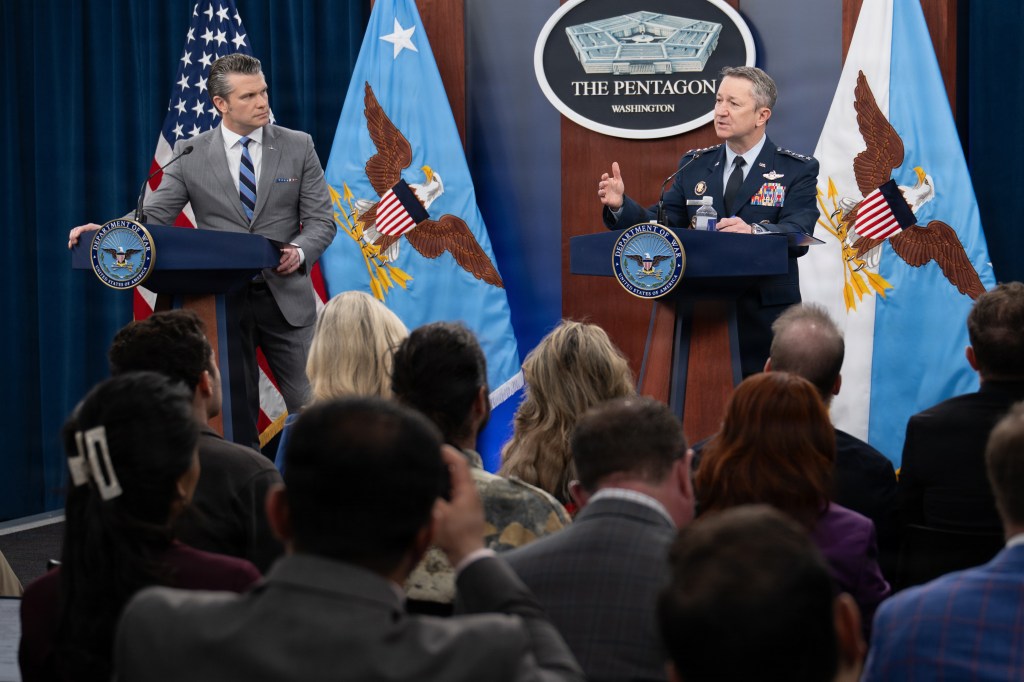
Speaking alongside the secretary, Chairman of the Joint Chiefs of Staff Gen. Dan Caine indicated that Iranians continue to operate “a variety of smaller Boston Whaler-sized boats” for mine-dropping missions, which reportedly span between 13 and 42 feet.
The two senior defense officials declined to specify the estimated quantity of mines Iran has placed in the strait, or the U.S. military’s expected timeline for fully clearing them out to allow for safer transits.
Naval mines typically are anchored or placed on seabeds, or float on or just below the surface — drifting with ocean currents. They can be difficult to locate, and represent cost-effective, passive weapons options that impact enemy naval assets or disrupt maritime navigation by creating dangerous obstacles.
“U.S. forces are actively addressing the matter using a combination of manned and unmanned capabilities to ensure passage through the strait is safe,” a defense official told DefenseScoop on Thursday. “Iran likely placed some mines in or near the strait at some point during the conflict. We’re not talking about a high volume.”
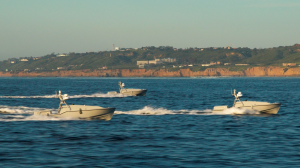
The Navy has been fielding and prototyping several variants of surface and underwater drones to scan for, detect and eliminate water-based mines over the last several years — including the MK-18 Mod 2 Kingfish, the surface-deployed Knifefish, and the Barracuda mine neutralization vehicle, among others.
“We don’t want an enemy or adversary to know what we’re throwing at them, whether it’s a lethal effect or a counter effect,” a U.S. military official told DefenseScoop on Friday. “When they know what’s coming or being used, they can better prepare and counter.”
Meanwhile, on the sidelines of the Sea-Air-Space conference earlier this week, Chief of Naval Operations Adm. Daryl Caudle also discussed how drones and accompanying modular platforms will be crucial to revitalizing the Navy’s mine countermeasure operations in the modern era.
“Mine warfare traditionally requires a permissive environment. The future is unmanned. We are moving toward autonomous systems and AI that can sense and report mines more safely and quickly than traditional ‘mowing the grass’ methods. However, those systems still need a ‘mothership’ to process data,” Caudle said at a media roundtable Monday. “We will bring every capability we have to the fight, including leveraging allies like the Baltic states and the U.K., who excel in this area.”