DARPA shares ‘Deep Thoughts’ solicitation for autonomous underwater drones
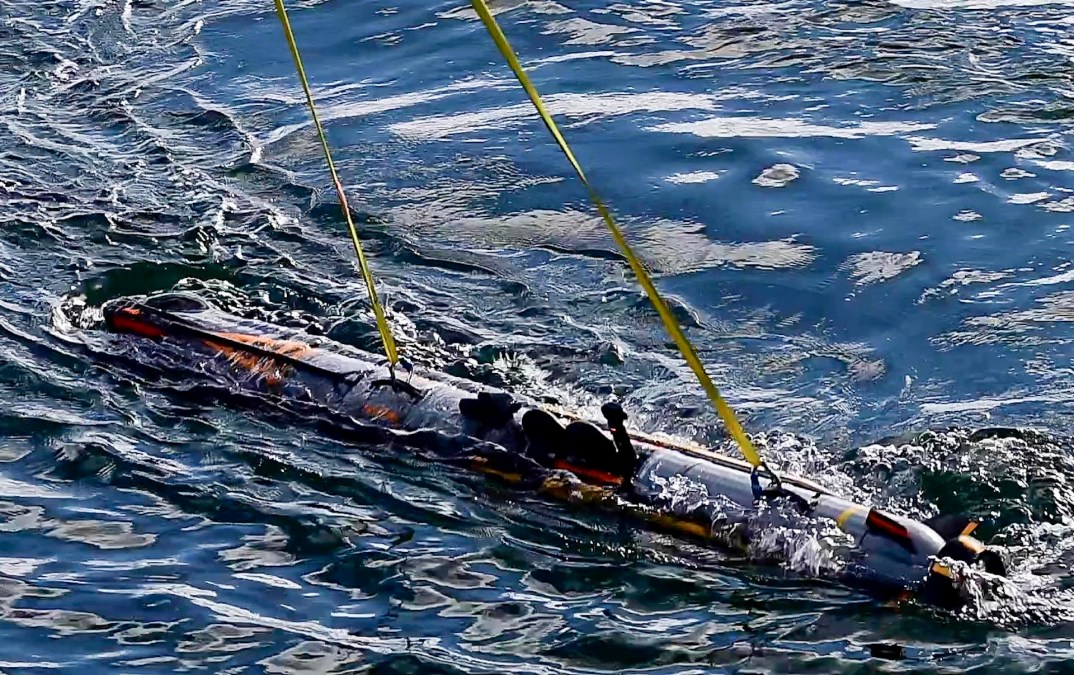
The Pentagon’s premier research and development agency released a solicitation Thursday for a program that aims to boost innovation in autonomous undersea vehicles.
The program, dubbed Deep Thoughts, is focused on several technical areas, including AUV and pressure vessel designs, materials science, manufacturing techniques, embedded subsystems and payloads, mission engineering and digital engineering capabilities.
Officials from the Defense Advanced Research Projects Agency (DARPA) are interested in novel materials, alloys and structural geometries; advanced manufacturing methods and techniques; and non-traditional approaches to subsystem and component architecture that enable free-form design, structural consolidation and multi-functionality, per the solicitation.
They’re also keen on having a “multi-level secure digital engineering ecosystem” to facilitate collaborative design, continuous integration, development and prototyping.
“Proposed research should investigate innovative approaches that enable revolutionary advances in uncrewed access to the full-ocean depths at a fraction of the size of current state-of-the-art AUV systems,” officials wrote in the solicitation.
DARPA is focused on “compressing the development cycle for deep-ocean autonomous systems from initial concepts to disruptive, mission-relevant, full-ocean depth AUVs by program completion,” they added.
According to the program website, officials want to reduce timelines for design, production, integration and testing of underwater drones from “years to months or even weeks.”
They aim to greatly reduce the size and cost of AUVs and enhance their producibility.
DARPA envisions developing underwater drones that can be easily deployed from a wide variety of platforms, noting that having “responsive and scalable access” to deep ocean environments would give the U.S. a strategic advantage.
The period of performance for the two-year, single-phase project is slated to kick off in November and will involve “fast-paced iterative design-build-test-learn cycles,” per the solicitation.
Industry abstracts are due May 21.
Multiple awards are anticipated, according to the solicitation, in the form of other transaction agreements for prototypes. The solicitation did not disclose the expected value of the OTAs.
The solicitation comes as the Navy is pursuing a variety of uncrewed platforms, including unmanned underwater vehicles, to augment the capacity and capability of its fleet. Last year, the sea service created a new portfolio acquisition executive for robotic and autonomous systems to oversee those efforts.
Industry has been developing new UUVs with the hope of selling them to the Defense Department and, in some cases, international customers.
At the Sea-Air-Space symposium this week, the deputy PAE for RAS said his office is getting ready to release a roadmap to industry to inform its marketplace for procuring maritime drones.
Chief of Naval Operations Adm. Daryl Caudle is also looking to launch a new Warfighting Development Center that specializes in training and deployment tactics for robotic and autonomous systems.