U.S. deploying ‘umbrella’ of defense and tech assets to shield ships in the Strait of Hormuz
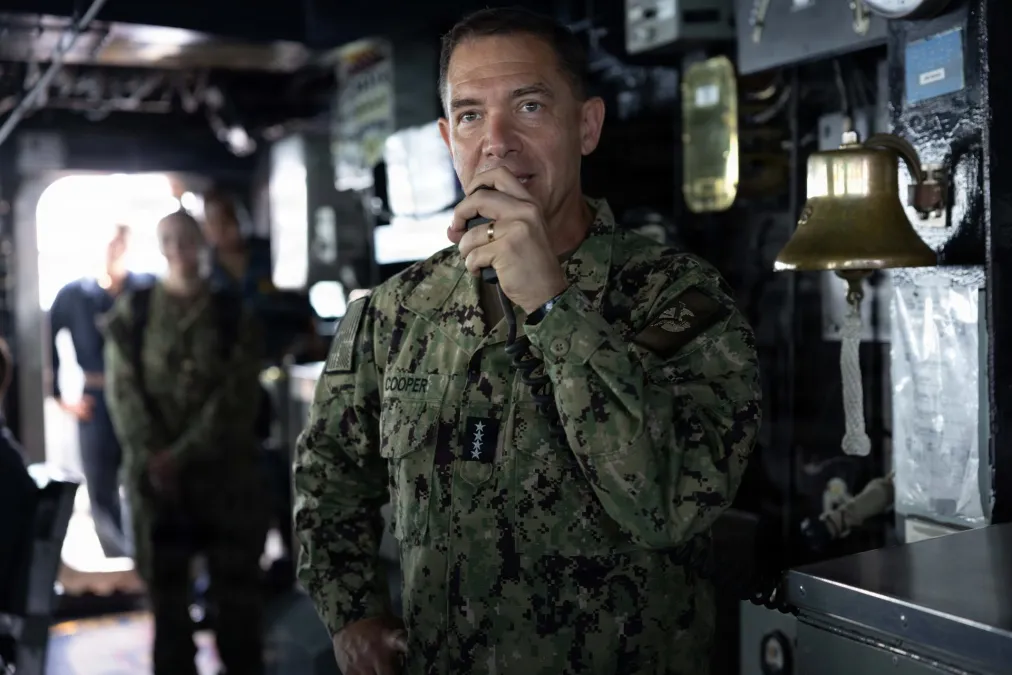
Iran has launched cruise missiles, drones, and weaponized small boats against commercial vessels and warships in the Strait of Hormuz over the last 24 hours, according to Adm. Brad Cooper, who briefed reporters on a new U.S. Central Command-led operation to safely reopen the global shipping chokepoint amid the war in the region.
“We have defeated each and every one of those threats through the clinical application of defensive munitions,” the Centcom commander said Monday.
The U.S. military is currently leading what Cooper referred to as “two separate and distinct” operations associated with Iran and that critical maritime trade route. The first involves enforcing a blockade in the Gulf of Oman to prevent the movement of commerce from Iranian ports.
The second is “Project Freedom,” which President Donald Trump announced Sunday and initiated Monday to help trapped merchant ships exit the Arabian Gulf and restart the flow of in-demand commerce across the strait.
Iran has disrupted a significant portion of global transports in that major waterway since late February, largely in response to Operation Epic Fury. Oil prices have subsequently surged worldwide.
Cooper emphasized at Monday’s press conference that Project Freedom is “inherently a defensive operation.”
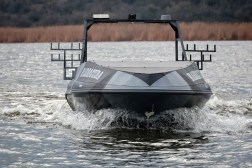
He said that the U.S. is not formally escorting individual ships. Instead, the military has built up a multi-layered buffer that includes aircraft, watercraft, airborne early warning systems and electronic warfare assets to help neutral vessels complete their transits.
“We are employing U.S. ballistic missile defense-capable destroyers, over 100 land- and sea-based aircraft, multi-domain unmanned platforms — meaning under the sea, on the sea, and from the air — and then 15,000 service members to extend this defensive ‘umbrella’ across the Strait of Hormuz to protect our forces and also, as committed, to defend commercial shipping,” the commander said.
In and around the strait, the U.S. has now concentrated A-10s, F-15s, F-16s, F-18s, F-35s, EA-18 Growlers, RC-135s, KC-46s and KC-135 fixed-wing aircraft and numerous U.S. warships, including destroyers, two carrier strike groups, an amphibious readiness group, and the Marine Expeditionary Unit.
Cooper also told reporters that AH-64 Apache and MH-60 Seahawk helicopters were “used just this morning to eliminate six Iranian small boats threatening commercial shipping.”
Centcom has contacted dozens of shipping companies and commercial vessels to encourage traffic over the last 12 hours. Cooper said the news has been “quite enthusiastically received.”
He denied reports made by Iranian state media earlier on Monday alleging that its military had struck two U.S.-flagged ships.
“We have gone through the strait. As we sit here right now, we have multiple U.S. Navy guided missile destroyers operating in the Arabian Gulf. And those destroyers that are not just there for themselves, they’re there to help protect commercial shipping,” Cooper said. “They’ve done so already in their part of this broad, air defense ‘umbrella’ that includes helicopters, as I described, and fighter planes — as well as ISR.”
The commander declined to answer questions about the types and distances of the missiles and drones that Iran has fired at military and commercial ships, but said there have been no injuries to U.S. personnel reported in the Project Freedom operations so far.
Though he wouldn’t supply much detail, Cooper also noted that the U.S. deployed “exquisite technology” and “low-observable capability” over the past several weeks to clear out underwater mines and create a pathway through the strait.
“We used our own military technology in a unique way to clear a free lane that’s not obstructed in any way, shape, or form through the strait,” he said.
U.S. defense leaders have steadily insisted that Iran’s weapons arsenal has been severely diminished since the start of Epic Fury.
“I’ll give you just an example [from] just from this morning. In my own experience — I’ve transited through the Strait of Hormuz probably 100 times in my career — you typically see between 20 and 40 small boats in the pack coming out. Today, we saw six, and eliminated them quickly,” Cooper said. “I think this is an example of the degradation of their capability. It doesn’t mean it’s all gone, but it’s highly degraded.”
The commander declined to comment on the status of the fragile ceasefire between the U.S. and Iran, or whether the new wave of military actions has put the pause for negotiations in peril.