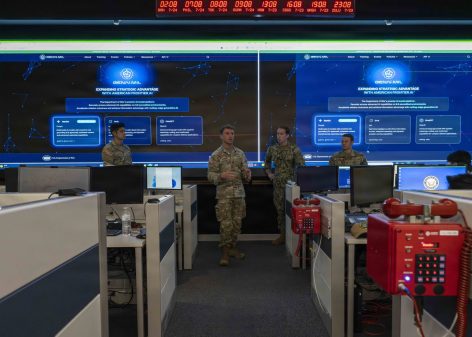
DOD expands its classified AI work with 8 companies — excluding Anthropic — amid ongoing dispute

Eight U.S. technology companies have signed formal agreements to deploy their frontier AI capabilities on the Defense Department’s classified networks “for lawful operational use,” according to a Pentagon press release published Friday.
DOD’s new deals with SpaceX, OpenAI, Google, NVIDIA, Reflection, Microsoft, Amazon Web Services, and Oracle follow a major contract dispute between the department and Anthropic that culminated earlier this year over potential ethical constraints that accompany the use of AI in warfare and for national surveillance.
“Integrating secure frontier AI capabilities into the Department’s Impact Level 6 (IL6) and Impact Level 7 (IL7) network environments will streamline data synthesis, elevate situational understanding, and augment warfighter decision-making in complex operational environments,” officials wrote in Friday’s press release.
DOD relies on its “Impact Level” classification system to categorize data and securely authorize cloud-based hosting environments and services.
Different federal agencies abide by different security protocols. For DOD, IL6 marks a rigid compliance standard that is required to process classified data for cloud-based defense workloads. Beyond that is IL7 — the most stringent security classification, which covers cloud computing environments designed to handle top secret, highly sensitive, or critical national security information.
The Pentagon’s press release notes that the eight companies “will provide resources to deploy their capabilities on both IL6 and IL7 environments.”
However, it’s unclear whether all those tech giants have already been fully authorized to deploy their capabilities on DOD’s classified networks at this time, or if some are on expedited paths to get there.
Pentagon spokespersons did not respond to DefenseScoop’s request for more information on Friday.
This effort supports the Pentagon’s AI acceleration strategy “by enabling new capabilities across its three core tenets of warfighting, intelligence, and enterprise operations,” officials wrote in the press release, and the underpinning agreements are expected to “accelerate the transformation toward establishing the United States military as an AI-first fighting force.”
Frontier AI refers to the most advanced, large-scale foundational models that are now pushing the boundaries of machine intelligence. While these powerful capabilities hold massive potential to transform military operations, the still-emerging models also pose serious risks to humanity that can range from ethical dilemmas to existential threats.
Last summer, Pentagon leaders unveiled individual contracts with OpenAI, Anthropic, Google and xAI — each worth up to $200 million — for “frontier AI projects.” Then, in December, DOD launched the enterprise-wide generative AI platform, GenAI.mil.
That hub is designed to deploy secure and reliable genAI tools to all service members and civilian users for tasks and data at IL5, which encompasses the highest authorization level granted to environments built to store and process controlled unclassified information (CUI).
“Over 1.3 million Department personnel have used the platform, generating tens of millions of prompts and deploying hundreds of thousands of agents in only five months,” Friday’s press release stated.
Of DOD’s original GenAI.mil partners, Anthropic’s models were the only ones at the time to also be integrated into the department’s classified workflows, via a partnership with Palantir.
But tensions between Anthropic and the Pentagon heightened in early 2026, reportedly stemming from disagreements over whether and how the military was applying Claude models in certain operations. DOD leaders subsequently moved to blacklist Anthropic as a “supply chain risk” — a designation that is typically reserved for foreign adversaries.
Anthropic sued the department in federal court and this high-stakes scuffle remains in active litigation.
Since the initiation of the GenAI.mil effort, the Pentagon has come to recognize that “it’s irresponsible to be reliant on any one partner,” its CTO and Undersecretary of Defense for Research and Engineering Emil Michael told CNBC on Friday.
“And we learned that that one partner didn’t really want to work with us in the way we wanted to work with them. We went out and made sure that we had multiple different providers — both open source, which is [a new] effort here at the department, and the proprietary model companies, and the infrastructure companies like Microsoft and AWS — and got them to agree to sign up to work with us on classified networks to make sure we had diversity supply,” Michael said. “We had the best of the best, and we had multiple different paths with open source and proprietary.”
In response to questions from DefenseScoop on Friday, Center for Security and Emerging Technology (CSET) Senior Research Analyst Lauren Kahn said DOD’s move to expand its industry-enabled classified AI work marks “a step in the right direction — it is necessary and, frankly, inevitable.”
She also called it “long overdue.”
“Ultimately, the Pentagon is a world of paper — the world’s largest bureaucracy — and this could dramatically facilitate work, much of which involves printing read-aheads, filling out rigid forms, and formatting talking points just right. Anthropic was the first company on the high-side, which paved the way for these other companies,” she explained. “These models all have different strengths and are evolving and updating at lightspeed, so it’s important to have access to a variety and let Pentagon users shop around — giving them access to the same capabilities civilians have in their everyday lives, and the same way they do now on the unclassified side.”
Prior to CSET, Kahn was a policy advisor for force development and emerging capabilities in the Office of the Undersecretary of Defense for Policy at DOD.
In her view, the announcement “smartly highlights upfront” that these systems will be used for “lawful operational use,” thus acknowledging some of the anxieties circulating about frontier AI in the wake of the recent events.
It’s not covered in the press release, but Kahn said the next step the Pentagon must pursue “to have any real effect at scale” will involve ensuring operators and DOD users are trained against things like automation bias, the tendency to overdelegate to machines — and that they begin to understand the benefits, pitfalls, and limitations of these systems.
“Having access to multiple models, other than hedging against vendor lock-in, actually helps accelerate that learning, because users can directly compare responses, accuracy and speed, and start to appreciate that not all these systems work the same way,” Kahn told DefenseScoop.