Air Force looks to accelerate F-15 EW upgrades at new ‘Speedline’
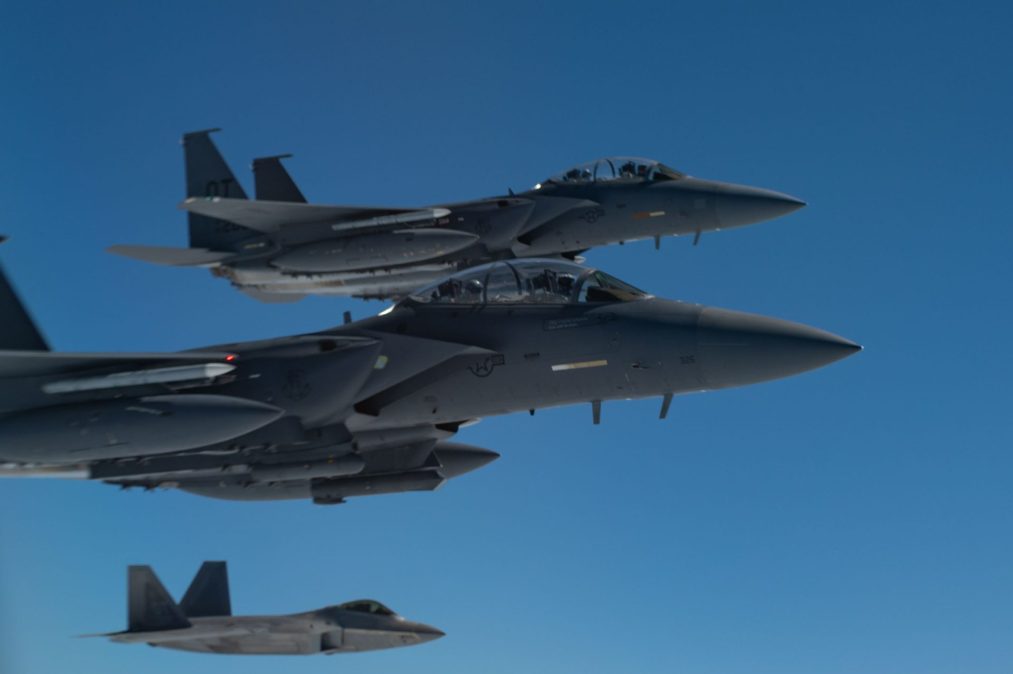
The Air Force Life Cycle Management Center has officially launched a dedicated facility that will allow the service to more quickly integrate its F-15E Strike Eagles with modernized survivability equipment.
Located at the Warner Robins Air Logistics Complex in Georgia, the new Eagle Passive/Active Warning Survivability System (EPAWSS) “Speedline” will enable the Air Force to upgrade its Boeing-made F-15E fighter jets with critical electronic warning capabilities outside of routine maintenance, AFLCMC announced Tuesday. The first aircraft is expected to arrive at the facility for installation in June, according to the service.
The EPAWSS is an advanced electronic warfare suite developed by prime contractor BAE Systems that’s intended to replace legacy analog equipment onboard the Air Force’s fleet of F-15 aircraft.
In early 2025, the Air Force cleared EPAWSS for full-rate production and awarded a $615.8 million contract to Boeing to cover installation. Shortly after, the first F-15E fully equipped with the EW suite was delivered to RAF Lakenheath in England.
Currently, the system is integrated onto the F-15E during the jet’s routine depot maintenance — a timeline that limits upgrades to an aircraft’s standard maintenance schedule. The Air Force established the schedule as a way to offset delays caused by difficulties in installing the upgrades onto legacy aircraft and workforce limitations, according to the Government Accountability Office’s weapons assessment published in 2025.
“The newly established Speedline resolves this limitation and operates entirely independent of the standard [programmed depot maintenance] line,” AFLCM said in a news release. “This vital separation provides the program with the necessary flexibility to complete installations of this critical defensive system on aircraft that may not be due for PDM for another five to seven years.”
The system provides full-spectrum EW capabilities that are standard for the newer F-15EX Eagle II jets. It leverages technology common on fifth-generation aircraft — including radar warning, geolocation, situational awareness and self-protection — that protects the F-15E as it flies deeper into contested battlespaces.
“The integration of advanced electronic warfare suites, such as the Eagle Passive Active Warning Survivability System, ensures the F-15E will not just survive, but actively disrupt and dismantle adversary kill chains in the most highly contested, electromagnetically dense environments,” Lt. Col. Matthew Heil, EPAWSS materiel leader at the F-15 program office, said in a statement. “We are not merely extending the life of this platform; we are aggressively expanding its lethality and survivability to ensure it dominates the modern battlespace.”