Army’s heavy units face counter-drone capability gaps
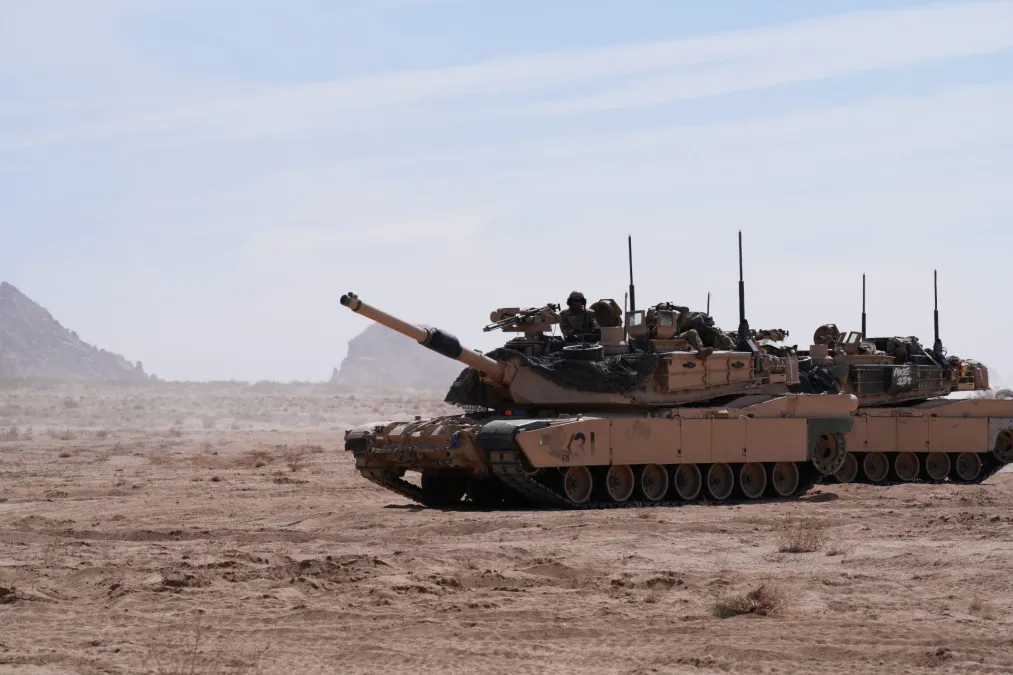
During a recent training rotation to the Mojave Desert, soldiers with 2nd Armored Brigade Combat Team reckoned with a problem heavy units across Eastern Europe have become all-too familiar with in recent years: drones.
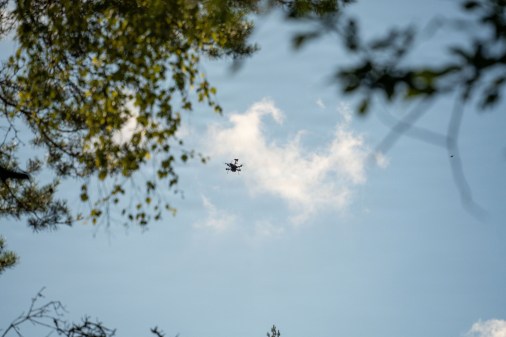
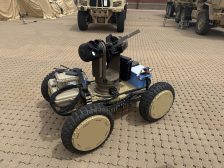
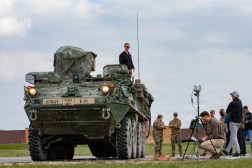
While troops with the Spartan Brigade launched loitering munitions, reconnaissance drones and electronic effects at a simulated enemy in Fort Irwin, California, last month in concert with their tanks, Bradleys and light vehicles, unit leaders also told reporters on Thursday that unmanned aerial systems still present an enduring issue for the tank-centric formation.
Lt. Col. Joseph Steadman, commander of 6th Squadron, 8th Cavalry Regiment, said the inability to defeat drones counts as “the biggest capability gap that we have as an Army Brigade Combat Team in order to maintain maneuver.”
“If we can’t do something about the enemy’s UAS and do it rapidly, then we’re not going to be successful at continuing to maneuver,” he said. “We, as an Army, are continuing to figure that out, there’s a lot of great projects going on way above us.”
The Russia-Ukraine war has demonstrated just how vulnerable heavy vehicles like tanks are to cheap drones that can attack weak spots in armor from any direction. Early on in the conflict, soldiers in both armies modified tanks into near-unrecognizable hulks, often seen adorned with so-called “cop-cages” to protect crewmembers from lethal UAS buzzing across the battlefield.
The development, compounded by grinding, frequently impenetrable stretches of contested front; the vulnerability of U.S.-made Abrams tanks in the conflict, which have become further modified by Ukrainian soldiers; and attrition of Cold War-era armored vehicles on both sides ignited a now-yearslong debate about the relevance of armored units in modern conflict.
Amid the Army’s sweeping plan to adapt to contemporary battlefields, armor branch leaders have acknowledged “uncertainty” about the community’s ability to adapt, while leaning into new technology, investing in new vehicles — such as the AI-minded M1E3 tank and XM30 replacement for the Bradley — and refreshing doctrine with sections advising tank platoons on drone defense.
2nd ABCT also recently trained to replenish its logistics-hungry formations using UAS to help mitigate the vulnerabilities of its large sustaining force. During the rotation in California, units worked to shorten refuel times and the brigade used Infantry Squad Vehicles to quickly zip to advantageous positions and launch drones.
Still, the branch has faced deep cuts to its cavalry squadrons and recent divestments to its armor formations amid criticism over its significance. And drones remain a chief concern.
The Small Wars Journal recently published an essay about the armor branch’s self-imposed “death ride” into obsolescence, warning it could “be dead by 2035” should it fail to change. Its author, retired Lt. Col. Amos Fox, argued the community is hampered by insularity and an outdated “maneuver-centric fetish,” also failing over the last two decades to cultivate leadership, maintain influence in the force and generally justify its relevance to modern conflict.
It was “thought provoking,” Col. Alexis Perez-Cruz, commander of 2nd ABCT, said of the essay. But the armor branch “remains the only force capable of delivering decisive, large-scale shock and terrain seizure when windows of opportunity open.”
“Is the battlefield changing in the way that we’re using technology, AI, drones, space? Yes,” he added. “The modern battlefield may limit some maneuver, but when deception, electronic warfare, firepower creates even just brief openings, armor formations are still the only elements that can rapidly penetrate, exploit, and we hold ground at scale.”
Those openings will depend on a whole host of new battlefield factors, a major one being able to counter drones. During the exercise, Steadman said that his forward scouts had success in mitigating the UAS threat by spreading out so the enemy could not mass its effects and target formations all at once. Other units have taken a similar approach.
“I don’t think at our level … we have enough of the technology,” Perez-Cruz said. “I think with current conflicts and all of the things happening, a lot of that, it’s being tested elsewhere in real life. I think we’re just scratching the surface on counter-UAS.”
While the vulnerability of expensive tanks against such small, cheap drones might represent one of the starkest examples of the drone vs. counter-drone imbalance, ABCT’s are not alone in their plight.
Scaling counter-UAS technology across the military has been an enduring problem, recently illuminated by the Iran war. The Pentagon rushed countermeasures to the Middle East region during the outset of the conflict, where the military had used expensive, hard-to-make interceptors against cheaply-made Shahed one-way attack drones launched by Tehran.
During a recent multi-day trip to Fort Carson, Colorado, where the 4th Infantry Division was testing the Army’s Next Generation Command and Control prototype, none of the sub-units DefenseScoop visited reported having organic counter-drone equipment.
In January, the publication also reported that soldiers deployed to the southern border amid the second Trump administration’s immigration crackdown queried senior Army officials during a town hall about a handheld counter-UAS weapon known as the Dronebuster, which the Army’s top civilian leader called “fucking terrible.”
As the Pentagon’s Joint Interagency Task Force 401 works to proliferate counter-drone technology across the military, rework policy and develop new tech, senior military leaders have also signalled concern about the protection of patrolling troops against UAS at the border.
Meanwhile, both the SWJ essay and 2nd ABCT leaders identified the air-ground littoral zone, or AGL — a narrow distance on the battlefield between airspace and land that has become congested with deadly new tech, yet key in the Russia-Ukraine war — as critical terrain for heavy units to own.
Perez-Cruz said that the combined arms nature of his formation, which uses engineers, infantry, air defense, and other types of units, would help the ABCT avoid remaining static on the battlefield and control key terrain.
But “until we solve the counter-UAS problem,” Steadman said, “we’re never going to fully own the AGL.”