SDA hopes to keep certain decision-making authorities as Congress weighs its future

NATIONAL HARBOR, Md. — As policymakers and Pentagon leaders determine the Space Development Agency’s future, its personnel are focused on meeting near-term deadlines to deploy the next generation of U.S. military satellites that detect hypersonic missiles and other emerging weapons threats.
SDA’s Director Gurpartap “GP” Sandhoo shared new details about how the agency is operating in this time of uncertainty, during a media roundtable Tuesday on the sidelines of AFA’s annual Air, Space and Cyber Conference.
“I personally have some concerns, but not too many because of some of the unique authorities that we have at SDA. If we keep those, then that doesn’t change anything. Then, it’s just a name change,” Sandhoo told DefenseScoop. “But if you lose some of those, then there’ll be some challenges we’ll have to navigate.”
He specifically pointed to the agency’s existing special hiring, original classification and head of contracting-related authorities.
“We can just move out. I don’t have to go to anybody to get those permissions — I could just make those decisions. So, that allows for very fast decision-making,” Sardhoo noted.
His comments follow legislative proposals that were recently introduced in both chambers of Congress featuring language that could dissolve SDA and transfer its standalone authorities to the Space Force’s new portfolio acquisition executives (PAEs).
Senate and House lawmakers are considering drafts of the fiscal 2027 National Defense Authorization Act that include provisions to repeal existing laws that established the SDA as well as the Space Rapid Capabilities Office.
Elements of those organizations could be absorbed into the U.S. Space Force’s acquisition structures down the line.
“If that’s what the NDAA is, that’s what the NDAA is, right? So I think those things are kind of beyond our control at this point,” Sandhoo told DefenseScoop. “But at the same time, we are trying to deliver the capability.”
He confirmed that the Department of the Air Force has been and will be holding meetings with the SDA and the Space Force to puzzle out the agency’s potential revamp or realignment.
“There’s many ways to organize,” he said.
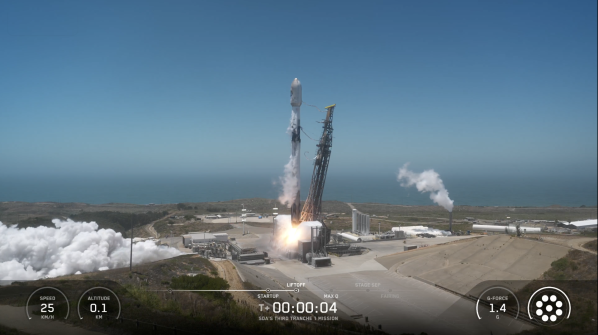
Since its launch in 2019, SDA has broadly been charged with rapidly fielding a mega-constellation in low-Earth orbit — known as the Proliferated Warfighter Space Architecture (PWSA) — made up of data transport, missile warning and missile tracking satellites that are being developed and launched in a series of tranches.
Previously SDA’s deputy, Sandhoo led the agency in an acting capacity from September 2025 to May 2026, when he was elevated to serve as its permanent director.
At that time, he was also named as the new portfolio acquisition executive for the Space Force’s missile warning and tracking programs. This move was likely made in anticipation of an NDAA inclusion that would make the SDA director responsible for that specific Space Force work.
“So, [we stood the PAEs] up from an acquisition perspective,” Sandhoo said Tuesday. “The Space Force has to decide how to organize and equip these units and entities, or centers, or directors, or system deltas.”
In response to reporters’ questions, he acknowledged the possibility that Congress could eliminate SDA in its current form, based on the NDAA draft legislation.
“They may choose to keep it. They may not,” Sandhoo said. “What the final language looks like, we don’t know yet.”
However, because SDA’s mission sets are already being folded into new PAE portfolios, the director suggested the agency’s rapid acquisition model is maturing into the Space Force’s standard buying blueprint.
“We are very fast at making a decision given the authorities we have [as a] single entity responsible for delivering the capability — which is [like] the PAE model they’re trying to get to. We’ve kind of been doing this for the last seven years, so we’ll see how that turns out,” Sandhoo told DefenseScoop.