Pentagon’s JWCC follow-on would create cloud marketplace, expand AI and edge computing

The Pentagon’s next iteration of the Joint Warfighting Cloud Capability (JWCC) contract would establish a cloud marketplace for military users while expanding support for artificial intelligence, edge computing and cross-domain operations, according to a draft solicitation.
On May 20, the Defense Information Systems Agency published a draft performance of work statement for the upcoming JWCC Unified Cloud Marketplace (UCM) contract on Sam.gov. Previously known as JWCC Next, the program is intended to create a single marketplace through which Defense Department organizations can access authorized cloud services from a broad range of vendors.
Under the proposed structure, the UCM would be organized into three tiers. The first would consist of hyperscale cloud service providers delivering core infrastructure and platform services. A second tier would encompass “Everything-as-a-Service” (XaaS) offerings — including software-, platform- and infrastructure-as-a-service capabilities. A third tier would be dedicated to commercial innovators and small businesses offering cloud-based technologies that meet the department’s security requirements.
The recently published draft PWS specifically covers the hyperscale tier of the proposed marketplace. However, the document provides additional information on the upcoming XaaS and commercial tiers, while highlighting the Pentagon’s broad plans to streamline access to cloud-based capabilities.
The Defense Department awarded Google, Oracle, Amazon Web Services and Microsoft contracts spots on the $9 billion JWCC program in late 2022. The contract served as a replacement for the controversial Joint Enterprise Defense Infrastructure (JEDI) program and provided secure, multi-cloud capabilities to the department in support of operational, intelligence and enterprise workloads.
While officials have touted the success of JWCC, the Defense Department began working on a successor contract in 2024 to improve the program — such as by adding more cloud service providers and different contract types.
The draft PWS places new emphasis on deploying cloud capabilities from hyperscalers to support operations in denied, degraded, intermittent or limited-bandwidth (DDIL) environments where connectivity may be unreliable.
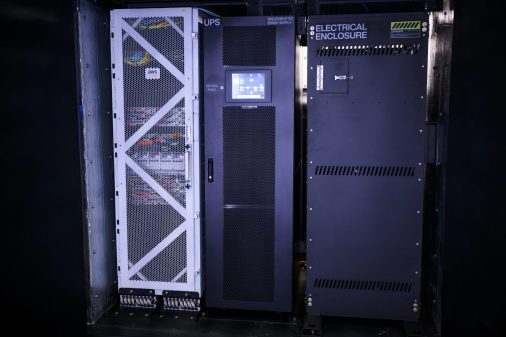
The Pentagon also wants to include edge devices and services in the JWCC UCM contract that can host and deploy cloud-based capabilities and “operate seamlessly across varying network connectivity levels, including in DDIL environments,” the document noted. Those could include man-portable or vehicle-mounted systems, as well as modular deployable data centers.
Artificial intelligence integration is another major focus of the proposed JWCC follow-on. The draft solicitation calls for cloud service providers to offer AI and machine learning capabilities across all classification and impact levels, including for DDIL environments. The Pentagon is also seeking analytics services to support activities such as data labeling, model training and the deployment of AI models in operational settings, according to the PWS.
“The solution must provide artificial intelligence (AI) and advanced data analytics services that securely enable data-driven and timely decision-making at the tactical level (i.e., within a single data domain), the operational level (i.e., a collection of local data domains), and the strategic level (i.e., across all data domains),” the document stated.
The draft solicitation also calls for hyperscalers to provide solutions to move data between systems operating on disparate networks, a longstanding challenge for the Pentagon. Capabilities will be required to support secure data transfer between classification and impact levels, making it easier to share information across the entire department.
The cross-domain requirements complement the broader push for artificial intelligence in the JWCC UCM. As the military develops AI tools that rely on data from multiple organizations and networks, the Pentagon will need mechanisms to securely transfer that information. The draft PWS specifically calls for AI and advanced analytics services that can work across multiple datasets and organizations in order to help gain a more complete picture of operations.
Furthermore, the draft solicitation places emphasis on resiliency, requiring JWCC UCM capabilities to continue operating amid infrastructure failures or cyber threats.
According to the draft solicitation, a provider’s solution should be able to operate continuously “despite catastrophic failure of portions of the infrastructure” — which could be caused by natural disasters or an enemy physically destroying U.S. structures.
The Pentagon is focused on solutions that can withstand adversary cyberattacks, as the document notes contractors will be required to conduct cybersecurity exercises that simulate attacks against both government and vendor-operated portions of the cloud environment.
The assessments would be carried out by red teams certified by the National Security Agency and could test the systems from different attack scenarios, including threats originating from inside and outside the network.
Additional information on the other two tiers planned for the JWCC UCM are forthcoming, according to the notice. Overall, DISA is expected to publish a final JWCC UCM request for proposals before the end of the year, and the agency plans to begin awarding contracts in 2027.