1.5M people use GenAI.mil, Pentagon CTO says
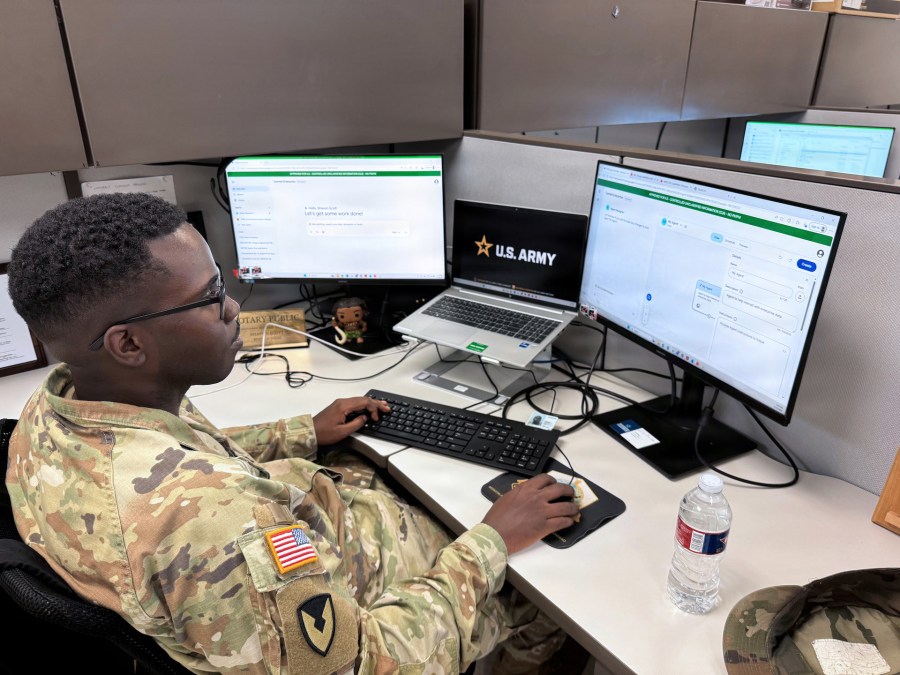
The Defense Department’s enterprise generative AI platform is now being used by 1.5 million personnel, according to Pentagon CTO Emil Michael.
GenAI.mil was introduced in December to give DOD employees access to commercial AI tools and bring efficiencies to their workflows. Google’s Gemini products were the first to be made available in the new system, and OpenAI’s ChatGPT and xAI’s Grok were also set to be integrated.
There were just 80,000 AI users in December, Michael noted during remarks at the Hudson Institute on Friday.
“It wasn’t really clear where to go for it, what you could use it for, the rules were unclear, so we just blew through that. We launched Gemini on our unclass[ified] networks, and today we have one-and-a-half-million people out of three-and-a-half million people using AI every day. So think about that. If you just present it to people, because these people were also in their private lives using it, so they knew what it could do. It just wasn’t available at work. So we just put it in front of them, and then we do case studies on what are the things people are using it for. Those things are now proliferated throughout the department,” he said.
“More and more people are like, ‘Oh my god, I could write a job description.’ I mean, very simple things to more exquisite things. ‘I have to report to Congress every year on this thing. Let me load all the papers onto it and have it draft me a congressional report that would otherwise take 200 hours of staffing time and do it in five hours.’ So it’s just a matter of trying to catch up to, in this case, what’s basic in the commercial world,” Michael added.
In recent months, the department created more than 100,000 agents that were customized for certain tasks.
As generative AI tech has proliferated throughout society, experts have warned about “hallucinations” and other ways that models can make mistakes.
Michael said there’s “risk in everything,” but he told conference attendees that there are “guardrails” in place for GenAI.mil.
He noted that 50,000 people have signed up for training on the tech, and there’s still a waitlist for that.
“People want to learn how to do this stuff. The policies are written out clearly, and appropriate guardrails and stuff for what people could do,” Michael said. “Right now at this level we’re not talking about the warfighters in Central Command, we’re talking about the average employee. But you know, I think we’re OK. The same rules apply to your web browser. You could do things in your web browser and search for certain things that [the Department of War] doesn’t want you to do … [and there are] policies against it, you know. You could do the same thing with AI. It’s not that different,” Michael said.
The GenAI.mil platform is meant to reduce drudge work for employees.
However, the U.S. military is also keen on using other AI tools to aid warfighting. That type of tech was reportedly used extensively during Operation Epic Fury against Iran.
Michael said that target lists are still being developed “independent of AI.”
“They’re done by like a group that’s like very sophisticated at doing that. But what AI could do is say, when do you hit that target because what’s happening in the weather, where are your assets, where’s the allies’ assets, and what will happen when, and when is the ideal time to strike a target that someone else has selected? So you could use less resources, you could do it at a time of need that’s more specific, and you don’t have fratricide or conflict with other parts of your force. So you could just see and consume more data to make you make better, faster decisions,” he said.
Every combatant command now has access to AI, according to Michael.
“It’s proliferated,” he said. “We’re starting out with simpler use cases, and they’ll grow to more exquisite use cases as we get more familiar and have the right policies in place. So, you do have to have some policies in place on this stuff.”
He added: “Think about developing a weapon. You need to do aerodynamics, physics, math. How can it speed up the creation of digital twins so before you build something, you know it’s going to work. And modeling and simulation. A lot of the things that lead up to a warfighting capability or combat power, you could use AI to do. And so we’re kind of trying to touch all those domains.”
Capacity is a concern. As part of its so-called “AI Arsenal” initiative, the Pentagon is requesting close to $30 billion in fiscal 2027 to invest in next-generation AI supercomputers and modernize the military’s computing infrastructure to power them.
The department needs more capacity if it’s going to expand its use cases, Michael noted.
“I’m trying to find a better word for ‘data centers’. I’ve been thinking about ‘combat compute commands,’ something like that. But we have to have enough so that we can do these more and more exquisite use cases, and that’s what AI Arsenal is about. And I am worried about this anti-data center movement generally for the country, because China, while they don’t have the exquisite chips that we have, they do have a lot of power, like electricity, and they do have a lot of will. So we have exquisite chips, the best researchers, the best models, [but] we might be constrained on power and community resistance. There’s no community resistance in China, they’ll put a data center wherever they want. So, it’s how do we make sure that that’s not the bottleneck for us.”
The Pentagon can’t just rely on commercial cloud providers and hyperscalers to build sufficient data infrastructure that the department could tap into, according to Michael.
“Because when we’re doing secret or top secret work that’s not done on a commercial cloud, we have to do that in a specialized cloud environment that’s air-gapped, that’s protected from other systems and other intrusions, and it’s way more defended, if you will,” he said. “That means it’s a different kind of cloud, it’s bespoke, and it’s only usable by us. That’s why it has to be different.”