Army will ‘open up’ ranges for defense vendors to speed up testing, with some sites mimicking Ukrainian frontlines
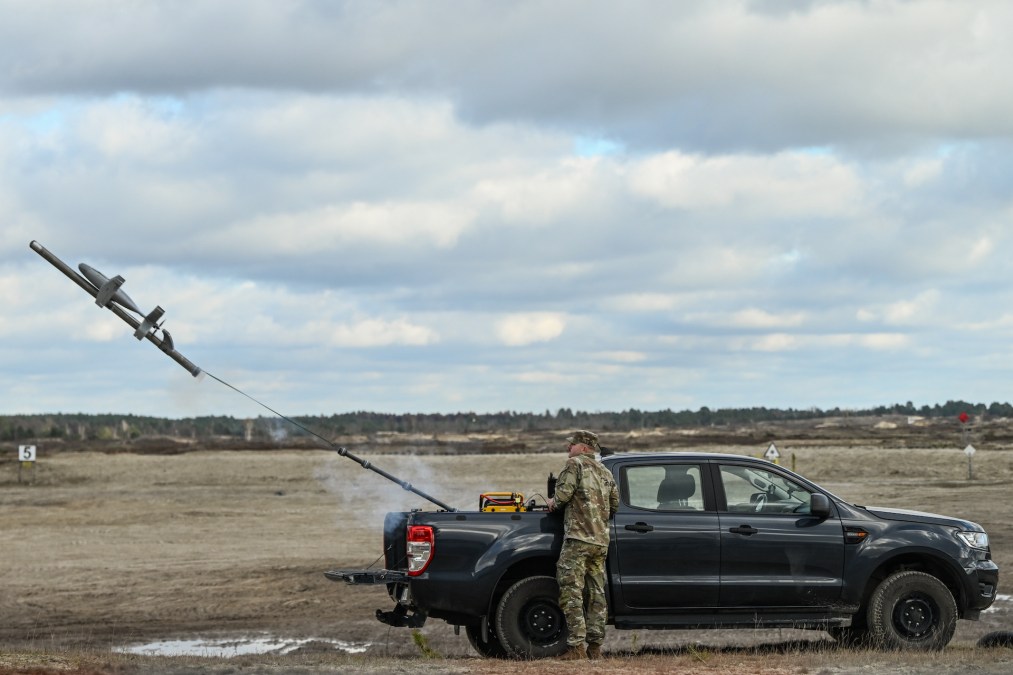
With vendors facing lengthy wait times to test new technology, the Army plans to increase industry access to its domestic ranges over the next several weeks, according to senior service officials, who said that at least two of those sites will mimic Ukrainian frontlines.
The service is also planning to establish a range abroad where the Army and industry “can start to do much more aggressive testing,” Army Secretary Dan Driscoll said Tuesday, though he declined to say which international U.S. ally the service will partner with to build it.
Driscoll, along with the Army’s top acquisition chief, Brent Ingraham delivered the remarks to reporters on Tuesday at the service’s low-cost interceptor industry day, where several officials urged defense vendors to help rapidly develop systems to take down drones, missiles and other aerial threats.
“We need systems that can scale. We need designs that can account for supply chains, production capacity, and sustainment from the beginning, not as an afterthought,” Brig. Gen. Guy Yelverton III, capability program executive for the Army’s defensive fires, told the industry audience. “We need capabilities that can be adapted as the threat changes, because the enemy is not going to wait for us to complete a traditional development cycle.”
That development cycle can take a long time and the Army is racing to field massive amounts of low-cost interceptors. The Iran war put in stark relief the imbalance between deploying expensive, hard-to-make defensive weapons the U.S. military has relied on for years against cheap, mass-produced offensive systems like Tehran’s Shahed drones.
“Imagine you’re standing in a modern technical operations center, the radar pings, an incoming threat is detected, and the commander makes a call to engage,” said Dwayne Hynes, who focuses on foreign threats for the Army’s intelligence staff. “A sleek, highly advanced interceptor rolls off the rails, breaks the sound barrier, and flawlessly obliterates the target in a spectacular explosion.”
“We took care of the threat, but let’s look at the math behind that,” he added. “We just shot an exquisite $2 million interceptor against a $20,000 drone made out of commercial off-the-shelf components and a lawnmower engine. You just can’t sustain the math.”
To get ahead of what officials call the munitions “cost curve,” the Army needs cheaper, mass-producible defensive weapons to tip that scale against its adversaries. It needs them quickly, officials said, and part of speeding up production means giving industry better access to the service’s ranges to test new systems.
Currently, defense companies, especially small start-ups, may have to wait 12 to 18 months to book Army ranges to test their systems, Ingraham said, describing the delay as a “limitation” to new companies and innovation.
“What we as a country have not built yet that a lot of other nations already have is places with less restrictions so you can do that,” Driscoll said.
So, over the next four to six weeks, the Army will begin making its domestic ranges more accessible as it leans on yet-to-be revealed allies to help speed up testing.
While neither official described current limitations at Army ranges, military testing is often checked by domestic policies, such as airspace restrictions and federal communication laws, which have become increasingly spotlighted as the services rush to field drones or counter-unmanned aerial systems technology, for example.
The Army officials declined to say which domestic bases the service will “open up” to industry and didn’t describe how they plan to create an environment where more aggressive testing can occur. But Driscoll said that some of the ranges will need to adopt real-world battlefield conditions, and officials are looking at Ukraine as an example.
The Army will identify at least two domestic ranges “that can mimic the [forward line of troops] in Ukraine,” Driscoll said. “You can have kind of electronic warfare and all of the contested environment created, and then you can have drone manufacturers and counter-drone tool builders engaging together, and then we also want soldiers to be able to go there, so that they can strengthen their skills and work hand-in-hand with developers.”
Other officials also pointed to the Ukraine-Russia conflict as an example of the urgent need to test, produce and field mass quantities of interceptors.
Hynes, who delivered the threat assessment at the industry day, pointed to a Russian attack earlier this month where Moscow used 70 missiles of various types and over 600 long-range drones to attack Ukrainian forces. Russia followed the volley with more drone and ballistic missiles attacks the next day, he said.
He said Russia conservatively pumps out up to 5,000 Shahed-type drones and 600,000 first-person-view UAS per month. While Ukraine has about half the drone production capacity, they’ve focused on interceptor drones, making about 30,000 per month, according to Hynes.
“What we need is something different,” Hynes said, emphasizing the need to build cheap, expendable and lethal interceptors, noting that conflict is “no longer just about the radar fidelity or the maximum range. It’s a pure, brutal war of attrition, and right now the adversary is winning the logistics race before the first shot is even fired.”