- Sponsored
- Sponsored Content
How adaptive weapons and trusted autonomy are reshaping the future of fires
The Pentagon’s next breakthrough won’t simply be a missile that flies farther or a warhead that hits harder. It will be a weapon that adapts in flight, shares data seamlessly across the kill chain, scales affordably and earns enough trust to deploy without a human asset beside it.
From the Air Force’s Family of Affordable Mass Missiles to the Pentagon’s push to field 10,000 low-cost cruise missiles within three years, the military is racing to integrate software deeper into the kill chain. The imperative is clear: future lethality requires volume, speed and data moving as one.
The shift to “adaptive lethality”
For decades, precision was the ultimate metric of advanced fires. The U.S. military became exceptionally good at hitting exact coordinates, but against a peer adversary, accuracy is just the baseline.
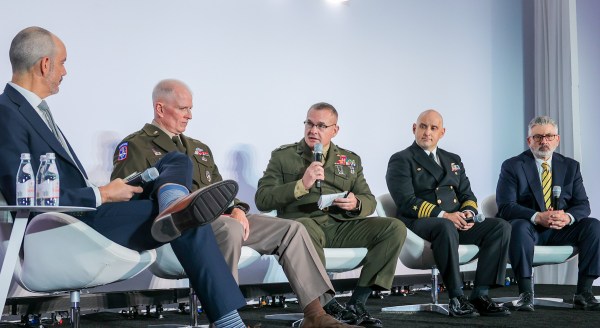
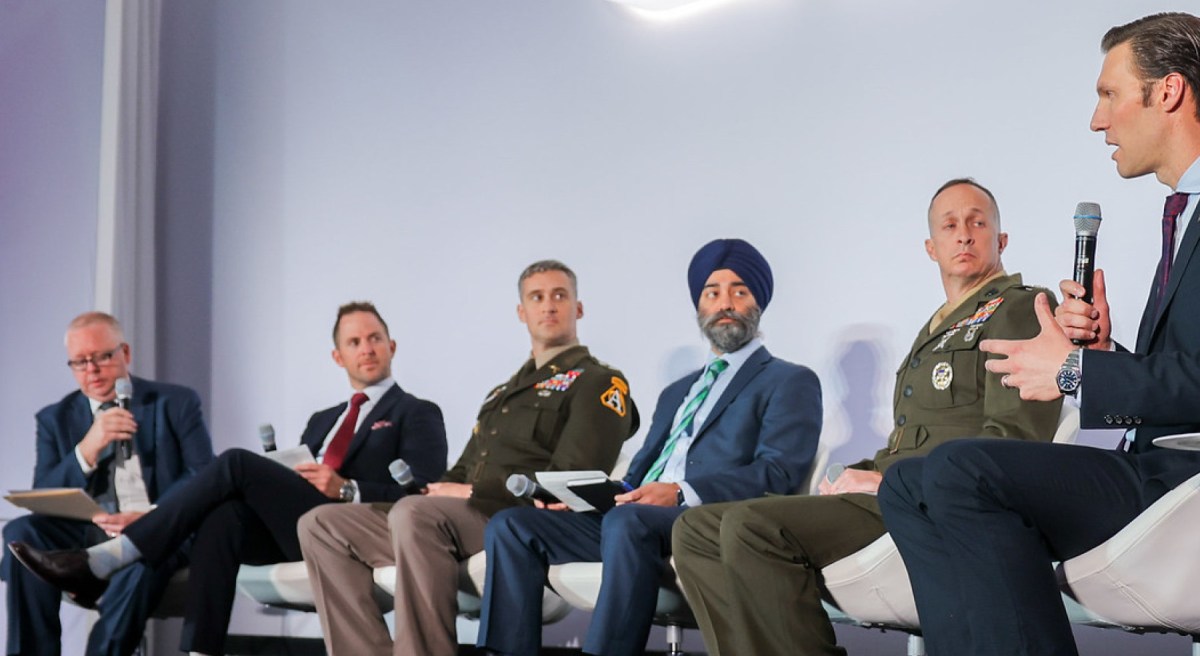
Chris Haynes, Senior Vice President and General Manager for Missile Subsystems at General Dynamics Ordnance & Tactical Systems, challenged this legacy mindset during the recent GDIT Battlespace of the Future summit, produced by Scoop News Group.
“Today, we can deliver weapons with unbelievable accuracy,” he said. “My question is, do we need to — and when we get on target, will we have the right lethal mechanism?”
According to Haynes, the answer is “adaptive lethality,” which uses intelligent fuzing, directional fragmentation and multipurpose warheads so a single munition can dynamically adjust to the conditions it encounters. In a fight where magazines are limited and replenishment is contested, flexibility becomes its own form of mass. As Haynes put it: “Instead of needing five different weapons to attack five different targets, we can have one thing that can attack all of them.”
This pivot cuts against the defense industry’s temptation to chase a single, revolutionary breakthrough. Lt. Col. William Taylor, an Army Product Manager for Precision Strike Reconnaissance Systems, warned that the military cannot rely on a single silver bullet. “I don’t believe in a panacea as an army,” said Taylor. “It’s about the fusion of a bunch of unique technologies that come together.”
Software-driven outcomes
This technological fusion requires a mix of high-end exquisite systems and low-cost loitering munitions, all synchronized via robust software. Army efforts like Operation Jailbreak, aimed at breaking down legacy data silos, and tactical tools like the Mortars App demonstrate how software is already moving directly into soldiers’ hands at the edge.
While hardware provides the necessary lift and thrust, software dictates its viability in contested environments, argued Bhavanjot Singh, Acting Executive Director of the Weapons & Software Center at the Army Combat Capabilities Development Command Armaments Center.
The goal isn’t automation for its own sake; it is delivering the exact effect the commander chooses at the precise moment required. Achieving this requires autonomous uncrewed systems, traditional munitions, long-range hypersonics and low-latency communications to operate under a single, unified battlefield logic.
Nowhere is that more urgently needed than in the Indo-Pacific, where geography itself becomes an adversary. Col. Matt Ritchie, Operations Division, Marine Corps Headquarters Plans, Policies, and Operations, noted that Iraq is roughly one-eighth the size of the South China Sea, which is only a fraction of the broader theater. Extreme distances, weather and communication degradation mean joint formations across the Marine Corps, Army, Navy, Air Force and Space Force must seamlessly hand off targets and combine effects.
In this environment, autonomous systems are vital. “I want to send a system instead of sending a Marine, because that preserves combat power, preserves that human capital for more important missions,” said Ritchie.
The procurement and scale bottleneck
Scaling these capabilities, however, runs directly into two familiar barriers: rigid procurement and industrial capacity constraints.
Rep. Patrick Harrigan (R-N.C.) noted that the proliferation of cheap, capable technology — as seen in Ukraine — demands rapid acquisition pathways and robust defensive capabilities to enable offensive fires. The root problem, he argued, is systemic. “We don’t have a contracting procurement mechanism that keeps up with that pace that’s required for today’s battles,” said Harrigan.
The defense industrial base faces a similar speed crisis. When asked if the industry is ready to produce advanced fires at conflict scale, Haynes’ answer was clear: “Short answer, no.”
The bottlenecks sit deep in the supply chain: single-source suppliers, long qualification cycles, limited surge capacity and rigid “no change” policies. “I would characterize our industry as being optimized today for certainty, not necessarily speed,” said Haynes. To survive a conflict in which software evolves quickly and inventories are exhausted quickly, Haynes argued that the military and industry must pivot toward fielding “80% solutions” rather than waiting for perfect systems.
Human trust as the ultimate barrier
Even if the Pentagon solves its technical, procurement and production challenges, the final barrier remains human. While the military has a massive appetite for autonomous weapons, commanders will not trust a system simply because a program office signs off on it.
Trust must be forged on the ground by the troops using the equipment. “The ground commander is not going to hear from you that your weapon system was successful or failed,” said Lt. Col. Taylor. “They’re going to hear from the other 680 soldiers… if they buy into this weapon system, that’s where trust starts.”
While mass, AI and hypersonics are critical pieces of the puzzle, the future of fires will ultimately belong to the force that can make its weapons adaptable, its software resilient, its production scalable and its autonomy trusted before the next conflict turns capability gaps into casualties.
This article was produced by Scoop News Group for DefenseScoop and sponsored by GDIT.