Army awards Anduril contract worth up to $1.8B over five years to expand NGC2
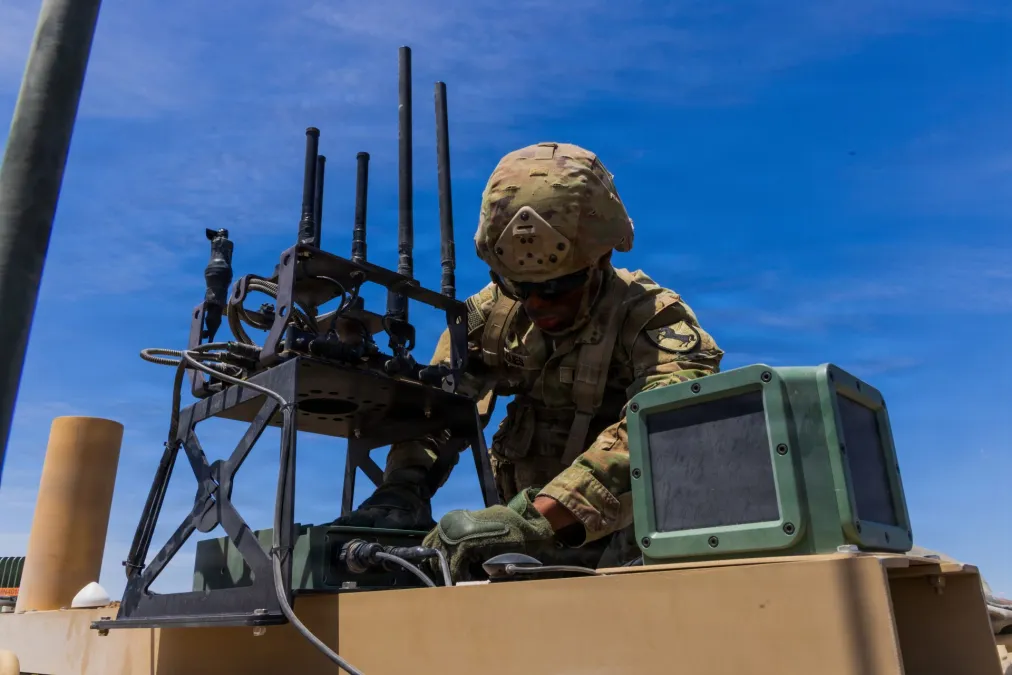
The Army awarded Anduril a contract worth up to $1.8 billion over five years to expand the service’s Next Generation Command and Control (NGC2) ecosystem to additional units, the company said Monday.
The contract includes a $162.8 million base period, which is focused on expanding NGC2’s common data layer to I Corps. The Army chose Anduril to lead its common data layer baseline for NGC2 in June.
The contract marks the latest signal for the Army’s expansion of NGC2, an ecosystem of interconnected hardware and software underpinned by Anduril’s Lattice software platform. The idea is to give commanders the ability to quickly exchange data and make decisions through an ever-evolving suite of sensors, AI programs and other advancing technology.
Army leaders have discussed for months that NGC2 was expanding to I Corps, which is oriented to the Pacific theater, after two divisions experimented with the tech over the last year.
“The five-year award supports NGC2’s progress from division-scale prototyping to corps-scale fielding, beginning with a significantly harder operational problem in the Pacific,” Anduril said in a press release announcing the contract. “America’s First Corps commands four Army divisions across a theater where units may be separated by thousands of miles and must coordinate with joint and allied forces while operating through disrupted and intermittent communications.”
NGC2 is a top priority for the Army, which has long-decried its inability to connect disparate systems under a unified network platform. Both Anduril and top service officials have framed NGC2, specifically Lattice, as a way to onboard new technology from different companies as conflict evolves.
“No single company should control every element of the Army’s command-and-control stack,” Anduril said. “A common data layer allows the Army to integrate new systems without rebuilding the underlying architecture for every sensor, application, or weapon, so new capabilities can be fielded on the same foundation as those already in use.”
A spokesperson for the Army told DefenseScoop that the service did not have anything to add about the latest award announcement.
In July, the Army embarked on a highly-anticipated test of NGC2 in the Mojave Desert called Project Convergence Capstone 6. Upon its completion, senior leaders dubbed PC-C6 a success, though they conceded that hardware performed poorly in the desert heat, requiring soldiers to use t-shirts soaked in ice water to cool systems down.
DefenseScoop spent multiple days at Fort Irwin, California, where the test was held, and reported that soldiers were contending with a new stable of drones that weren’t connected to NGC2 at the time.
The publication also reported in September that III Armored Corps out of Fort Hood, Texas, was beginning to receive the basic layers of NGC2, marking the first time a unit dumped an older network model for the new ecosystem via a consolidated fielding process.
Updated on Oct. 8, 2026, at 5:15 PM: Following publication, representatives from Lockheed Martin said the company was never in the running to be NGC2’s common data baseline lead; the article has been updated accordingly.