Navy seeks to prototype air-launched torpedo system for Silent Anvil program
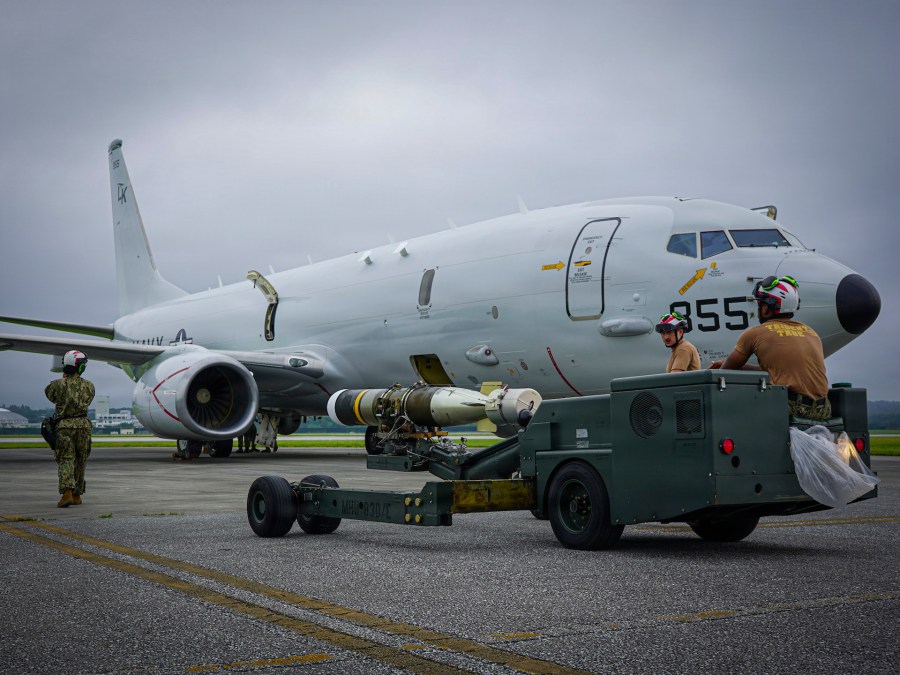
The U.S. Navy is looking to add a new “standoff” anti-submarine warfare weapon system to its arsenal and is reaching out to industry to see what capabilities companies have to offer.
The market research effort, which kicked off Tuesday with the release of an RFI, is in support of the service’s Silent Anvil Air-Launched Torpedo (SAA-LT) program.
SAA-LT is billed as a next-generation delivery system being developed to counter emerging threats in undersea warfare and “expand the range” of drones and manned aircraft that can conduct anti-submarine operations.
The platform “will be captive-carried and released from both internal and external aircraft weapons stations utilizing standard Department of War (DOW) carriage systems” and “operate as a precise and highly maneuverable glide weapon, transitioning quietly to target areas to engage enemy submarines from distance,” officials wrote in the sources-sought notice, using the Trump administration’s preferred name for the Department of Defense.
Naval Air Systems Command is conducting market research to determine industry’s capabilities to design, develop, test and build “cost-effective, rapid prototyping alternatives.”
A “template” release altitude range for the weapon is listed in the RFI as 10-60 kilofeet. NAVAIR is seeking industry input on the maximum achievable glide range for the system. A performance goal is to “maximize aerial flight endurance while minimizing aquatic immersion time” for the torpedo.
The torpedo will include an acoustic sensor, warhead, command-and-control section and electric propulsion system, while the flight components of the platform will include a wing kit, radio with aperture, and guidance and control.
The form factor should be similar to the GBU-39 Small Diameter Bomb and have compatibility with the BRU-61/A bomb rack to “maximize aircraft carriage options across multiple manned and unmanned platforms,” officials noted.
The RFI suggested that the U.S. Air Force could also potentially use the weapon. Officials wrote that the SAA-LT will be “designed to be modified, and reconfigured should the USN or USAF seek additional capabilities.”
The program is planning to use government-owned interfaces and standard software interfaces to allow for fast, inexpensive modifications and payload customization tailored to specific mission requirements, according to the notice.
To facilitate networking with other platforms, the SAA-LT must integrate with the military’s tactical C2 tools and allow for coordinated operations and in-flight target updates.
“The system may utilize the standard Small-Form-Factor Weapon Attritable Radio Multi-Mode software defined radio to enable the Beyond Line of Sight (BLOS) communications link,” per the RFI.
The Navy is pondering two design options for industry to consider: a full, integrated SAA-LT solution or an unpropelled glide wing kit capable of carrying a government-furnished torpedo to the target area.
Officials want to see a demonstration of an “end-to-end” prototype capability for the SAA-LT program within 18 months of agreement award, and the delivery of approximately 180 all-up rounds within three years of a successful demo, according to the notice.
The Naval Aviation Systems Consortium might be used for the potential award of one or multiple other transaction agreements for the prototyping effort, the document noted. An industry day is slated for Sept. 17.
Vendor responses to the RFI are due Sept. 29.