The military transferred Oshkosh IP over a new digital exchange so Marines could make their own parts
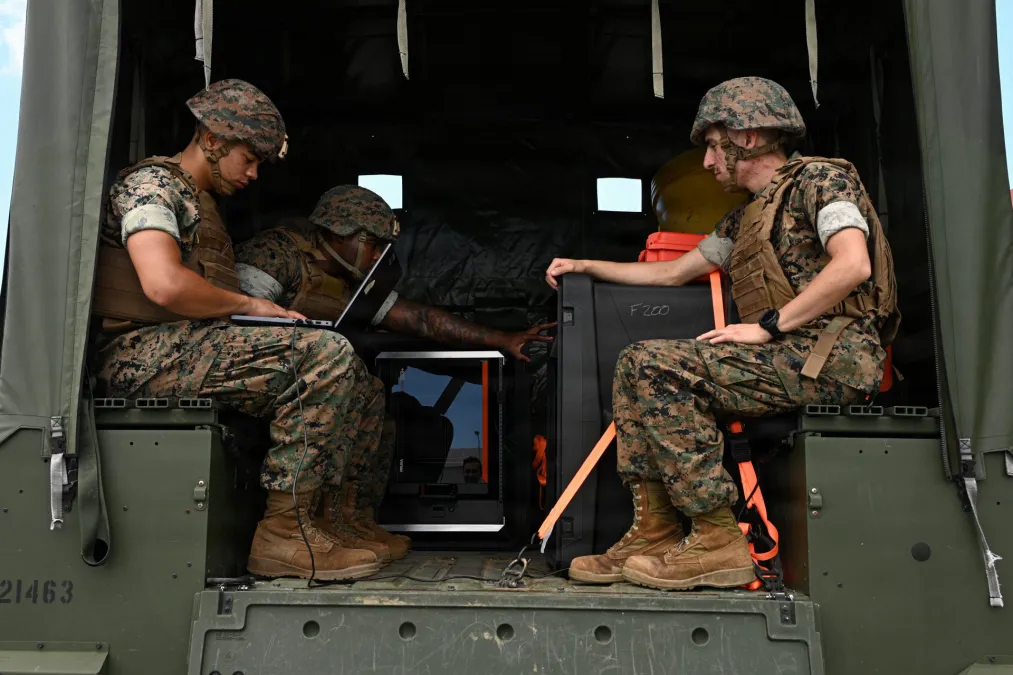
The Marines had broken the step ladders on their heavy logistics trucks. So, while they were training in the Pacific over the summer, they made some more.
It was a simple fix for a part the Marines were constantly having to replace. But the physical manifestation of the ladders represented what officials called a promising, though partial, answer to the logistics challenges the military expects to face if the U.S. and China go to war.
Schematics for the parts traveled hundreds of miles across Japan through the Digital Manufacturing Exchange (DMX), a nascent platform that aims to build a web of allied manufacturers, American defense companies and multiple U.S. military services so frontline troops can get parts quickly, locally and without having to rely solely on lengthy supply chains.
The concept reached a critical milestone during exercise Valiant Shield 2026, officials said, where a Japanese manufacturer called MadeHere K.K. helped Marines produce parts from intellectual property Oshkosh Defense agreed to let the military transfer through the DMX.
“If physical supply routes are blocked in the event of a major contingency or a major war effort or wartime scenario” especially in the Pacific, David Anderson, director of operations for the Marine Depot Maintenance Command (MDMC) told DefenseScoop, “this allows us to send the digits instead of the physical part and get it manufactured at the point of need.”
Military officials have long warned that supplying forces across a vast, yet militarily contested Pacific battlefield where supply chains and logistics infrastructure are sure to be prime targets will be undoubtedly difficult.
The DMX, the Marine officials said, gives the military an extra option, especially because it aims to lean on local manufacturers when long, physical supply chains from the U.S. or elsewhere outside of the region get strained in a large conflict.
The ecosystem is not just for a potential conflict with China. Col. Nicholas Lozar, commander of MDMC, said that troops have to wait for parts on backorder stateside too, and if the IP from an Original Equipment Manufacturer lives in the DMX, it also gives them another option to get a part quicker.
The military expects to compensate defense companies for letting it transfer IP through the DMX. How that will shake out isn’t clear yet.
“There’s no one that can give you a good answer on that one because the answer doesn’t exist,” Lozar said, adding that figuring out the cost-model for the DMX with OEMs “is one of the things that we’re working on the hardest now.”
The military has been buying equipment from certain defense contractors for a long time, and an OEM can give an accurate estimate on how much money it would charge the military to make a part, Lozar said.
“When you pay for an end use part, you’re paying for all of the manufacturing and overhead that goes into manufacturing that part to include the intellectual property,” Lozar said. “But if I’m just paying for the intellectual property, how much should I have to pay for that?”
A spokesperson for Oshkosh Defense declined to answer DefenseScoop questions about any cost-model details on Wednesday, including how much the military paid the company to use its IP during Valiant Shield 2026.
Through MDMC’s hub, “Oshkosh Defense can maintain strict quality standards and intellectual property protection while serving Warfighters closer to the point of need,” the spokesperson said. “As part of this platform, secure digital files are made available to authorized users to manufacture approved replacement parts.”
When asked whether the company had concerns about sending more restricted IP across DMX, the spokesperson said the recent exercise “demonstrated how this partnership works, and Oshkosh Defense is confident in this capability to support additional critical components in the future.”
The Marine officials said the military is developing the DMX into a program of record. They anticipate IP licensing agreements being worked out ahead of time; while OEM’s will get compensated in some way for the military’s use of their IP, they expect the initiative will ultimately prevent the department from spending a lot of money on acquiring IP outright.
The initiative began about two years ago when the Joint Requirements Oversight Council, an advisory body that helps the Pentagon prioritize top military programs, identified a “gap” in the department’s ability to securely share IP between services, allies and industry, Anderson said.
The Marine Corps had already been pursuing solutions to contested logistics, according to Lozar, and it gave his unit the ability to pilot an initiative for the rest of the military that would also benefit the Fleet Marine Force.
Since then, DMX has gone through several phases. Initially, officials simply wanted to see if the newly accredited and built environment could upload and livestream technical data packages. Last year, MadeHere K.K. connected to DMX and then entered a public-private partnership with MDMC in January to help the military with manufacturing in Japan.
The idea is for DMX to tie into the military’s supply chain naturally and through a semi-automated process that takes requirements and assigns them to the closest manufacturing point so “the Marine on the other end, all he knows is that the part showed up,” Lozar said.
During Valiant Shield, DMX transferred data from other services, such as Army aviation schematics for UH-60 Black Hawk parts. Officials also tested how the ecosystem would work in a limited connectivity environment, a top concern for the military as increasingly sophisticated adversaries are able to disrupt networks.
All told, the program produced 19 components from 11 unique parts during the exercise, according to a service release, using data from the Navy, Marine Corps, Army and Oshkosh.
“The Digital Manufacturing Exchange is going to revolutionize our supply chain to where our troops on the far reaches of the planet — whether in combat or not — are going to be able to get what they need faster and more effectively,” Lozar said. “But that doesn’t happen without the partnership with our industry partners. And the more of them we get into the Digital Manufacturing Exchange, the better off we’re all going to be from a national security perspective.”