DIU moves to prototype new contract model that will fast-track security clearances for startups
The Defense Innovation Unit will soon sponsor approved startups and non-traditional companies with certain temporary security clearances so they can participate in classified conversations to fully grasp the U.S. military’s real demands, ahead of winning major Pentagon contracts.
Senior defense officials on Thursday previewed a unique contracting solicitation that’s in the pipeline for release in the next few weeks and will prototype a process to grant venture-backed and other small businesses with fast-tracked Facility Security Clearances (FCL) held under DIU’s new Bridge Program.
“It’s obviously very unsexy work to fix compliance barriers that we’ve built inside the department. But go to any investor, any company — what is the crux that they’re concerned about?” DIU’s Chief of Strategic Initiatives Sarah Pearson told a small group of reporters. “It’s this type of stuff.”
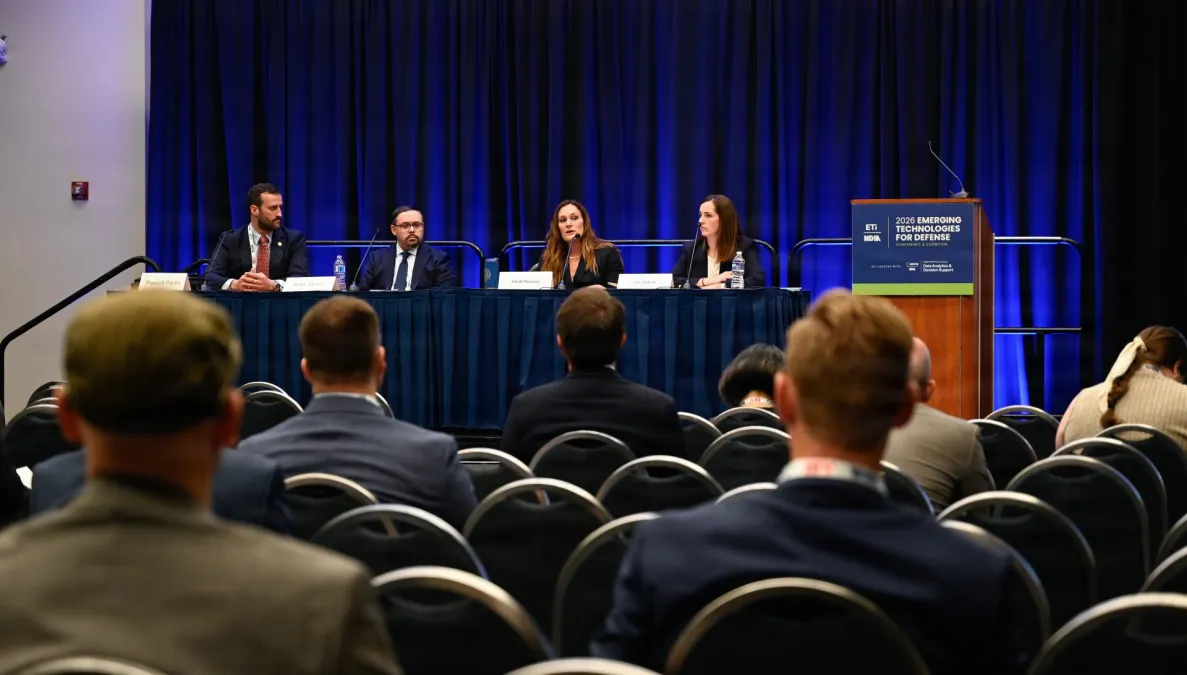
During an onstage panel and subsequent media roundtable at the National Defense Industrial Association’s Emerging Technologies for Defense Conference, Pearson and other Defense Department insiders shared new details about how their teams are hustling to clear long-standing constraints that limit proven commercial technologies from quickly transitioning directly into the military services.
“You know who doesn’t care about compliance? Our adversaries. They’re not going to pause the bombing while we get compliant,” said Prescott Paulin, the Office of the Under Secretary of Defense for Research and Engineering’s director of industry engagement, emphasizing the need to move fast.
DIU launched the Bridge Program in August, after more than a year of strategic planning.
Broadly, the specialized campaign aims to confront major structural barriers and bottlenecks that commercial firms routinely hit when trying to field a working prototype to widespread operational military deployments.
Through Bridge, DIU is initially going after three main friction points that encompass challenges associated with classified infrastructure deficits, slow security and cyber accreditation processes, and test and evaluation-related complexities.
“It is all part of the same strategy — but [DIU is] using different contract vehicles [and] approaches,” Pearson told DefenseScoop.
Earlier on the NDIA panel, she announced that DIU was getting set to publish a new contract opportunity in a specific strategic technology realm that will allow companies to respond about their products for consideration to potentially receive a low-cost “prototype contract” through Bridge.
“If you’re a vendor that has technologies in that area, you’ll be able to apply to share your capabilities in varying formats and artifacts. Maybe it looks something like a product roadmap, or something else,” Pearson explained. “In exchange, we’ll grant you a facility clearance. We’ll take you through the FCL process, and if [the Defense Counterintelligence and Security Agency determines the applicant is clearable] then DIU will hold the clearance for that vendor for a period of years.”
In response to questions from DefenseScoop at the roundtable, Pearson — who leads Bridge at DIU — said that undefined time period would likely be “north of one year.”
“I’m probably not going to specify how many years. It would be the same for all of them,” she noted. “I’m very much looking to treat this in a pseudo-binary way. If you meet these criteria — then here’s your FCL — should you get approved by DCSA. Because again, they’re the authority.”
Notably, in support of DIU’s Bridge concept, DCSA recently designed and has been executing on “a rapid FCL model” that’s tailored to non-traditional, VC‑backed startups that the Pentagon views as critical emerging-tech suppliers, according to DCSA’s Chief Operating Officer Blake Moore.
He indicated on the NDIA panel that the agency is aggressively applying artificial intelligence and automation to prioritize, review and triage cases via this work.
“We are now seeing a 5-to-6X decrease in the amount of time it takes for these companies to get an FCL cleared, based on what we’re doing with [the Defense Intelligence Agency] and what we’re doing with these companies,” Moore said. “How we’re doing this is essentially removing facility personnel and infrastructure requirements in parallel rather than in sequence. We’re not doing chronological order anymore — we’re doing these in parallel — and we’re applying technology on top.”