Army extends ADOC pilot by a year as officials work to make the data ops center a more permanent fixture
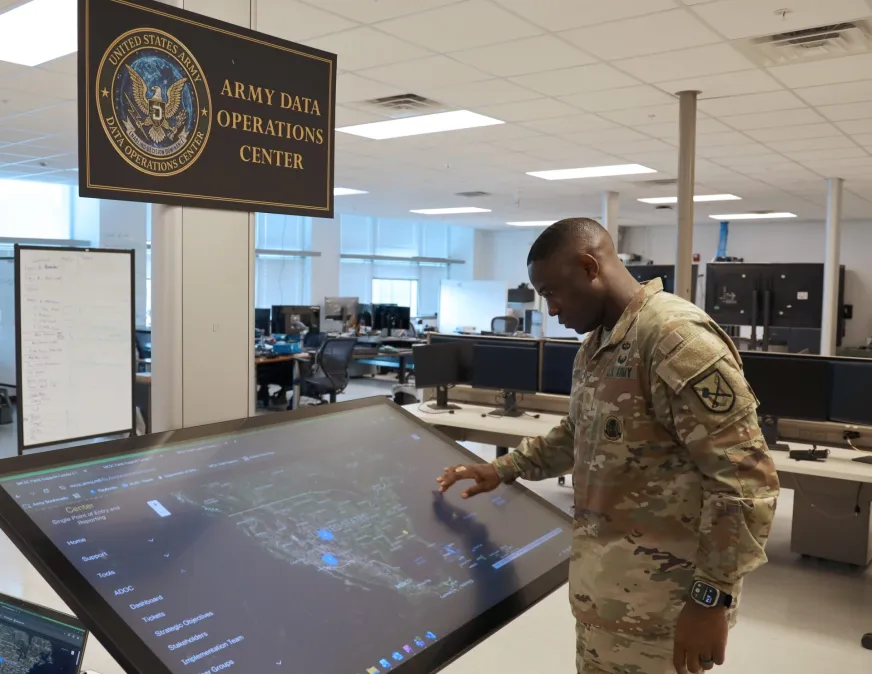
The Army Data Operations Center pilot effort has been extended 12 months, giving senior leaders more time to decide whether to formalize the organization on a long-term basis.
The ADOC first went live as a task force in April under an initial six-month pilot effort aimed at helping help the Army tackle its data management challenges.
“What the ADOC highlighted on really day one is that we also have a data access problem, and so that’s what the ADOC is really chartered to do, and it’s to tackle the access to data, handle those data connection requests, and ensure that if we have soldiers or leaders or commanders or anyone for that matter who is looking for data that resides on another plane or behind another security boundary, … we’re going to knock that boundary down,” Col. Reginald “Reggie” Evans, director of the task force, said Thursday during a panel at the Annual Data Forum, produced by AFCEA International.
“The challenge that we have today is we have put more data into the hands of our soldiers than we ever have before, and so we’re talking from a theater Army headquarters all the way down to the soldier. That’s where you’re going to start to see the gaps and seams, and that’s where the ADOC is going to really make its money, and … why we need to be tied to the warfighter,” Evans said.
The organization created a ticketing system that enables it to field requests for assistance from units around the world.
The task force has leaned on artificial intelligence capabilities to facilitate its work.
“With the small team that we’ve had, automation and agentic workflows were critical,” Chad Nash, deputy of the ADOC, said during Thursday’s panel. “We were able to take a flow or a process that … was not documented [and] we were able to build in workflows that autonomously do agentic AI. We were able to build those fields and those forms to take that burden … off the soldier, off the warfighter, that administrator.”
The pilot effort has been extended until Oct. 1, 2027, according to Nash.
“What that will allow us to do is to continue gathering our findings and continue to allow us to gain metrics on what we’re seeing in volume of, you know, scale in terms of the challenges and those stovepipes that we may have. We’re also realizing some of the benefits of being able to solve these issues in [less] duration of time. Things that took in the beginning maybe two months to solve, we’re able to solve those problems in days,” he said.
After the extension period, Army leaders can make the decision on the long-term plan for the ADOC.
“We anticipate that,” Nash said. “And we’re only learning more, we’re only getting better, and certainly as we solve these tactical challenges, we’re evolving our processes, and in some instances, actually creating new processes using technology to make those things better.”
Evans suggested that takeaways from the initial pilot period have helped officials flesh out what a more permanent ADOC might like look.
“Over the last six months, we’ve learned what the structure looks like. We learned what roles, responsibilities and functions the ADOC should execute. We know what skill sets we need within the ADOC to execute those functions. We’ve identified a rough order of magnitude of what it would cost us. And so we’re taking all of that to our Army senior leaders for a decision to go ahead and move forward with formalizing ADOC. That would be our recommendation,” he said.
However, there are “longer lead items” and “action items” that still need to be worked through to enable that formalization, he added.
“There are some command plan actions that really take time, and so we just needed more time to get those actions in place so that at the end of this next 12 months, we can permanently fill those billets with folks versus the borrowed manpower that we’re using now,” Evans said.