Why unauthorized drone incursions are ‘a clear and present issue’ for US Transportation Command
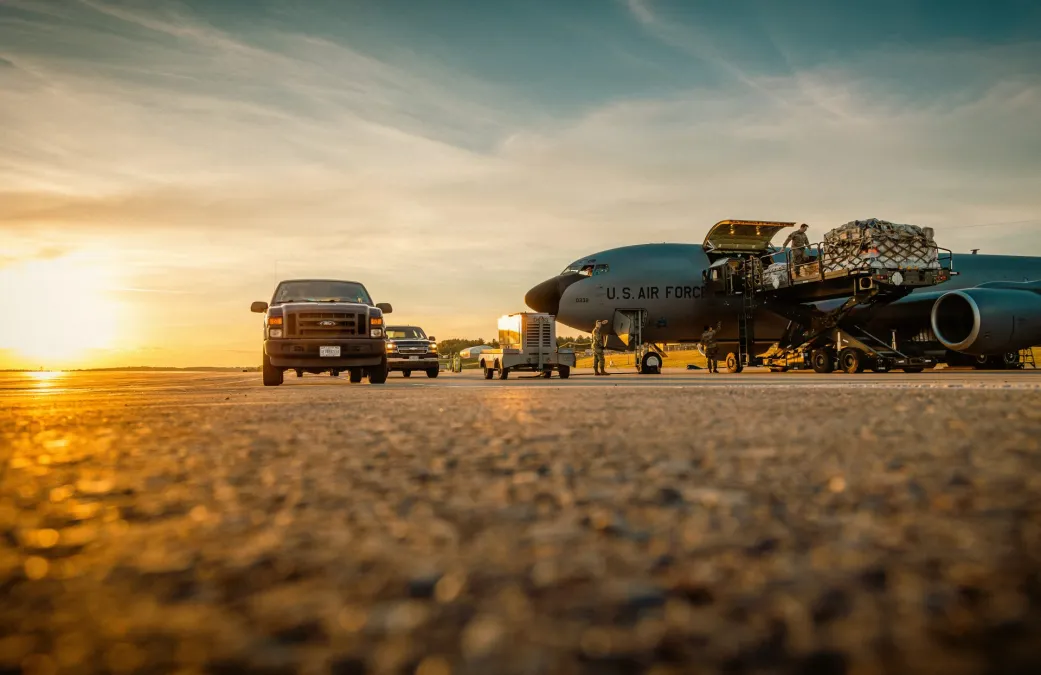
ST. LOUIS — In an era when unauthorized drone incursions at U.S. military installations are surging, these disruptions pose a particularly unique threat for U.S. Transportation Command.
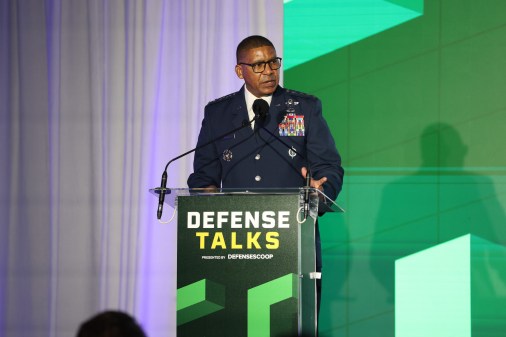
“It is a clear and present issue that we have to pay attention to,” Transcom Commander Gen. Randall Reed said Wednesday. “So, yes, we have conversations in that realm — and we have done so quite frequently.”
During a 3-day trip to five locations around Colorado and California this week, Reed heard from Transcom’s civilian and commercial partners and multiple military personnel about the urgent need to keep both U.S. defense installations and civilian transportation nodes open and safe from adversarial or unidentified drones.
“It is one of those areas where technology changes very quickly and the people who use it adapt very quickly, which means if you’re trying to do something to protect what you’re doing or to negate the threat, we need to operate just as quickly,” he told DefenseScoop in an interview on a C-40 aircraft near the conclusion of the trip.
Over the past few years, hundreds of mysterious unmanned aerial systems (UAS) have been documented over strategic and sensitive military installations — exposing unsettling gaps in America’s detection and defense capabilities.
Some incursions have reportedly involved coordinated, potentially high-tech drone swarms exhibiting extended flight durations, sparking fears of foreign surveillance or reconnaissance operations.
“It is [a concern] across the entire joint force,” U.S. Strategic Command Commander Adm. Richard Correll said Monday alongside Reed at a Sierra Nevada Corporation facility in a joint interview with DefenseScoop. “So, it’s another threat that you have to account for — and you can account for it with technology, that’s part of the answer, but it’s also operational procedures and targets and TTPs [or tactics, techniques, and procedures].”
Both commanders said their teams are changing how they move and operate to get after the threat.
“This is also an instance where, from a national perspective, my thoughts turn towards critical infrastructure. And so when it comes to things like an airport, or a seaport, or a rail head, or a rail line, or a highway, or a bridge — Transcom needs that to be safe and secure — just from a national perspective. Period,” Reed noted Wednesday.
As he suggested, compared to other U.S. combatant commands, counter-drone operations aren’t just about protecting stationary military installations; they also involve securing those civilian transportation nodes, like those ports, rail, highways, and bridges that Transcom depends on.
Drone disruptions at key aerial ports, seaports, and strategic railway hubs pose risks that could paralyze military logistics and create severe ripple effects across operational readiness.
“We still need the nation to be safe and secure. We still need the economy to function. And Transcom rides on the backbone of the national infrastructure, so the safer the national infrastructure, then the more options Transcom has, the more resilient we are, and the more levers we have to work things either through military means or commercial means,” Reed explained. “So, to a certain extent, it’s one big pile. It’s Transcom and the nation — and when you have that together, it’s really big and it’s roughly powerful — but it takes a lot of work to synchronize.”
The commander confirmed that various elements and strains associated with unauthorized drone threats were discussed in his closed-door meetings with senior military officials from multiple services, and at more than one stop on his trip.
It also came up during a roundtable that DefenseScoop attended with Reed on Tuesday at Military Ocean Terminal Concord (MOTCO), a military base and vital ammunition seaport in California.
More than two dozen people were present for that conversation, including senior officials leading Army Transportation Command, members of the Coast Guard and FBI, and local officials who run ports that make up a significant logistics node for Transcom along the California coast.
Lt. Col. Lauren Cabral, commander of the Army’s 834th Transportation Battalion, spotlighted recent progress associated with counter-UAS “authorities and leverage” that her team helped the Port of San Diego secure and amplify.
“It started out with just a simple question that we asked two years ago during the Port Readiness Committee meeting, while we sat there with the Coast Guard and with the port. And as a trusted partner, we 100% were putting the trust in them to provide that protection and that resilience, if you will, while we operated down at the terminal — and they took that for action,” Cabral said. “They took it at the forefront of their portfolio there and maximized every opportunity they had to ensure that we can operate seamlessly down in San Diego.”
Dave Foster, the director of homeland security for the Port of San Diego, briefly summarized that work.
“In close coordination with Coast Guard Sector San Diego and through FEMA funding — Port Security Grant funding, to be specific — we’ve embarked on significant infrastructure improvements for our ability to track and mitigate threats,” Foster said.
He also flagged a recent Federal Aviation Administration notice of proposed rulemaking that he said is “of particular importance” for San Diego’s port security and operations.
The NPRM would restrict drone operations near fixed sites and terminals with facility security plans, according to Foster, who noted that the proposed rule would directly affect military logistics and operations through his and other ports.
At the roundtable, he and California-based officials pointed out that, with upcoming mega-events like the FIFA World Cup, there’s an ongoing national pursuit to push mitigation authorities to counter and defeat drones down to the local levels.
In the interview Wednesday, Reed said he’s observed an uptick in UAS incursions and accelerated deployments over the last five to six years.
“From a Transcom global joint force perspective, we see that the entire joint force needs [counter-UAS capabilities]. Therefore, we’ve been a very strong advocate for it, and I will say that the department has really put a lot of energy, a lot of time, and a lot of resources into the problem — and we’re right there with them,” the commander told DefenseScoop.