DOD poised to move all classified AI workloads off Anthropic by October
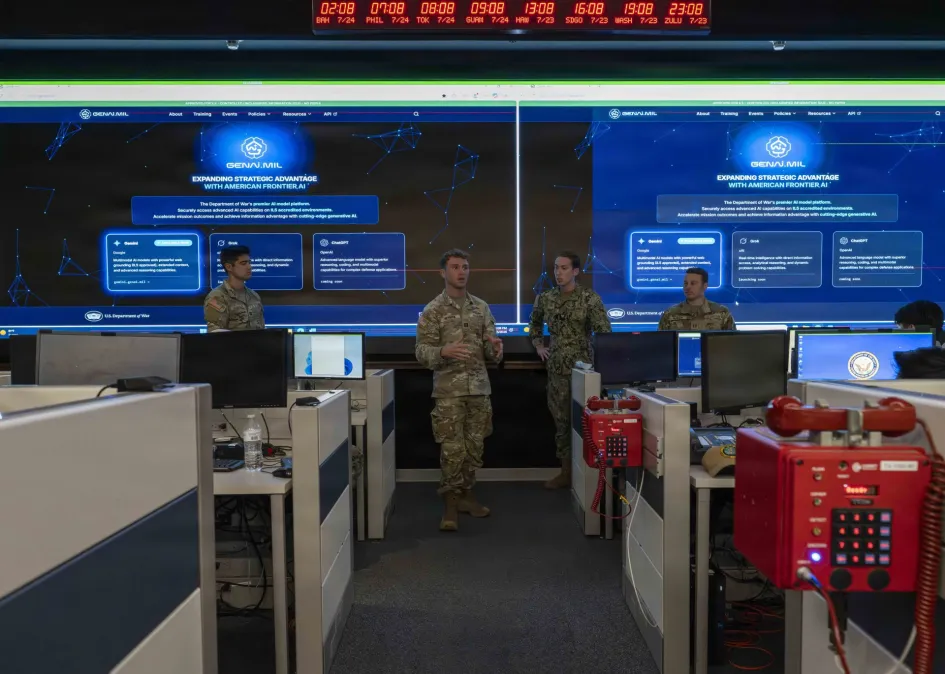
The Pentagon is close to completely migrating all of the military’s classified systems away from Anthropic models and over to alternate frontier AI vendors, according to Under Secretary of Defense for Research and Engineering Emil Michael.
“I’d say about 90% has transitioned. All of the Maven Smart Systems or Palantir work has been transitioned months ago, and we’re on track to get it done by the end of the month,” Michael told a small group of reporters on Thursday.
His and other officials’ comments onstage and on the sidelines of the National Defense Industrial Association’s Emerging Technologies for Defense Conference this week shed new light on the Defense Department’s move to a multi-model ecosystem (excluding Anthropic) that deploys diverse generative AI capabilities to support real-world operations across its intelligence and warfighting networks.
Notably, the Pentagon uses commercial frontier models in both classified systems and on unclassified operational tools like the nascent GenAI.mil platform. Technology suppliers, deployment methods, and security levels differ, depending on the workspace.
This fast-tracked migration stems from a widely publicized breakdown in negotiations between the department and Anthropic that unfolded after the U.S. firm’s capabilities were already deeply intertwined in military and other major vendors’ systems.
While the company insisted on contract safeguards that would restrict its AI models from being used for certain applications associated with the mass surveillance of U.S. citizens or fully autonomous lethal weapons systems, DOD rejected the terms — arguing that defense software must be available for “all lawful purposes” in an unconstrained way.
The department subsequently designated Anthropic as a national security supply chain risk. Now the two are hashing it out in court.
“One of the mistakes, independent of whether we had a dispute with Anthropic, is the fact that the Pentagon was solely reliant on one model. I mean, what if that model were [Google’s] Gemini or some other model that hadn’t kept up with the frontier, right? We would be putting our warfighters in a disposition that was suboptimal,” Michael said at the roundtable. “So the number one idea is to get multiple models, because as we all know, every month this industry changes — maybe every week — who’s leading and what.”
The Pentagon tech chief was also asked about the department’s ongoing legal battle in an earlier interview onstage.
“Anthropic was designated as a supply chain risk under two different laws. One of them was in the Northern District of California was adjudged. They form-shopped that place. The more important one is the second case. It only is heard by the D.C. Circuit Court, which is a higher court — goes right between there and the Supreme Court — and I think they’re sort of more of a national security-oriented forum,” Michael said. “We should hear from them soon, [in] the next month or two. So, there’s still a supply chain risk because that court didn’t designate a preliminary injunction.”
In response to questions from DefenseScoop and other reporters at a media roundtable that followed, he emphasized that the DOD’s transition away from any reliance on Anthropic has “been great.”
“I think, in fact, the warfighters on [Palantir’s] Maven, who’ve seen the newer versions of [OpenAI’s] ChatGPT, have liked it a lot better than Anthropic. And they found [xAI’s] Grok to be way faster than both of them. So they each have different attributes depending on the mission,” Michael said.
Meanwhile, in separate exchanges with DefenseScoop at the NDIA conference, U.S. officials with access to GenAI.mil discussed their experiences chatting with those secure government-tuned frontier AI models that recently came online, and against the backdrop of DOD’s major moves to cut all ties with Anthropic.
They requested anonymity to speak candidly about the technology and their work.
“I’ll use it for anything I can,” one official said. “It is not perfect and it’s not the end all be all, but I’ve now actually given my team an edict — I said, ‘If you’re going to bring me a product and you haven’t run it through AI at least once, you don’t get to come into my office.’ And part of it is to force that learning, because it’s a different skill.”
Another U.S. official said it’s important for the department to “not oversell where we are in the AI journey.”
“So as an example, I am productive. I pay for [Anthropic’s] Claude, and I’ll go sit at my computer at home, and in 20 minutes I can get the amount of work done that would take me four hours on government systems. There’s no API access to GenAI.mil. I can’t build agents. I can’t have GenAI.mil inside my inbox. So the hyper-productivity that I have outside of the ‘dot mil’ domain, I do not have inside the ‘dot mil’ domain currently,” the official told DefenseScoop. “Now, again, we’re not there yet. I think there’s a vision to get there, but we have a lot of work to do to get there.”