- Sponsored
- Modernization
New report urges defense agencies to adopt unified data observability

Defense agencies expanding their use of artificial intelligence and autonomous systems face a mounting challenge: How to overcome the operational friction arising from the massive sprawl of distributed data systems. That sprawl contributes to critical blind spots and vulnerabilities across IT stacks. More fundamentally, it delays threat response times at a time when AI gives adversaries increased speed and capabilities.
To reduce those vulnerabilities and enhance mission readiness, military leaders need to execute a wholesale shift toward unified data observability, according to technical experts in a new report published by Scoop News Group and sponsored by Datadog.
At issue is the need for real-time, unified observability of operational data across network infrastructure, applications, data storage and AI workloads to identify risks, investigate incidents autonomously and restore mission-critical services faster, says Chris Goings, strategic account executive for the Department of Defense at Datadog in the report. “As system complexity explodes, customers realize traditional monitoring is no longer sustainable. We need to be able to unify this data,” said Goings.
To overcome these structural limitations, the report argues that defense agencies must replace isolated monitoring tools with a centralized telemetry architecture.
Traditional stand-alone monitoring tools that rely on deep table scans fail to process the dynamic telemetry generated by modern software-defined infrastructure and AI-enabled applications. In contrast, next-generation observability platforms continuously analyze metadata, logs, and telemetry across an agency’s entire data ecosystem. Datadog’s platform, for instance, can process trillions of data points per hour gathered from more than 1,000 native technology integrations into a unified view.
Clinging to fragmented legacy tools exposes defense operations to active operational risks, ranging from delayed threat response times to unbudgeted cloud expenditures. Unifying enterprise telemetry replaces inefficient “swivel chair management” — where operators lose critical time jumping between vendor-specific dashboards during security events — with a shared view of verified data across operations and cyber defense teams.
“Observability represents a fundamental evolution beyond traditional monitoring,” said Joe Gavin, director of federal business at Datadog. “Where monitoring gave IT teams siloed views into the reliability and performance of their stack, observability unifies metrics, traces, and logs across every layer of the environment — enabling faster root cause analysis and significantly reducing mean time to resolution.”
The report highlights several additional advantages of embracing unified data observability platforms for defense agencies, including:
Tracking ephemeral cloud workloads: Modern microservice architectures rely on cloud workloads that execute and vanish within seconds to optimize resource costs, leaving traditional monitoring tools with no path to trace past performance or security events, notes Rick Stewart, senior engineer at Datadog. “With Datadog, we can determine what happened at a specific time, what various workloads actually did during that ephemeral window, and why.”
Accelerating Zero Trust and cyberthreat investigations: Historically, defense agencies lacked the capability to route operational and security log data efficiently to both operations and security teams through a single system. Modern observability platforms, such as Datadog’s, can simultaneously alert operations and security teams about affected resources via filtered dashboards and provide recommendations to address issues, reducing the need for and the cost of multiple vendor monitoring tools.
Securing human-machine teaming and autonomous systems: As military forces field autonomous platforms and AI agents, the need for real-time visibility into system health, communication links, and model behavior becomes vital to mission assurance. Agent observability provides a zero-trust audit layer over autonomous activity. It can also track token consumption, detect model drift or anomalous outputs, and prevent unauthorized data access.
Additionally, by unifying telemetry data, agencies can consolidate operational, security and FinOps information onto a single, shared platform for greater data observability and cost control.
The report includes examples of federal agencies that have benefitted from replacing multiple point solutions with a single observability platform from Datadog, including:
- U.S. Department of Agriculture (USDA): At the U.S. Forest Service, Datadog unified visibility across a complex hybrid environment supporting more than 150 mission applications, replacing fragmented monitoring tools and helping reduce mean time to resolution by 60%.
- National Institutes of Health (NIH): The National Cancer Institute used Datadog to modernize fragmented cloud monitoring tools, reduce operational costs, and improve visibility across hundreds of cloud accounts.
Datadog’s government cloud platform recently achieved FedRAMP High certification, the report notes, and the company is actively working with Department of Defense sponsors to achieve Impact Level 5 (IL5) authorization for Controlled Unclassified Information (CUI) and unclassified National Security Systems (NSS) workloads.
The report concludes with recommendations from technology research and advisory firm Gartner for selecting an observability platform. Datadog was recognized by Gartner for the sixth consecutive year as a category leader among commercial observability platforms.
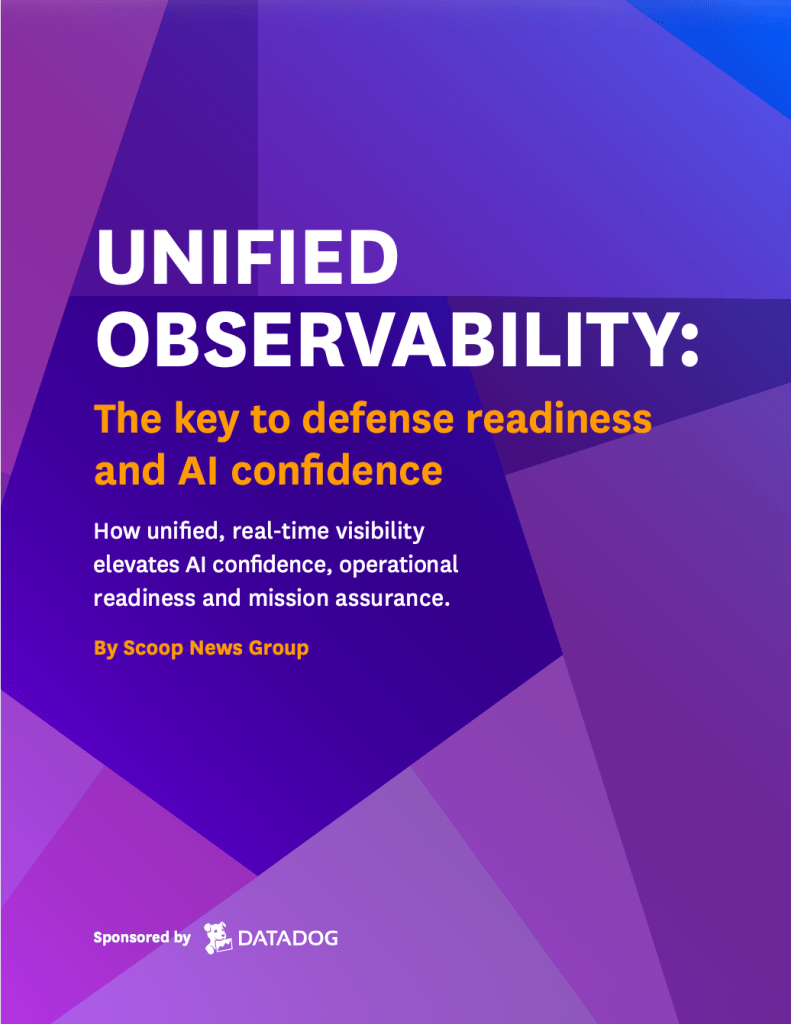
Download the full report, “Unified observability: The key to defense readiness and AI confidence.”
This article, and the full special report, were produced by Scoop News Group for DefenseScoop and sponsored by Datadog.