Army to ‘ramp up all munitions across the board,’ general says, including specialized missiles
The Army’s top general in charge of munitions said Tuesday the service was looking to boost armament stocks “across the board,” but singled out some specialized missile systems, one of which has struggled in development, that he expects to make production gains soon.
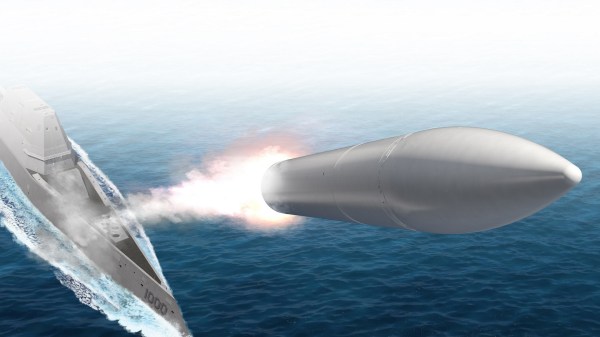
Lt. Gen. Frank Lozano, the Army’s program acquisition executive for fires, said the service was “within a few weeks” of fully equipping the first battery of a hypersonic weapon system known as Dark Eagle, which was delayed for years and didn’t meet its original fielding timeline of 2023.
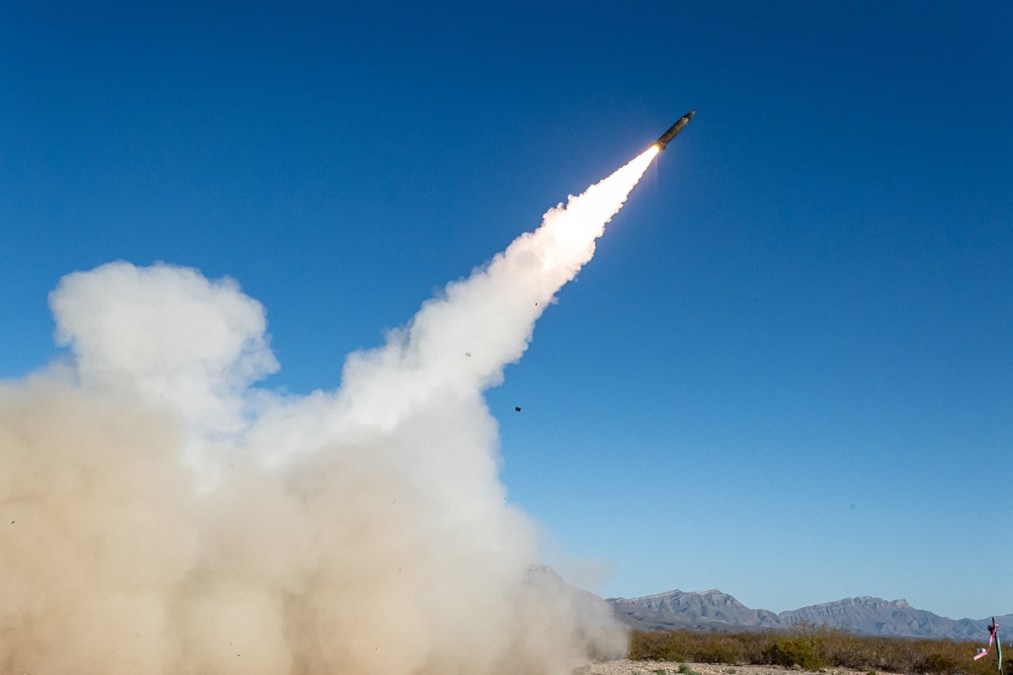
The Army’s Precision Strike Missile, or PrSM — which the U.S. used for the first time in combat during the war with Iran that began late last month — will also see a production boost, he said, adding that the service will send “requests for more funding to ramp those munitions up even more.”
“We’re looking to ramp up all munitions across the board,” Lozano told an audience at the McAleese Defense Programs Conference this week. “I want to make sure that we have enough to fight, and fight and win anywhere we need to fight and win on the globe.”
His comments come as the war with Iran, known to the U.S. as Operation Epic Fury, eats into munition stockpiles, raising concerns from some experts that, while America’s current inventory is holding up, heavy expenditures mean “high-demand” armaments risk getting steadily diverted from other important regions and stores will need to be quickly rebuilt.
Earlier this month, President Donald Trump said defense companies agreed to “quadruple” production of certain munitions quickly, but did not specify timelines or quantities.
While air assets have taken a central role in the campaign, U.S. Central Command said it has used a number of long-range weapons against Iran over the last three weeks, including Tomahawks, Patriot interceptors and Terminal High Altitude Area Defense systems.
DefenseScoop previously reported that overusing long-range missile systems, such as the PrSM, would deplete important stockpiles meant for the Pacific against China, should armed conflict arise between Washington and Beijing, citing experts.
“There’s nobody who’s been frustrated more than me with the delivery rate of long-range hypersonic missiles,” Lozano said in response to a question about Dark Eagle, also known as the Long-Range Hypersonic Weapon (LRHW) system, which is manufactured by Lockheed Martin.
“We are so close to that first battery being fully equipped with all of its capabilities, and I don’t want to spoil the surprise when we actually get there, but we’re within a few weeks,” Lozano said.
DefenseScoop reported earlier this year that the Army expected to complete fielding of Dark Eagle in “early 2026” after years of technical issues in its testing. In the course of production, however, Lozano said he took “a step back” to adjust his expectations.
“Lockheed Martin [is] still trying to mature that manufacturing and production process, which isn’t very automated, and a lot of those subcomponents and a lot of that assembly that’s occurring is occurring by hand,” he said. “I’ve been up close and personal with that missile, it is incredibly complex. So they are continuing to mature, and they’re continuing to produce more, and we’re looking forward to buying more, because although it’s exquisite, it’s very, very capable.”
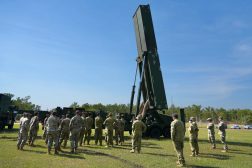
PrSM, which was launched in combat for the first time from a M142 High Mobility Artillery Rocket System (HIMARS) against Iran, is also developed by Lockheed and is a surface-to-surface ballistic missile meant to replace an older system with a lesser range.
The military was previously banned from using ground-launched missiles with PrSM’s range, which is at least 500 kilometers, under limitations from the Intermediate-Range Nuclear Forces (INF) Treaty, which Trump pulled the U.S. out of during his first term.
“I don’t want to focus on that current operation only, but with regards to the capabilities that PrSM brings to the fight, we want greater magazine depth, we want greater inventory,” Lozano said, adding that more requests for funding the capability are coming.
Lockheed announced last week that it completed the first flight test of PrSM Increment 2, which has a multi-modal seeker that is expected to enable the weapon to strike moving targets in maritime environments.
The Trump administration is expected to submit its fiscal 2027 budget request to Congress in the coming months, potentially in April.
Lozano also said the Army would take control of the THAAD program, a truck-launched air defense platform, from the Missile Defense Agency in fiscal 2027.