‘Data alone is not disclosure’: UAP research community reacts to Trump’s first PURSUE file drop

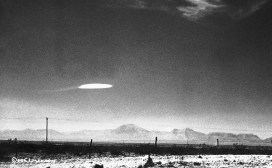
On May 8, the Trump administration released pixelated imagery of strange, seemingly out-of-this-world objects and official reports by military pilots and other U.S. personnel about metallic spheres, flying discs and glowing orbs, via its first trove of interagency declassified “unidentified anomalous phenomena” files.
This highly anticipated records-drop follows a dedicated, yearslong public campaign led by veterans, former defense officials, researchers and other experts to force the disclosure of government-held UAP data.
Six officials deeply involved in that work told DefenseScoop this week that this first tranche of media published under the new Presidential Unsealing and Reporting System for UAP Encounters (PURSUE) project marks a historic — yet incomplete — step towards government transparency.
“For years the public was told there was little to see,” said Christopher Mellon, former deputy assistant secretary of defense for intelligence. “The scale of what exists is itself a revelation. That said, data alone is not disclosure. Releasing raw files without context may confuse more than clarify.”
Early ambiguities
Mellon served nearly 20 years in the U.S. intelligence community.
He drafted legislation that established the U.S. Special Operations Command in 1986. Since retiring from federal service, Mellon has been working as a private equity investor for biotech and IT startups. He also currently chairs the Disclosure Foundation’s board.
“We view [this initial release] as a meaningful step towards transparency, not because it resolves the major questions, but because it puts something important on the record: the government has been collecting data, receiving reports, and conducting analysis on UAP for decades, and in many cases withheld that material from public view,” he told DefenseScoop. “That is no longer deniable.”
Federal agencies and the military have a decades-old, complicated legacy dealing with technologies and craft that personnel have reported performing in ways that seem to transcend modern capabilities. At a high level, the Defense Department’s teams set up to investigate unidentified anomalous phenomena — or UAP, the modern term for UFOs and transmedium objects — have taken different forms over the years.
The All-domain Anomaly Resolution Office (AARO) is the latest version. It was officially launched under the Biden administration in 2022 to fulfill a requirement in that year’s National Defense Authorization Act, following concerns from lawmakers that some UAP could be high-tech drones or other platforms developed by adversarial nations.
Several of the office’s leaders have briefed Congress to date. AARO officials have maintained that they have found no evidence to confirm that any UAP cases involve extraterrestrial activity or technology.
The hub has issued multiple reports spotlighting the ever-expanding DOD portfolio of UAP investigations since its creation and maintains a government website for records and other information.
In February, President Donald Trump announced on social media that he would be directing Defense Secretary Pete Hegseth and other relevant departments and agencies to “begin the process of identifying and releasing Government files related to alien and extraterrestrial life, unidentified aerial phenomena (UAP), and unidentified flying objects (UFOs), and any and all other information connected to these highly complex, but extremely interesting and important, matters.”
Officially changing the name of the Department of Defense requires an act of Congress, but last year, Trump signed an executive order rebranding DOD as the Department of War, or DOW.
The PURSUE program encompasses the official, interagency activities tasked with handling this mass declassification and dissemination effort. Batches are dropping on the new, centralized war.gov/ufo portal — not the existing aaro.mil website.
In response to questions from DefenseScoop Thursday, a source who requested anonymity and to be referred to as a “War Department official” said: “AARO is responsible for coordinating the declassification of identified DOW files. AARO also prepares DOW files and files provided by other agencies for posting on war.gov/ufo. AARO will continue to conduct its statutory mission of detecting, identifying, analyzing, and resolving UAP. Any encounters described in these releases that are resolved in the future will be posted on aaro.mil.”
The initial PURSUE tranche contained a little more than 160 files, with at least 100 of those including redactions, according to researchers and experts who are currently studying them.
Several officials noted that there’s a lot of work ahead to match these records with files that were previously published to uncover trends and other insights.
“Although there is a lot of information here, there is little context,” Alejandro Rojas said. “Case summaries without coordinates, sensor parameters, or altitude data make independent analysis very difficult.”
Rojas is a consultant with Enigma Labs, which runs a public reporting and analysis platform that has collected heaps of civilian UAP reports — including sightings occurring near military training ranges, airports, and major population centers.
His team is now adding elements from the PURSUE drop to maps in Enigma’s free app and website.
“What makes this valuable for us is that we can cross-reference these official cases against our database of over 200,000 public sightings to see whether patterns emerge, such as clusters in location or time of year. That kind of analysis isn’t possible when files sit in a classified vault,” Rojas noted.
In separate conversations, former senior defense officials also said a lot of the new records were low quality and lacking features that make it difficult to effectively conduct independent analyses.
“My initial reactions were positive and pleasantly surprised. I thought some of the videos contained truly anomalous phenomena,” said retired Rear Adm. Tim Gallaudet, a former oceanographer of the Navy, pointing to footage of right-angle turns and formation flying craft.
Gallaudet serves as an advisor to the Sol Foundation, the Disclosure Foundation, and Americans for Safe Aerospace.
“The fact that this was the first time that an administration openly admitted that UAP files have been shielded from the public was promising. However, the ambiguity of the video content in particular is concerning as no metadata was included,” he said. “Therefore, it is impossible to conclude that any of the objects were truly anomalous.”
Gallaudet has testified before Congress on UAP transparency topics. He publicly maintains that he is “aware of classified” Pentagon and IC videos — as well as sonar, radar, FLIR and other data — of “UAP that are clearly objects of nonhuman origin due to their structure and performance characteristics.”
“If any of those are released, we will know whether or not true transparency is the objective,” Gallaudet said.
Evidence without analysis
Most of the officials who spoke to DefenseScoop are still sifting through and reviewing all the material in this first PURSUE drop — so they couldn’t precisely confirm how much of the files presented new information that was not disclosed in prior releases by the National Archives, DOD, NASA, or other federal agencies.
Many hinted that the majority of the files included media that’s already been widely disseminated.
“For those of us in the UAP research community, the newness of the data in this first tranche is underwhelming,” said Grant Lavac. “Much of it is a compilation of documents that have been in the public domain for decades.”
Lavac is a UAP researcher from Australia who has actively filed information and records requests with multiple governments for years.
In his view, “the story here isn’t necessarily the content, but the process of official acknowledgment.” The first PURSUE release, he noted, “drags the UAP issue out of the fringe and into the mainstream of national security discourse.”
America’s whole-of-government approach, Lavac said, stands in “stark contrast” with Australia’s at this time.
He warned that the “transparency gap” between the two nations on UAP disclosure “is becoming untenable.” Lavac noted that while the Trump administration continues to elevate this topic as a “serious matter,” the Australian Department of Defence has steadily argued against diverting resources to the issue.
“As an Australian researcher, the unresolved reports from [U.S. Indo-Pacific Command] and Papua New Guinea (PNG) are the clear standouts,” he told DefenseScoop, regarding the first PURSUE trove. “These records indicate observations of UAP close to Australian shores, highlighting just how much of a global issue this is.”
Although many experts expressed frustration with the quality of the PURSUE files and their limited context, they also pointed to items that warrant closer attention buried in the initial records dump.
“The video of an object in Greece making multiple 90-degree turns at approximately 80 miles per hour is notable — not because it proves anything, but because it represents exactly the kind of flight characteristic that has driven sustained military and intelligence interest in this phenomenon,” the Disclosure Foundation’s Executive Director Jordan Flowers said.
He and others also spotlighted imagery and reports captured by NASA’s astronauts from Apollo 12 and Apollo 17 missions. They said those records place UAP-adjacent observations in a context of the highest-credibility witnesses operating the most sophisticated systems of their era.
“The FBI orb reports from 2023, including the ‘Eye of Sauron’ description witnessed by multiple teams from varying locations over two days, are striking precisely because they are recent, multi-witness, and documented by federal agents — not the profile of easily dismissed anecdotal reports,” Flowers noted.
One issue that requires more attention as PURSUE comes to fruition, he told DefenseScoop, is the U.S. government’s reported disinformation campaigns dating back to the 1950s, in which false UAP documents were allegedly produced as a smokescreen for real weapons programs that were being unlawfully hidden from Americans’ view.
“If some of what is now being released to the public as authentic government UAP records are in fact disinformation artifacts from that era, the public deserves to know,” Flowers said. “Transparency requires not just releasing files, but accounting for their provenance and integrity.”
His team will be digging deeper into this and other public accountability matters in June at the foundation’s Disclosure Forum, with legislators, national security officials, scientists, legal experts, and journalists.
Mellon, the Disclosure Foundation’s chairman, added that the organization takes this “release at face value as a genuine transparency effort — while remaining clear-eyed that genuine efforts can still fall short.”
The intelligence community has “almost certainly” completed sophisticated work integrating this data, distinguishing sensor anomalies from genuine unknowns, and assessing the capabilities of observed phenomena, the former senior defense official said, however, “none of that analytical product has been released.”
“The more substantive concern is not that the government is trying to overwhelm the public with low-quality data — it’s that it is releasing evidence without releasing analysis,” Mellon told DefenseScoop.
He and other experts want to see future PURSUE file drops move towards less ambiguous data, better context and clearer explanations of what the government knows, what it does not know, and what analytical work has already been done.
“Otherwise, the public is left trying to interpret fragments without the information needed to separate mundane explanations from genuinely unresolved cases,” former Navy aviator Ryan Graves said. “The goal should be a durable, credible reporting and analysis process, not just periodic releases of low-context files.”
Based on his own experiences with military-connected UAP, Graves formed and now runs the witness program Americans for Safe Aerospace to provide an entity for the public to safely and securely report observations or encounters.
Through PURSUE, his team is seeking records that help improve aviation safety, such as sensor data, pilot and aircrew reports, analyses of operational hazards, and any process changes that make it easier for commercial and military aviators to report encounters without stigma.
“The most useful releases are not simply the clips that appear unusual. The real value is in records that include clear provenance, sensor context, metadata, chain of custody, date and location, and enough operational context to allow serious independent analysis,” Graves said. “Ambiguous imagery without that surrounding data is hard for pilots, researchers, or the public to evaluate responsibly.”
Responding to DefenseScoop’s questions, the War Department official suggested the government plans to release additional files through PURSUE on a rolling basis.
“We are not providing any comment or assessment on the files overall or on any specific file, so that the American people can make up their own minds regarding the files,” the official said.