Inside the Army’s new data operations center and its ‘sprint’ to help fix digital headaches
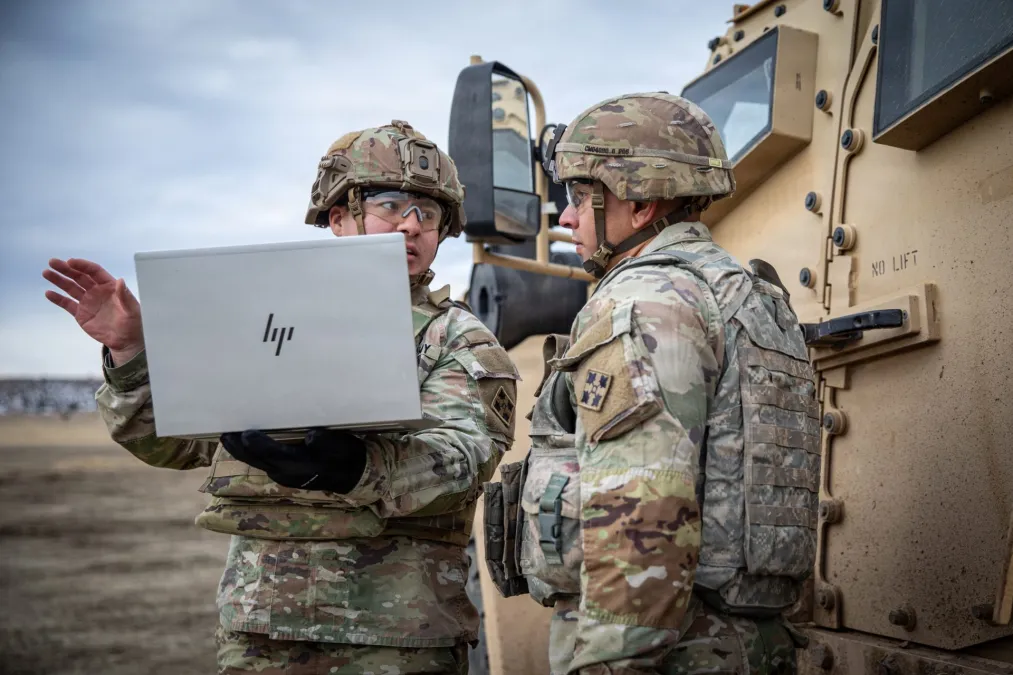
Personnel across the Army’s data teams have been “banging their heads against the wall” over information management issues and the service recently launched a new hub meant to help alleviate those headaches, senior military officials told reporters Tuesday.
The Army Data Operations Center went live April 3. A nucleus for network-focused staff across division-level units and above to call for help about connectivity or data issues, officials said the ADOC will free data teams from “red tape” so commanders can make quicker decisions.
Top officials have teased the ADOC for months, billing it as a “9-1-1” asset for how the Army moves massive amounts of data. Now, the center is in a prototype phase, a pilot that will play out over the next six months, they said. Requests for help have already started to flow in.
The formation of the center comes amid a broader Army effort to shed data “silos” and usher the service through a sweeping organizational restructuring that puts a premium on fast, accessible information. While the nascent ADOC hasn’t yet received any requests for help with current operations, such as the war with Iran, leaders said it would heed such calls with urgency.
“Commanders today face a battlefield where speed and precision in decision-making are critical,” said Lt. Gen. Christopher Eubank, head of U.S. Army Cyber Command, during a media roundtable. “The ADOC will ensure that tactical units at the edge have seamless access to the right data at the right time, enabling them to outthink, outpace and outmaneuver adversaries.”
“By eliminating data silos and integrating enterprise level resources, the ADOC will provide commanders with information at the speed of relevance,” he added. “This capability is essential for modern warfare, where the ability to act faster than the adversary can mean the difference between success and failure.”
One official said the ADOC is currently made up of mostly civilians with some soldiers involved. The ADOC task force, as the officials described it, consists predominantly of data, software, and AI and machine learning pipeline engineers.
Those personnel are broken up into three teams. A warfight engagement cell is on call 24/7 to field requests and triage issues. Another is the “FINISH Cell,” which is composed of “upper tier” data engineers that can help solve issues. Then there is the data integration cell, focused on ADOC authorities, policy review and how the entity can host AI models.
Officials described the model as a “blueprint” for what could become a permanent structure meant to help units tackle urgent data problems as the Army prioritizes information speed.
“We have tons and tons of data on our battlefield, we have tons and tons of data in our enterprise,” said Lt. Gen. Jeth Rey, deputy chief of staff for the Army G-6. “We don’t have a data problem. We have a data management problem, and data becomes the ammunition that we need to provide to our senior leaders in order for them to make quick and informed decisions and gain decision dominance across the board.”
Officials held a planning session for ADOC earlier this year at Fort Gordon, Georgia, the Army’s home for cyber and signal personnel. More than 60 people from across the service and the joint force showed up: the message from attendees was an appeal for help with data.
“We were seeing these lieutenant colonels in these operational data teams that are banging their heads against the wall trying to figure out how to make these connections happen,” said Brig. Gen. Michael Kaloostian, the ADOC task force director.
“They need somebody to call, there isn’t a help desk for them to call,” he added. Now, with the ADOC, “we’re just there to augment and help. Let’s alleviate some of that burden, let me take some of that work off of their plate.”
Connectivity to enterprise business systems had proven challenging, he said, and figuring out how to work with data owners to pull information into the tactical level “are the type of problems that have been causing headaches for those divisions.”
Kaloostian said the 4th Infantry Division experienced “an enormous amount of [data] latency” that was disrupting targeting flows during a recent Next Gen C2 exercise in Colorado, specifically while using the Army Intelligence Data Platform (AIDP).
Small data teams were trying to figure out the slowdown on their own, “just spending so much time trying to remedy that, they weren’t focused on everything else that they were supposed to be doing in that” exercise, he said, highlighting opportunity for the ADOC to investigate such issues and allow division-level staff to concentrate on training priorities.
Rey said the Army “had a really difficult time on the border” working with the Department of Homeland Security when it came to interagency system communications. That data flow becomes paramount when introducing drone technology and autonomous systems.
“Those examples are coming every single day to us that are now going to be addressed by the ADOC itself,” he said. Officials said they’ve received seven requests over the last five days from different units across the Army, not just for NGC2, to help solve “tough” data problems.
By next month, officials anticipate the ADOC will have transformed rapidly. The cyber, data and information domain is evolving quickly, officials have said, and the ADOC’s initial “sprint” will be focused on building its ticketing system — the help request line — as well as analyzing trends across the service to refine its support moving forward.
After the 180-day trial is over, officials will make recommendations to the Army for what the ADOC should look like. According to the Army, the pilot will establish the center’s structure, authorities and assemble its personnel. It also intends to “deliver immediate value” by resolving data flow issues between systems, for example.
Rey said the Defense Department had shown interest in the concept, and that it could be something the Pentagon takes up. What the future specifically holds for ADOC, however, officials couldn’t say.
“For us, it’s impossible to know what five years from now might look like,” Kaloostian said, including what ADOC could look like and “whether a centralized capability in the future is even needed.”
“But right now, we know that this capability is required,” he added, citing feedback. “It truly is a gap. We’re standing up these operational data teams. We’re becoming data-centric. We know how important it is to be able to use data to support warfighting. We understand all of that, but there has to be something that brings it all together.”