Air Force, Space Force combine multiple AI tools in latest battle management experiment
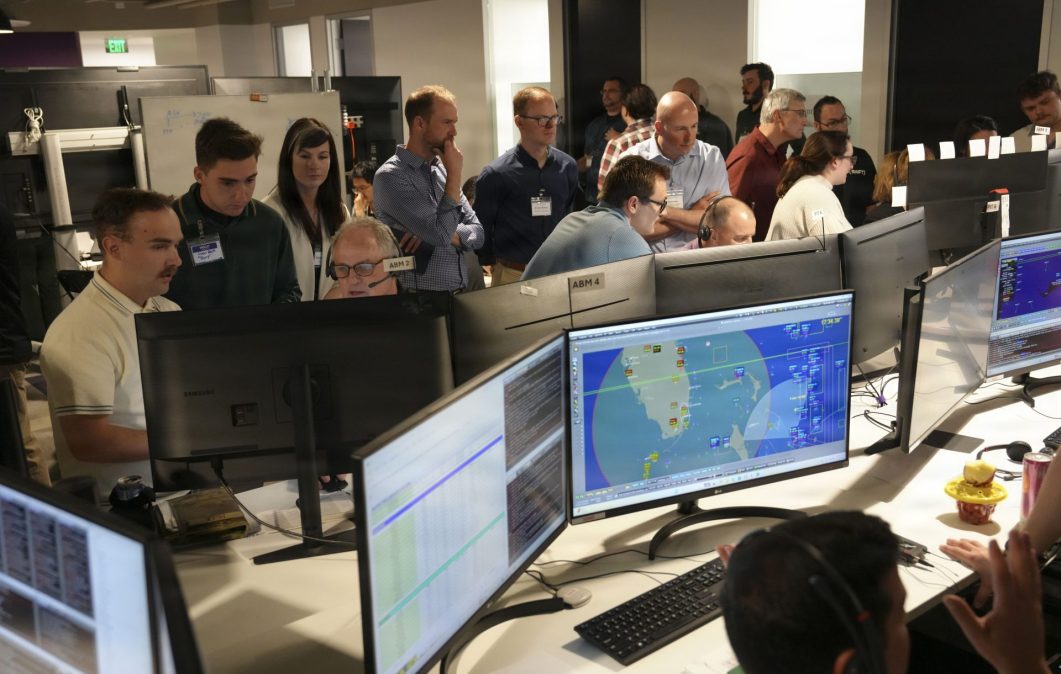
The Air Force recently experimented with multiple artificial intelligence tools designed to improve battle management, expanding on and validating the service’s past work to test the technology for future operations.
The Department of the Air Force’s Advanced Battle Management System (ABMS) Cross-Functional Team hosted its inaugural Multi-Decision Advantage Sprint for Human-Machine Teaming (MASH) experiment in May. Held in Las Vegas, Nevada, the two-week event was the latest in a series of wargames designed to develop and test industry’s AI-enabled battle management tools.
According to the service, MASH marked an evolution in the Air Force’s experimentation campaign by successfully integrating disparate capabilities and having Space Force guardians actively participate alongside airmen.
“The data analysis is ongoing, but initial trends strongly mirror our previous successes, demonstrating a significant acceleration in decision-making speed,” Col. John Ohlund, director of the ABMS CFT, told DefenseScoop. “Ultimately, this validates the potential for human-machine teaming to substantially expand the volume of viable options available to commanders during high-tempo operations.”
In 2024, the Air Force’s 805th Combat Training Squadron — which is also referred to as the Shadow Operations Center-Nellis (ShOC-N) — began a multi-faceted experimentation campaign designed to inform development of AI tools and operational concepts for the DAF Battle Network, the service’s contribution to the Pentagon’s Combined Joint All-Domain Command and Control (CJADC2) effort.
One of those experiments is known as the Decision Advantage Sprint for Human-Machine Teaming (DASH), where industry software teams are tasked to create AI “microservices” focused on a small section — referred to as subfunctions — of the broader command-and-control process.
However, MASH introduced new complexities by evaluating multiple subfunctions and turning them into a single, cohesive workflow, Ohlund said.
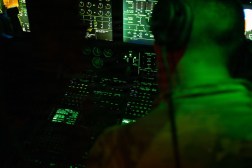
During the wargame, six industry teams and the 805th’s own software engineers were tasked to build custom AI tools designed to automate and accelerate parts of the air battle management mission, according to the Air Force. Those AI capabilities were repeatedly stress-tested in a simulated operational scenario conducted by battle managers.
“The AI tools were designed to automate three core decision-making functions, accelerating how operators process and act upon complex data streams,” Ohlund explained. “Specifically, they analyzed incoming information to identify and categorize potential entities, matched the best available joint capabilities to address those situations and then generated multiple, optimized courses of action.”
The experiment’s design meant that each simulation tested three separate microservices that were purpose-built by different industry teams for individual subfunctions. A significant breakthrough during MASH was the Air Force’s ability to integrate distinct software applications without affecting operations using an orchestration tool developed by the Air Force Research Laboratory.
“AFRL has done incredible work building an orchestrator that ensures these different companies can exchange data, ontologies, and metadata seamlessly,” Ohlund said. “We are proving that a true plug-and-play, modular approach not only works, but it fosters continuous competition and allows the government to select the best-of-breed software services as they mature.”
Furthermore, MASH was the first of ShOC-N’s experiments to have members from another military service actively participate. Space Force guardians served alongside airmen within the battle management teams as it tested the AI tools through simulations, providing immediate feedback to developers regarding the technology’s decision-making logic and limitations.
Ohlund noted that guardians brought expertise for the space domain, while also demonstrating that both the Air and Space Force have similar battle management challenges despite operating in vastly different environments.
“Their participation highlighted that while the air and space domains operate on different timelines and distances, the fundamental requirement for rapid, synchronized decision-making is identical,” he said. “Their unique perspectives helped ensure the battle management software was built from the ground up to support a truly integrated, multi-domain force.”
Overall, the AI used during MASH helped battle managers by automating time-consuming tasks and consolidating large amounts of incoming data. This allowed service members to process situations much more quickly so they could focus on making strategic decisions.
“A week ago, it took my team and me 50 minutes to an hour to get one tasking done. With the help of the tool, we were able to get five or six taskings done,” Capt. Adam Sochia, an air battle manager from 552nd Operations Support Squadron, said in a statement. “Basically, in the amount of time that we can do one tasking, this tool gives us the data and accurate options to complete five or more additional taskings.”
The ABMS CFT and 805th will continue to conduct wargames with AI tools through the rest of the year. The Air Force hopes to invite members from each of the military services to participate in future experiments so that it can continue creating an operational blueprint for modern, multi-domain C2 operations.
“The reason we challenge the software to solve multi-domain problems is because that’s the reality of the future fight,” Ohlund said. “An Air Force air battle manager doesn’t have the authority to execute a space or cyber effect, but like any good staff officer, it’s their job to prepare the information and package the options for the general. We want the computers to do that work, to ruminate over every possible multi-domain effect; that way we can present the highest quality menu of decisions to the right commander, faster than ever before.”