Air Force explores AI tools to predict aircraft failures, strengthen sustainment
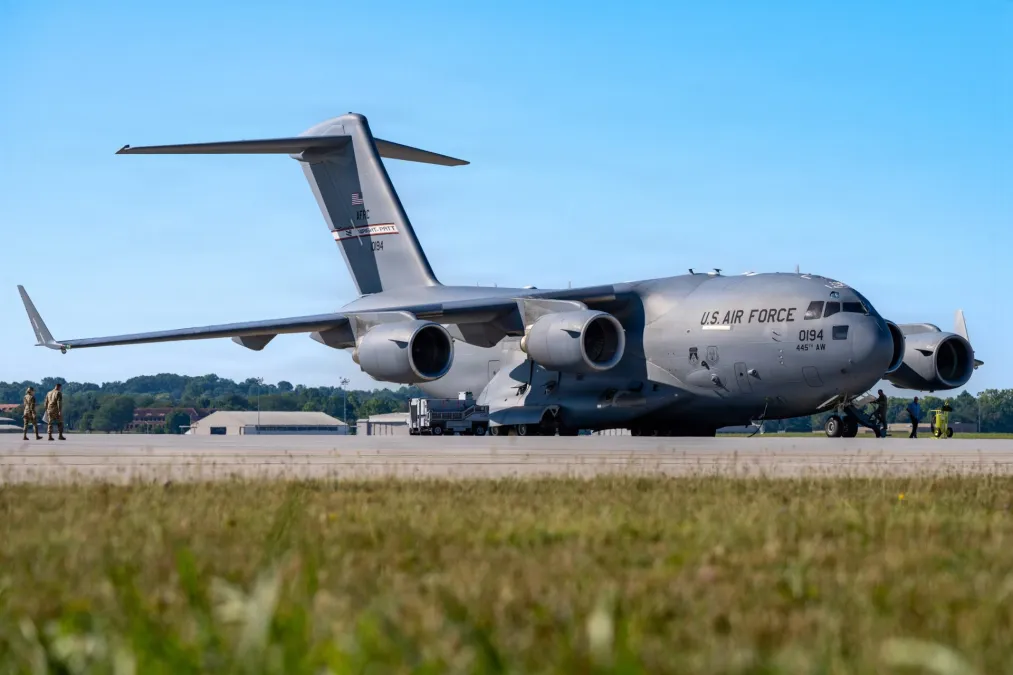
DAYTON, Ohio — While the Air Force is increasingly turning to artificial intelligence for its sustainment and maintenance needs, service officials say most efforts remain in experimentation or market research as they determine where the technology can provide meaningful gains.
Leaders from multiple portfolios told reporters at the Air Force’s Life Cycle Industry Days that they believe AI has wide-ranging potential to improve the service’s fleet availability — including predictive maintenance, supply chain management and broader decision support. And although the Air Force isn’t shying away from integrating the technology as it matures, challenges around determining which applications provide significant operational value remain.
“I would say we definitely have our foot in the pool, but we need to jump in a little deeper,” Brig. Gen. William Ottati, portfolio acquisition executive for mobility, said last month during a media roundtable at the conference.
Maintenance and sustainment has been an enduring, expensive mission across the entire Department of Defense, especially as the military services continue operating legacy platforms beyond their intended lifespans. The issue is often compounded by shortages in maintainers and engineering expertise, as well as dwindling supply chains that create bottlenecks for parts.
Even before the Pentagon’s recent push for enterprise-wide AI adoption, the technology has been lauded as a revolutionary tool to address the Pentagon’s readiness needs. For years, officials and experts have said AI and machine learning could shift the military away from reactive maintenance toward predictive repairs.
However, despite advancements in AI capabilities, the service is still in early stages of experimenting with the tech. The Air Force’s Rapid Sustainment Office is largely responsible for identifying and scaling enterprise-wide solutions, but several individual portfolios are exploring AI mechanisms that address their specific challenges, according to officials.
In many cases, it’s not about finding a use case for AI, but instead identifying and implementing which capability actually works for the service’s needs.
“I think we are wide open to all those use cases, and there’s probably more use cases than we’ve thought about,” Ottati said. “So we’ll continue to work with our operational partners and all other parts of the enterprise to make sure that we’re using it, but it feels like there’s a lot of tools out there.”
One of the most popular applications for AI among portfolio executives is predictive maintenance, which is already being implemented in some programs. The practice involves using real-time sensor data, performance records and machine learning to forecast when a military platform will fail — allowing personnel to repair or replace parts before they ever break.
Predictive maintenance is particularly useful for the Air Force’s legacy systems that are more likely to need repairs and rely on obsolete supply chains.
For example, the service uses a reliability-centered maintenance software based on an advanced algorithm and legacy system data to help sustain some of its older propulsion systems, John Sneden, PAE for propulsion, told reporters. That includes engines for the T-38 Talon jet trainer and the C-130 Hercules, and will soon extend to the F100 engine, he said.
Under the PAE for fighters and advanced aircraft, the Air Force is experimenting with predictability tools designed to identify which F-16 Fighting Falcon parts are most likely to keep the jet grounded, Matt Sukraw, deputy system program manager for the F-16 program, said during a separate briefing.
Many of the Air Force’s most promising AI sustainment applications involve legacy aircraft and the decades of maintenance data associated with them — such as the B-52 Stratofortress, especially as the service looks to keep the Cold War-era bomber flying through the 2050s.
Col. Timothy Spaulding, PAE for bombers, said that AI-enabled maintenance capabilities will be integrated into the B-52 portfolio within the next year. However, he stressed that turning that data into reliable insights requires more than just applying a new AI model onto old information.
“It is super easy to say and very difficult to do in practice,” Spaulding told reporters. “And so, I think that’s where we stand — trying to make sure that we can actually implement something that would be effective in the long term.”
Beyond anticipating equipment failures, some portfolios are looking to lean on novel artificial intelligence tools from industry that can aggregate massive, siloed logistics datasets and provide greater visibility into critical part supply chains, Rodney Stevens, PAE for training, said during a briefing.
“There are many industry partners that offer AI solutions where they can apply their large language models and their illumination tools and their associated agents to be able to help identify where we may have single points of failure or a choke point in the supply chain that will allow us to embrace where we currently are,” Stevens said.
The common goal is not replacing personnel with artificial intelligence, but using data to give maintainers and logisticians better information before a failure or supply problem ever happens. At the same time, officials noted that they’re interested in using AI as a broader decision-support tool.
Col. David Hall, senior materiel leader for the Air Force’s KC-46 division, told reporters that the service has been leveraging AI for parts of the Pegasus tanker’s airworthiness evaluation process — allowing officials to analyze documents faster and highlight abnormalities to their engineers. The team is also looking at possibly combining swaths of maintenance data and manuals so that personnel can more easily troubleshoot and identify issues with the aircraft.
“There’s several places we’re looking across the board, but we’re really focused on just the processes we use to sustain and operate the platforms,” Hall said.
As officials evaluate advanced AI solutions for maintenance and sustainment, many said they are working closely with industry to understand what capabilities and applications are possible. At the same time, the Air Force wants to understand what data is needed for the AI tools, and how limitations in that information could affect overall results.
Ottati noted that the mobility portfolio has been asking industry specifically about the sources behind their AI capabilities, and how vendors will account for poor-quality information and unreliable answers.
“I need to understand what they’re using. What are their data sources, what are their sources of truth?” he said. “If you’re using bad data, you’re going to get bad answers.”