How AI agents are informing JIATF-401’s procurement plans after Falcon Peak
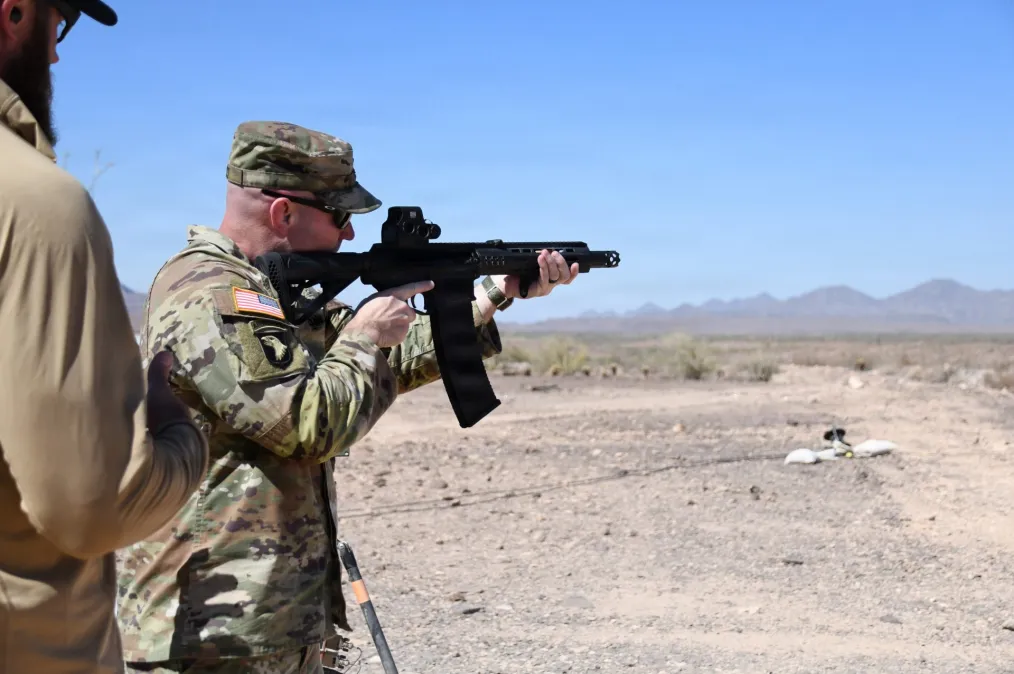
YUMA PROVING GROUND, Ariz. — Under Brig. Gen. Matt Ross’ leadership, Joint Interagency Task Force 401 is cautiously applying artificial intelligence to review heaps of data the military captured on commercial counter-drone products demonstrated at the recent, month-long Falcon Peak exercise.
“We use AI every day inside of JIATF-401,” Ross told DefenseScoop. “What we’ve learned is there’s some things that it does really well, and there’s some things that it doesn’t do as well.”
The JIATF-401 director shed new light on how his team is turning to agentic AI to speed up and support procurement decisions following Falcon Peak 26.2, in an onstage presentation and a press briefing with a small group of reporters invited to cover U.S. Northern Command’s latest counter-drone experiments in the ongoing series last week at various points on America’s southern border.
“We’re going to buy some equipment coming out of Falcon Peak, because that was the contract we made with industry,” he confirmed.
The Defense Department formally launched JIATF-401 last year as part of a governmentwide campaign under the second Trump administration to better align authorities and resources with its goals for drone defense.
This Army-led task force serves as a synchronizer and enabler for the department to conduct wide-scale technology tests, streamline safety standards and enhance its counter-unmanned aerial systems arsenal. The team is also coordinating directly with other government and law enforcement agencies that are simultaneously ramping up their own counter-UAS activities.
“We’re going to continue to see the threat of unmanned systems abroad. And now that threat is coming home, so we’re going to have to deal with that here,” Ross said.
He noted that one of the elements of this Falcon Peak exercise that he’s most excited about is “the fact that we do have the codified test standards now across” the entire DOD.
“So, anything that’s been evaluated since those standards were published earlier this year has been evaluated to the same points of performance,” he said. “We’ve consistently measured the same things so that we can do relative comparisons for different types of capability. Coming out of this exercise, we’re already crunching the numbers for performance of each of the vendors that was out here.”
JIATF-401 will share all the results with the U.S. military services and its federal government partners.
“How are we doing the data crunch? What we’ve established inside of JIATF-401 is something called a ‘tech arsenal,’” Ross told DefenseScoop. “[We] just put all the data into a central repository, and then we are using agentic AI to be able to sort through that mass of data, to provide us better results and relative comparison between systems that have been evaluated at different instances” during Falcon Peak 26.2.
Agentic AI broadly refers to autonomous or semi-autonomous systems that can be trained to complete multi-step workflows with very little human oversight.
“Where we’re at today, I can go into our tech arsenal and I can just ask it a question in plain English and say, ‘Hey, I’m looking for an active radar that can sense Group 1 and Group 2 UAS between one and four kilometers, and my price point is $15,000, and I can’t go above that. What have we tested in the last 10 years? Please provide me an output in a table that prioritizes or that rank orders by performance,’” Ross explained. “And so we can do that today, which is a step in the right direction. It’s only as good as the data that goes into it, but that’s what we’re doing with this.”
“We’ve made progress” with AI, he added, “[but] we still have work to do.”
In response to DefenseScoop’s questions about the task force’s timeframe for making acquisition decisions and awards, Ross said he could not provide an exact answer — “but it’s days, not weeks.”
“I want to move really quickly because we’ve got some committed industry partners that are downstairs right now that took their time and money to come out here and perform,” the JIATF-401 director said. “They provide so much feedback on how we do the assessment because they care about it, and so we want to reward those that are doing well.”