Anduril redesigns tech for Army’s Soldier Borne Mission Command program
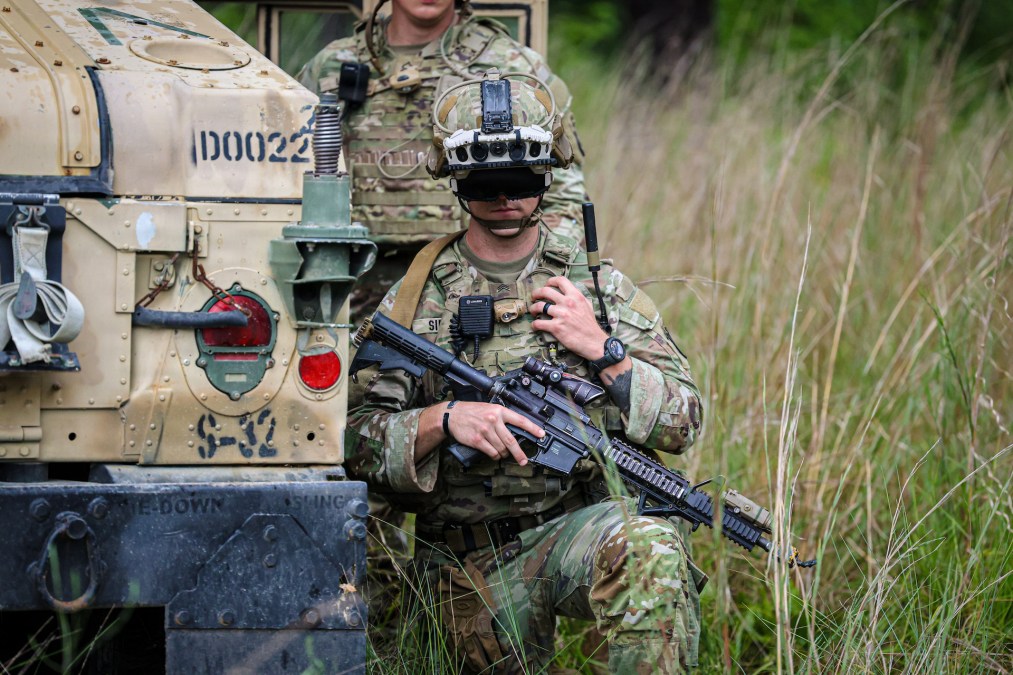
Defense tech maker Anduril, one of the primary performers on the Army’s Soldier Borne Mission Command program, recently made headsets available to the Army for testing and is gearing up for the next phase of the prototyping effort, according to a top executive.
The SBMC project aims to develop soldier-worn heads-up displays equipped with augmented reality, night vision, AI, and command-and-control capabilities that can connect with other systems such as drones, among other features. The initiative was launched in the wake of struggles with the Army’s Integrated Visual Augmentation System (IVAS) program, which sought to provide similar technology for troops to enhance their battlefield capabilities and boost training but received negative feedback from soldiers who tested the equipment. Service members complained about the weight and form factor of IVAS devices and reported experiencing nausea while using them.
In 2025, Anduril took over the ill-fated IVAS program from Microsoft shortly before the Army pivoted to the new SBMC effort.
Last year, the Army awarded hundreds of millions of dollars in contracts to industry teams to rapidly prototype technology for the SBMC program. Anduril, Rivet and Elbit Systems of America were tapped to provide solutions for the initiative. Anduril is also doing adjacent work for the Army on the software side.
Anduril is now “moving from phase one to phase two,” Quay Barnett, the company’s general manager of warfighter systems, told reporters during a roundtable Monday to provide updates on the effort.
“We’ve already delivered phase one systems,” he said. “Two weeks ago, we had testing with the 75th Ranger Regiment at our Seattle test site, so out in the field in field-like conditions, getting feedback, getting iteration for them, so that we can incorporate that into our phase two design and make those updates iteratively and rapidly with end users.”
Anduril later clarified that those phase-one systems remain Anduril-owned and were not formal contractual deliveries. The preferred phase-two configuration will be “the formal deliverable,” a company communications official told DefenseScoop in an email Monday night.
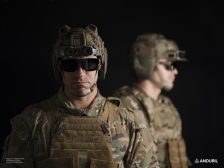
Wearable components of the product for phase one include glasses, a sensor bar, an edge compute device, a battery and a controller.
“Basically, you have the heads-up display glasses. These are partnerships we did with Meta and with Oakley’s Standard Issue … brand in order to get the right form factor. And then we built a sensor bar that has the night vision, the low light thermals, and all of the kind of imaging that you would use for low visibility conditions. The way this works is this bar actually comes down over top of the glasses for nighttime use and stays stowed during daytime use,” Barnett explained.
“We fundamentally believe that this was a good starting point to validate all of the systems, and to validate the architecture, and to validate our heads-up display, but we don’t believe that this is the right solution for nighttime use,” he added.
For phase two, the government has approved Anduril’s pursuit of a new design that includes a digital interface, according to Barnett, who served in the special operations community during his military career.
“There’s some weight savings, there’s some form factor advantages of having it closer to the eye, and then there’s some pretty massive performance advantages of having 4K displays in the eye that expand the field of view about 70% from current night vision systems. Because it is a digital night vision system, it also means you can bring all of those same overlays that you would get from a daytime HUD into that night experience,” he told reporters.
Additionally, some new camera systems will be incorporated into the phase two equipment, he suggested.
The company is also using its own internal R&D money to develop capabilities that could be folded into SBMC.
“As we think about our internal investment, we’re doing things like voice activation, we’re doing things like additional sensors that we think warfighters will need that are not spec’d into the program. We think there’s a lot that can be done with the frontier models being body worn that brings a lot more capability than what was originally scoped into the program,” Barnett said.
For SBMC phase one, the number of hardware systems that Anduril initially provided is in the “low hundreds.” For phase two, the company will deliver “several hundred” systems that have the modified design, and testing of that equipment is slated to begin in late January or early February, Barnett said.
An Anduril communications official told DefenseScoop Monday evening that the company will deliver 170 phase-two prototypes. “Across prototyping and initial production for testing, hundreds of systems will ultimately be delivered,” they said.
Barnett told DefenseScoop that advanced software capabilities will also be integrated next year.
Anduril is awaiting approval from the Army to provide quotes from Army Rangers detailing their feedback on its phase-one prototypes, according to the company.
Barnett noted that the company put a lot of focus on developing a form factor and user interface that provide a better user experience than the old IVAS technology that troops didn’t like.
“One of the things we worked on very hard when we did bring forth the software, we completely refactored the entire kind of controller and interface. So where in the past … the buttons were not good, we physically changed to more of like a dial and a depress system. We have functionality like short hold, [which] means I get quick situational information. Long holds of the same button now bring me into expanded, you know, views with more detail. All of that, you know, quick release [and] it goes away. You know, tactical kind of kill mode where like [it] just goes to my … kind of organic field of view,” Barnett told DefenseScoop.
“I think we took some of the specific functions from like 21 button clicks down into two, you know, to get kind of deep inside menu and settings and things. So we put a lot of focus on that from our user interface.”
He continued: “From a weight standpoint, I mean, you’re wearing glasses; we did a lot of work around like how we did our retention system” and partnered closely with Oakley to ensure good weight distribution.
The full heads-up display weighs about 110 grams, according to Barnett.
Anduril has already built out its manufacturing capacity so that it can produce thousands of SBMC systems, he noted.
A downselect and production award for the program could come in fiscal 2028, Barnett said.
It’s unclear what the total dollar value of the SBMC program will be. The IVAS program was expected to be worth up to $22 billion before it got scrapped.
Updated on Aug. 17, 2026, at 10:30 PM: This story has been updated to include a clarification from Anduril that the phase-one prototypes made available for Army testing were Anduril-owned and were not formal contractual deliveries. It has also been updated to clarify that Anduril is awaiting Army approval to provide direct quotes from Army Rangers about their user experience with phase-one prototype systems.